A Timeslip story
The night Tycho Brahe found a star that was not supposed to exist
He was twenty-five, walking back to supper from a laboratory in a converted abbey, and the thing over his head was not allowed to happen: a new star, in the one region of the universe that could not change. He did not trust his own eyes. He called the servants over, then stopped strangers on the road and made them look up too.


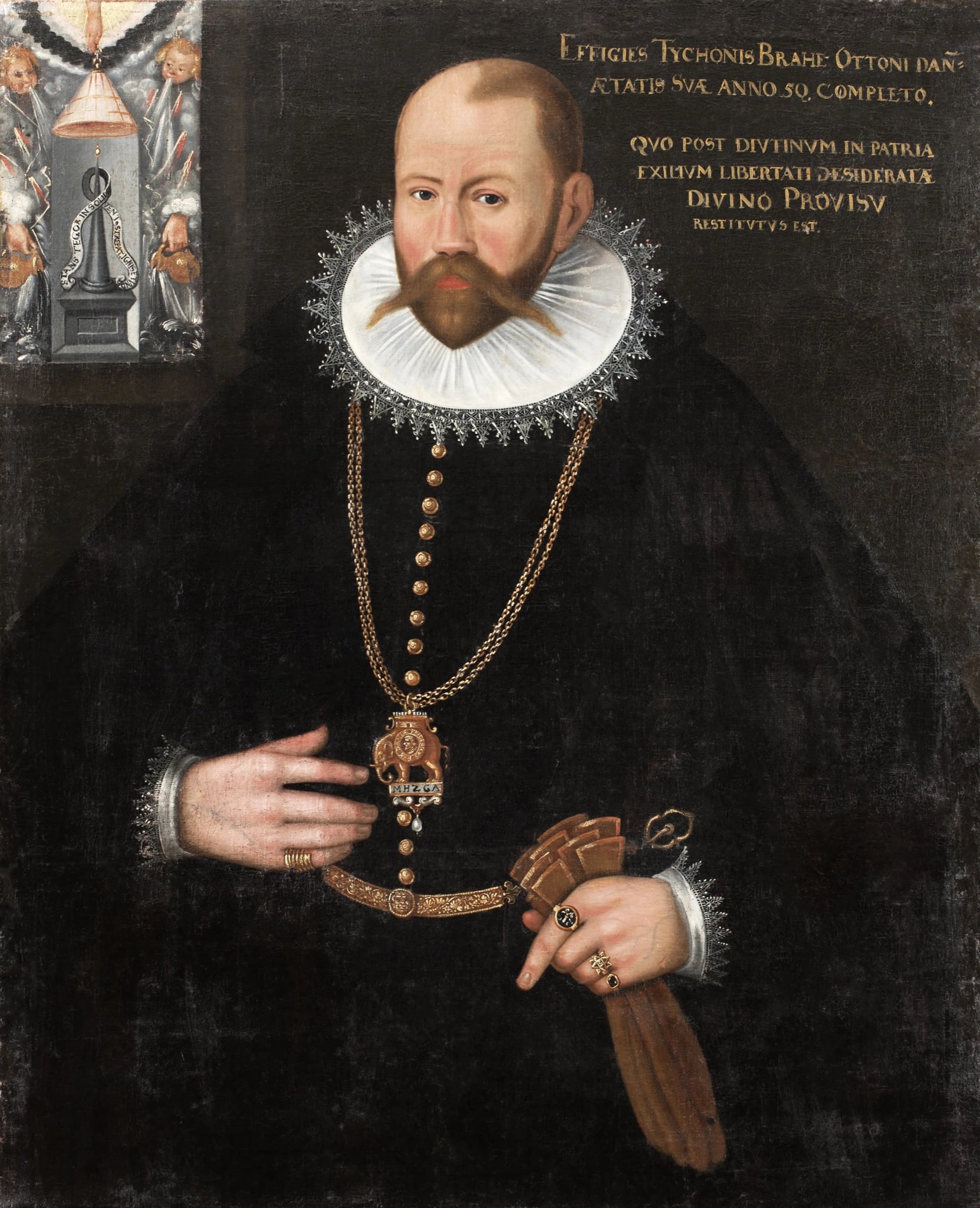
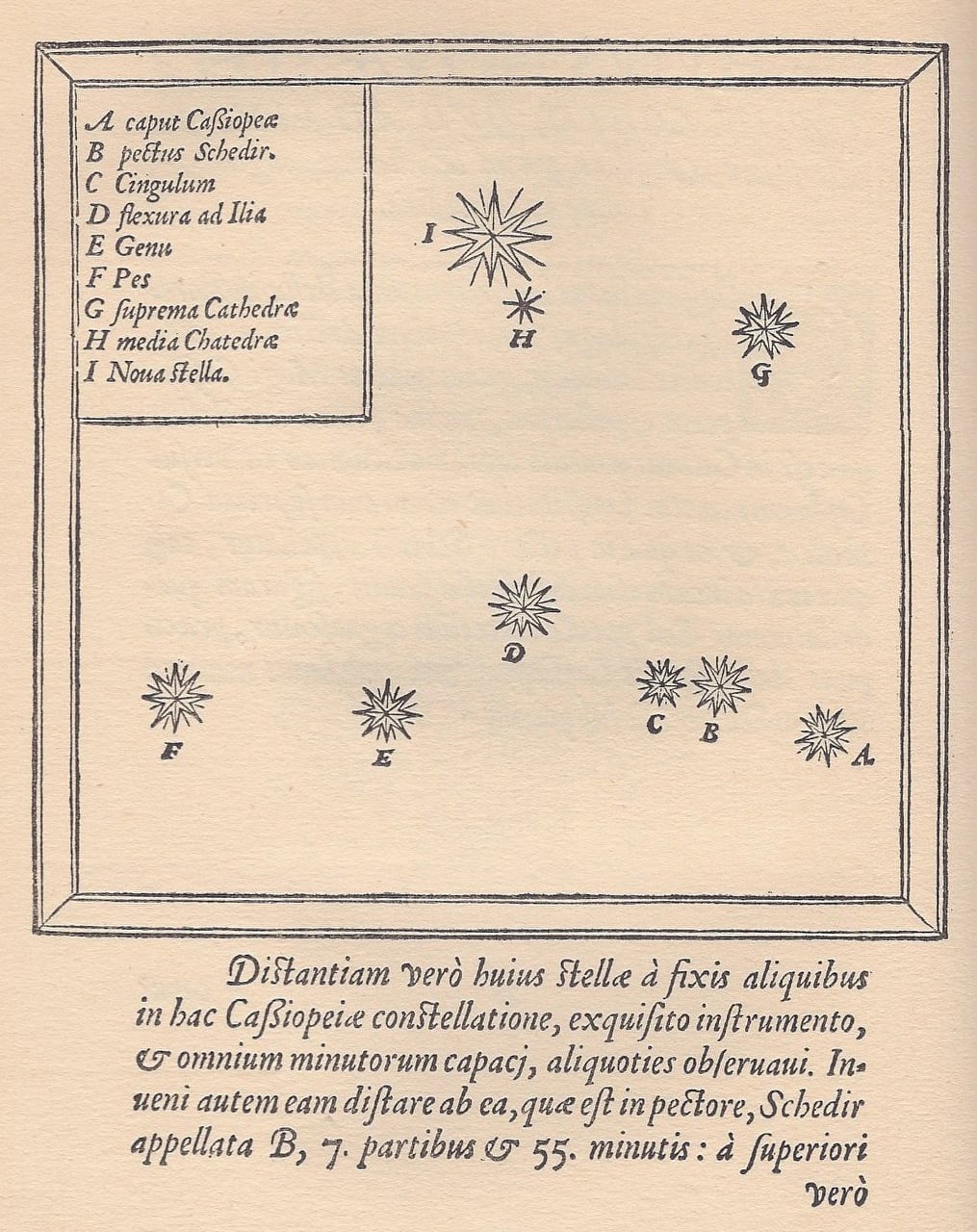
The yard was frozen hard, the air was still and the sky was completely clear, and the young man crossing it had his head down against the cold. He had spent the afternoon in an alchemical laboratory built into a Cistercian abbey that no longer had any monks in it, and he was walking back to the house for supper. Something made him look up. Almost directly overhead, inside the crooked W of Cassiopeia, there was a star brighter than Jupiter, and it had not been there before.
His name was Tycho Brahe. He was twenty-five, the son of a Danish nobleman, and he wore a metal prosthesis where a sword had taken the bridge of his nose in a duel six years earlier. He wrote the moment down. "It happened just before supper," he recalled. "In the middle of my walk back home, I was contemplating different bits of the sky... when lo and behold! Just overhead, a strange kind of star from an unexpected place, blinding the eyes and shining brilliant, radiant, fulgent light."
And then he refused to believe it. He called over the servants who were with him and they told him it was glorious; that was not enough, so he stopped some peasants going past on the road and made them look up too. Only when they agreed did he go in to eat. The evening was 11 November 1572 by the calendar Denmark used, 21 November by the one that replaced it ten years later. Over the sixteen months that followed he took the star apart with a wooden ruler and a set of open sights, and ended an idea about the universe that had held for two thousand years.
Why a new star was impossible in 1572
To see what stopped him in the yard, you have to know what the sky was for. The cosmos of 1572 was Aristotle's, and it came in two halves that did not mix. Below the Moon lay the realm of change: four elements, weather, growth, decay, birth and death. Above it lay the realm of perfection, a nest of crystalline spheres carrying the planets and, beyond them, the fixed stars, incorruptible and permanent. Nothing up there could appear, brighten, dim or go out.
Comets were the obvious objection, since they plainly did appear and go out, and the standard answer was to demote them: a comet was high dry weather burning in the upper air, well below the Moon and safely inside the region where things were allowed to happen. This was not a minority view held by cranks. It was the settled physics of every university in Europe, taught for two millennia and welded to Christian theology. A new star in Cassiopeia was not an interesting sight. It was a category error.
I was amazed, practically stupefied, thrown into such perplexity by the impossibility of it all that I began to doubt my own eyes.
Tycho Brahe, in his own account of the night
How Tycho measured a star without a telescope
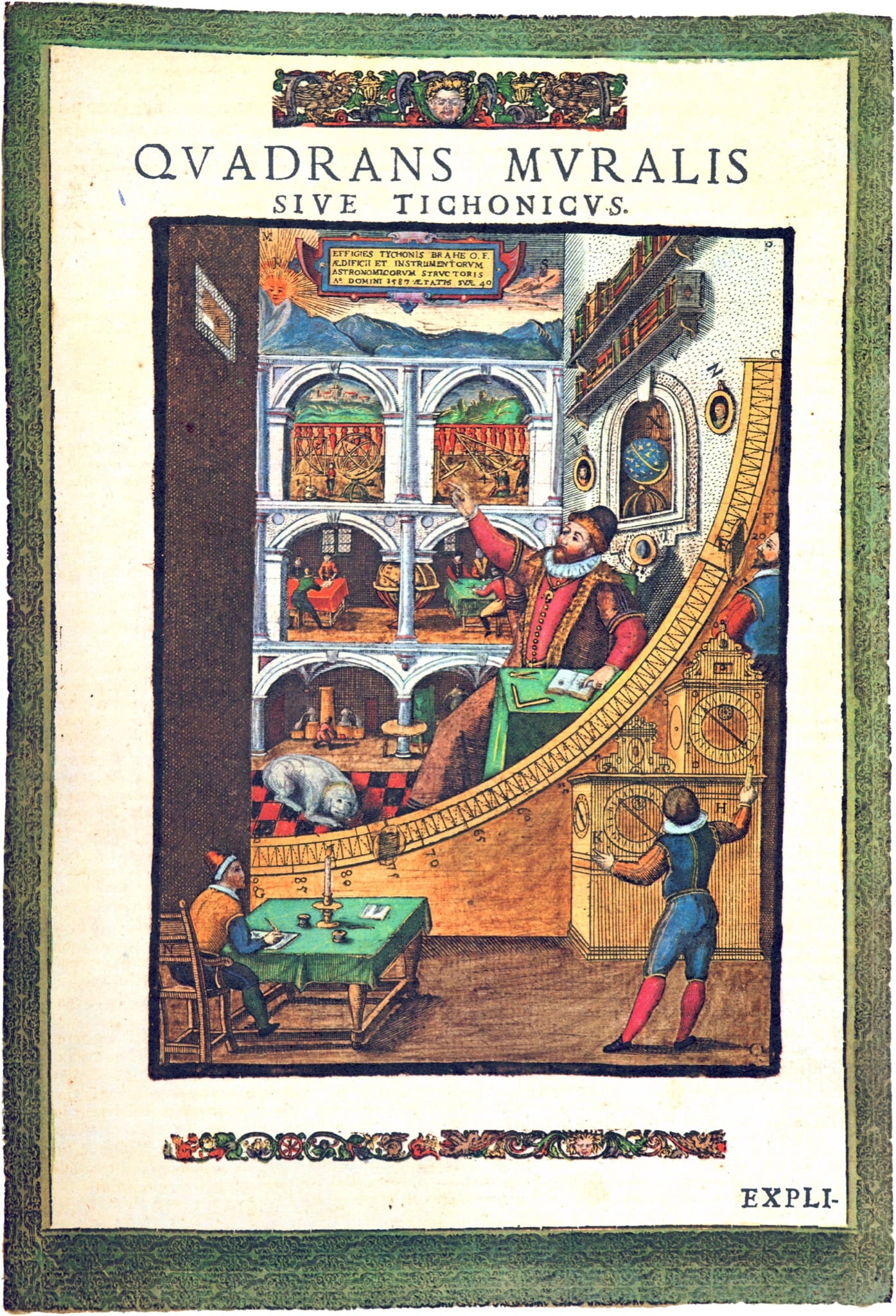
The telescope was thirty-six years in the future. Everything Tycho did that winter he did by eye, with instruments that were not optics but geometry: very large, very carefully divided protractors with open sights. In 1572 that meant a wooden cross-staff, an improved half-sextant on a plinth and a quadrant made in Augsburg. What made him the best observer in Europe was not eyesight but an obsession with the instruments themselves — how their scales were divided, what each one got wrong, and what had to be subtracted from every reading.
The question he set out to answer has a shape anyone can feel. Hold a finger at arm's length, close one eye and then the other: it jumps against the wall behind it, and the nearer it is the further it jumps. That is parallax. If the new star were close, the turning Earth would swing him far enough to make it shift against Cassiopeia. If it were far off, it would sit still.
Night after night that winter he measured the angles from the new star to the known stars around it, and night after night they did not change. There was no parallax at all, none the finest instruments in Europe could detect. A measurement of nothing is an odd foundation for a revolution, but that is what this was. The star was not in the air and it was not below the Moon. It was out among the fixed stars, in the one part of creation forbidden to change, and it had changed.
It went on changing while he watched. Already brighter than Jupiter on the evening he found it, it rose to about magnitude −4.0 around 16 November — Venus at her best, and bright enough to pick out in daylight — then faded through the following year and went out altogether in March 1574. His month-by-month notes on its brightness are careful enough that astronomers in the 2020s have used them to rebuild the light curve of an explosion nobody alive has seen.
Was Tycho Brahe the first to see the supernova of 1572?
No, and it is worth saying flatly, because the shorthand nearly always gets it wrong. Tycho did not discover the star. It had appeared in the first days of November, it was extremely bright, and much of literate Europe was already looking at it before he walked out of that laboratory.
Jerónimo Muñoz saw it in Spain. Thomas Digges and John Dee saw it in England, the Jesuit mathematician Christopher Clavius in Rome, and the young Michael Maestlin in Germany, who tested it for movement by stretching a piece of string between two known stars and sighting along it — a trick regularly misattributed to Tycho. Observers in China recorded it too. Several of them beat him to it by days.
What was Tycho's was the measurement. Others saw a new star; he proved where it was not, and argued the consequences in print. The book appeared in 1573 under a title that has outlasted almost everything else about him: De nova et nullius aevi memoria prius visa stella, on the new star, never before seen in the memory of any age. The word astronomers still use for a star that suddenly appears is a piece of that title.
Five years later a great comet gave him the other half of the argument. Measured the same way it showed no useful parallax either, which made it not weather in the upper air but an object crossing the planetary distances, straight through the regions the crystalline spheres were supposed to occupy. Spheres cannot both be solid and let a comet through.
Why the king of Denmark gave Tycho Brahe an island
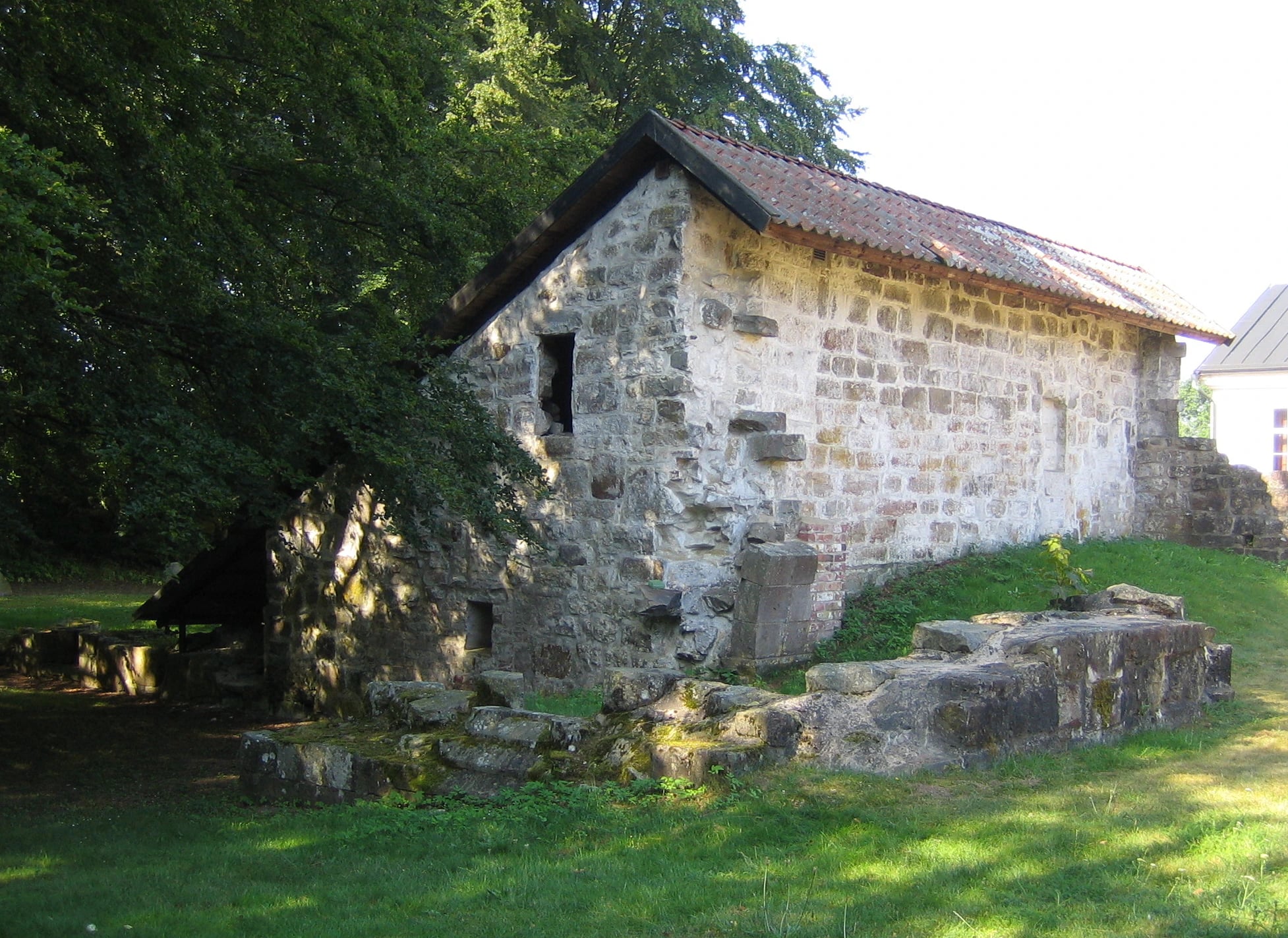
The reason any of this happened in a converted monastery in Scania is a story about tolls. Herrevad was founded in 1144 as the first Cistercian house in Denmark; the Reformation of 1536 took it from the Church, its last monks handed it to the crown in 1565, and it passed to Tycho's uncle Sten Bille, who paid for the alchemical laboratory his nephew was walking out of that evening. The rest of the industry on the site was the nephew's own: by 1570 he had paper being made at the Klippan mill nearby, the first in Scandinavia, and a glassworks built at Herrevad at his request, the first in the country.
Denmark could afford young men like that, because it owned a bottleneck. Every foreign ship coming down out of the Baltic through the narrows at Helsingør, half a day's ride west of Herrevad, stopped and paid the Danish crown a share of what it carried; from 1567 the Sound Dues were charged as a percentage of cargo value, and in the sixteenth and seventeenth centuries they were worth as much as two-thirds of the crown's whole income. A king with that much money did not have to ask his nobility for permission.
So in 1576 Frederick II gave a twenty-nine-year-old astronomer an island. Hven sits in the middle of the Sound, and Tycho got it with the funds to build on it: the cornerstone of Uraniborg went down on 8 August 1576, the first purpose-built observatory in modern Europe and the last great one raised before the telescope existed. When he found that wind flexed instruments mounted in towers, he built a second observatory beside it, Stjerneborg, sunk into the ground.
It did not survive the next king. Under Christian IV the money and the patience ran out, Tycho left Denmark for good in 1597, and he died in Prague on 24 October 1601, having spent his last months employing a difficult and brilliant assistant named Johannes Kepler — who used the observations to work out that Mars does not travel in a circle.
Where Tycho Brahe saw the new star, and why it is in Sweden now
Scania stayed Danish for another eighty-six years. In February 1658, beaten in war, Denmark signed the Treaty of Roskilde and gave it up along with Blekinge, Halland, Bornholm and two Norwegian provinces — about a third of the realm, surrendered to keep the rest. The yard Tycho crossed that night has been Swedish ground ever since, which is why the most famous observation in Danish astronomy happened somewhere you now reach through Sweden.
The abbey did not last either. What was left of the monastic complex was pulled down, and by 1727 a cavalry regiment had raised a headquarters out of the rubble and called it Herrevad Castle. Of the medieval buildings almost nothing stands: part of the old sacristy, used for years as a shed, and the foundations of the choir and nave, uncovered by excavation in the 1980s.
What Tycho's new star actually was
A star between eight and ten thousand light-years away had blown itself apart, and the light had been crossing the gap ever since. The distance is now put at 8,000 to 9,800 light-years, which places the explosion itself some nine thousand years before the evening it arrived.
Working from Tycho's own brightness notes, Walter Baade concluded in 1945 that the fading curve matched a type I supernova. The case was settled in 2008 by an experiment of some nerve: Oliver Krause and colleagues found light from the 1572 explosion that had taken a longer route to Earth, scattering off interstellar dust on the way and arriving four and a third centuries late, and put a spectrograph on it. It was a normal Type Ia — a white dwarf that took on more mass than it could hold and detonated.
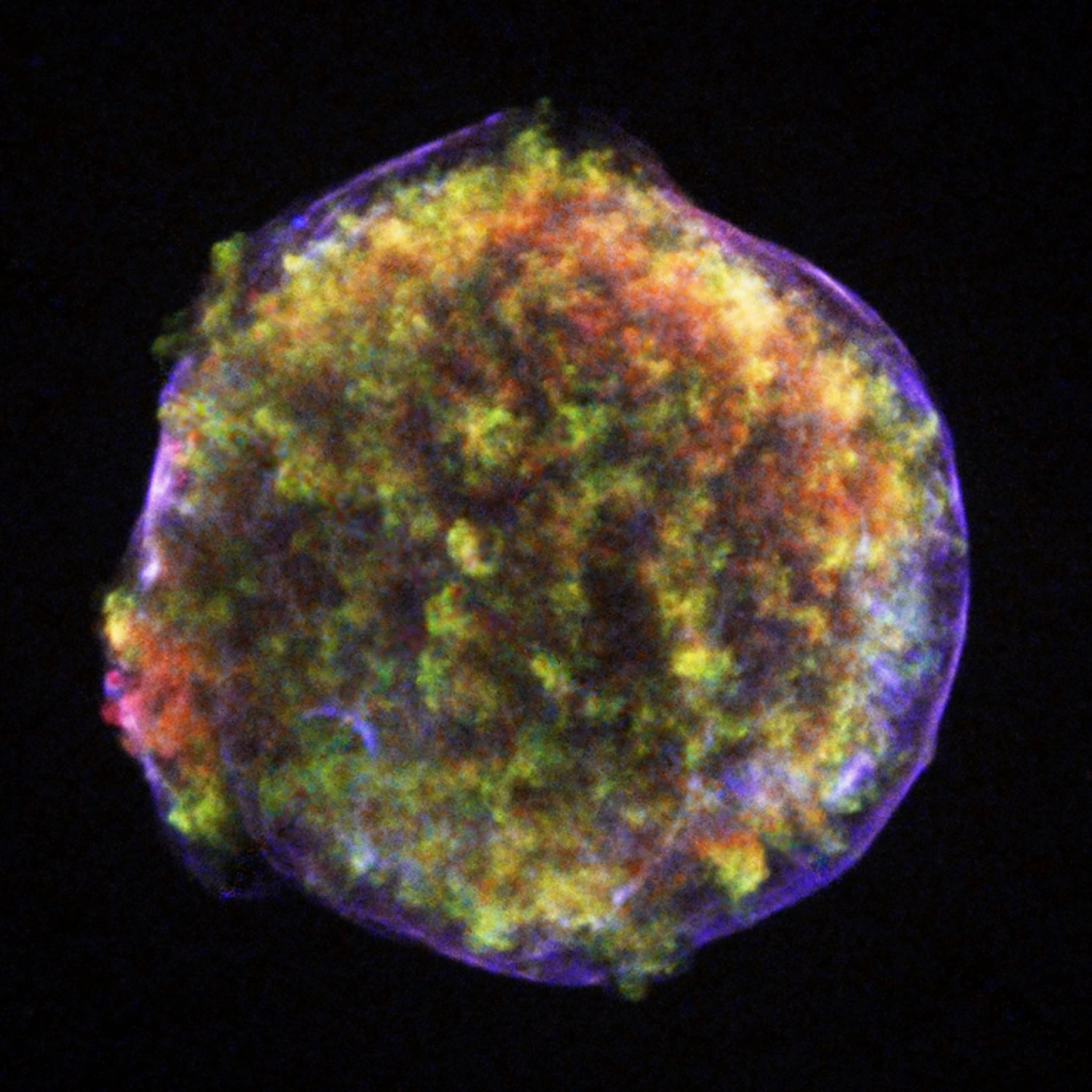
None of that was available to him. What Tycho had was a point of light that would not shift when he measured it, instruments good enough to prove the point, and the nerve to publish a fact the heavens were not supposed to permit. The remnant carries his name, which is the one monument he neither designed nor paid for.
Sources
- SN 1572 — Wikipedia — the other observers, the brightness curve, and the modern classification and distance
- Tycho Brahe — Wikipedia — the 1566 duel and the prosthetic nose, Herrevad, the grant of Hven, Prague and Kepler
- Herrevad Abbey — Wikipedia — the 1144 foundation, the Reformation, Sten Bille's laboratory, the glassworks and paper mill, and the site after 1658
- Uraniborg — Wikipedia — the 1576 cornerstone, Stjerneborg, and the end of the observatory under Christian IV
- T. C. Hinse, B. F. Dorch, F. Occhionero & P. Holck, How Tycho Brahe's recordings in 1572 support SN 1572 as a type I(a) supernova, Frontiers in Astronomy and Space Sciences 10:1255481 (2023) — the Julian and Gregorian dates, the instruments he used in 1572, and the light curve rebuilt from his own notes
- How Tycho Brahe Discovered a New Star with a Piece of String — Literary Hub, extract from L. S. Fauber, Heaven on Earth (Pegasus, 2019) — the walk back to supper, the servants and the peasants, his own words in translation, and the correction that the string test was Maestlin's
- Tycho Brahe — World History Encyclopedia — the parallax argument, the comet of 1577, and what it did to the crystalline spheres
- The astronomy of Tycho Brahe — Niels Bohr Institute, University of Copenhagen — his own verdict on the star as the greatest miracle of nature since the creation of the world
- Tycho Brahe Observes a Supernova — EBSCO Research Starters — the night itself, and Maestlin and Digges testing the star with stretched threads
- O. Krause et al., Tycho Brahe's 1572 supernova as a standard type Ia as revealed by its light-echo spectrum, Nature 456, 617 (2008) — the light echo that settled the type, four and a third centuries late
- Sound Dues — Wikipedia — the toll at Helsingør, the 1567 change to a tax on cargo value, and its share of Danish royal income
- Northern Seven Years' War — Wikipedia — the war against Sweden that ended at Stettin in December 1570
- Treaty of Roskilde — Wikipedia — the 1658 cession of Scania and the other provinces to Sweden
- Gregorian calendar — Wikipedia — the 1582 reform, which is why 11 November 1572 is Old Style and 21 November is not


