A Timeslip story
The summer the potato blight reached Ireland
A gardener at Glasnevin found the disease in his vegetable plot and predicted famine. Three weeks later the crops about Dublin were perishing, and a country that fed itself on one clone of one crop had nothing to fall back on.


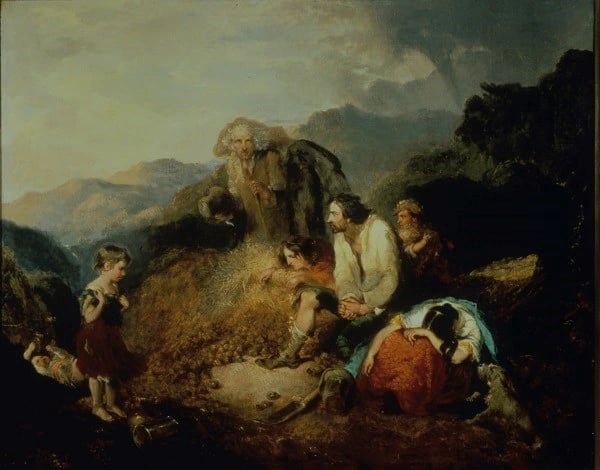
There was a smell first. Almost everybody who wrote about the autumn of 1845 in Ireland mentioned it — a sweetish, nauseating stink coming off ground that had been sound a fortnight earlier. The foliage blackened and collapsed, and when families opened the ridges to lift the crop they lived on, some of what came out was already marbled brown and rotting.
The rest was worse, because it was on a delay. Tubers came out of the ridge looking sound, were pitted for the winter as usual, and turned to grey slime within weeks. Families who thought they had saved something opened their store in November and found it liquid.
Roughly a third of the Irish crop failed that year — the government's own scientific commissioners put it at half by November. That was survivable. The next year the same disease took about three quarters of the harvest, and the winter after that is remembered in Ireland simply as Black '47. Within seven years a million people were dead and a million more had gone.
The cause was a microscopic water mould that had crossed the Atlantic in a cargo of seed potatoes — but the mould only explains the crop. What made it a catastrophe was everything Ireland had built on top of the potato.
Where the potato blight came from
Phytophthora infestans is not a fungus, though it was called one for well over a century. It is an oomycete — a water mould, closer on the tree of life to seaweed than to a mushroom — and it needs cool, wet weather to sporulate. Its home is the Americas.
It first appeared in Europe at the end of June 1845, around Courtrai in Flanders. By mid-July it was across Flanders, the southern Netherlands and northern France; in August it was on the Isle of Wight and in Kent; and that same month it reached Dublin. The Irish summer of 1845 was unusually cool and wet — precisely the weather the mould wants.
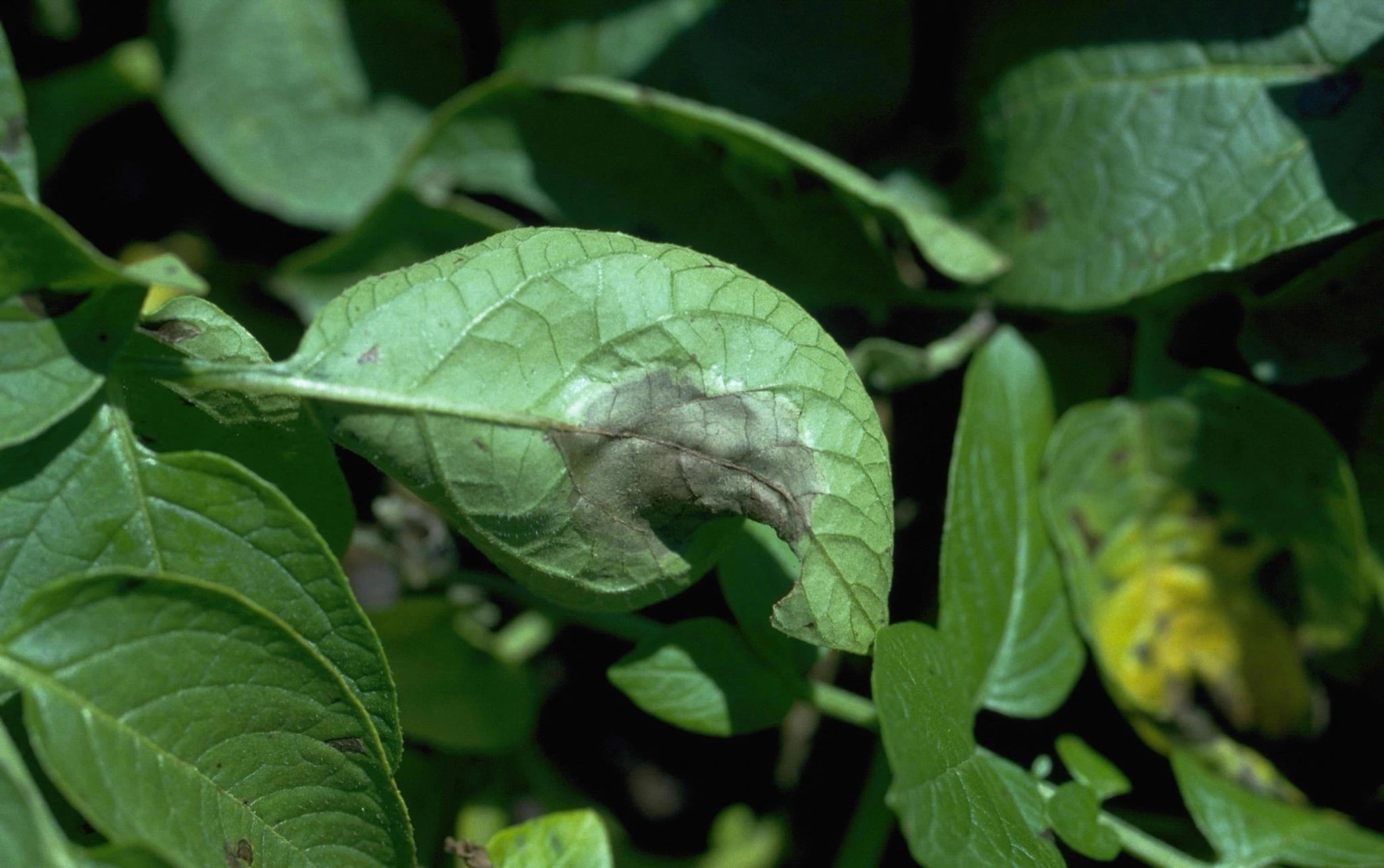
The argument about what the rot even was ran on for a generation. Not until 1861 did the German botanist Anton de Bary prove that the mould caused the disease rather than merely following it, and give the genus the name it still carries: Phytophthora, plant destroyer. The official advice of 1845 ran to drying and ventilating, and was useless.
Why Ireland lived on potatoes
By 1845 Ireland held something close to 8.5 million people, on an island that today has about seven million counting the Republic and Northern Ireland together. Most lived on the land, and a very large share — estimates run from a third to a half — ate potatoes and very little else.
That was arithmetic, not taste. After the confiscations of the seventeenth century most of the ground belonged to a frequently absentee landlord class, worked by tenants with no security of tenure and no claim on any improvement they made. Holdings were divided between sons and divided again, until vast numbers of families lived on a few acres or less, often rented by the season under conacre — ground let for one crop and paid for in labour. The 1841 census counted over half a million such farmers.
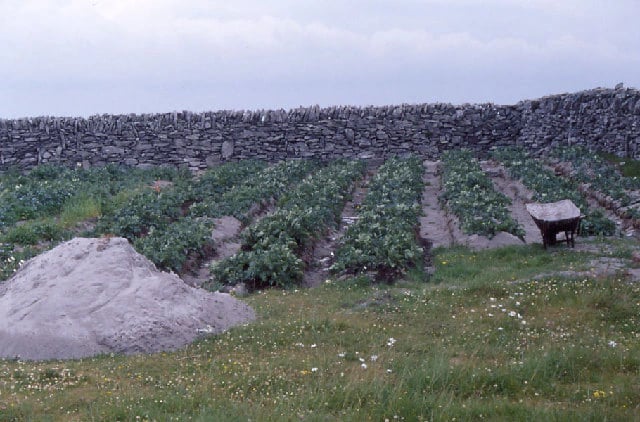
On four acres you cannot feed a family on grain. On one acre, with a spade and enough manure or seaweed, you can feed them on potatoes, and feed them decently. So the poor built lazy beds: long raised ridges of earth turned by hand with the loy — the narrow one-sided Irish spade — and drained by the furrows between them. Ridges like that grow potatoes on wet, thin, stony ground where nothing else grows at all.
Then came the fatal compression. The variety almost everybody planted was the Irish Lumper, first recorded in 1808: coarse, watery, unloved and astonishingly productive on bad ground. A whole country was eating one clone of one crop, with no genetic variation anywhere in the system for a new disease to run into.
The same fields grew wheat, oats, barley, butter and beef, but those were the rent. They went to the landlord and very often onto a ship: Ireland exported food throughout the Famine, exports exceeding imports until 1847. That fact, more than any other, is why the Famine is still an argument rather than a closed file.
Who first recorded the blight in Ireland
The first man in Ireland to write down what he was looking at was a gardener. David Moore — a Dundee man who had come over at twenty, and by then curator of the Botanic Gardens at Glasnevin on the northern edge of Dublin — walked into the vegetable plot on 20 August 1845 and found the potato haulms going black. He had been following the disease all summer in the horticultural press. He recorded it, and predicted famine.
Three weeks later the countryside caught up with the garden. On 13 September the London Gardeners' Chronicle, edited by the botanist John Lindley, stopped its press.
We stop the Press with very great regret to announce that the potato Murrain has unequivocally declared itself in Ireland.
The Gardeners' Chronicle, 13 September 1845
Lindley reported that the crops about Dublin were suddenly perishing, and then asked the question nobody wanted answered: where would Ireland be in the event of a universal potato rot? He was not being dramatic. He was being arithmetical.
What the government in London did
Ireland in 1845 had no parliament of its own. It had been governed directly from Westminster since the Act of Union came into force on 1 January 1801, so the failure of the Irish crop was a British domestic policy question, argued out by men with other priorities.
The Prime Minister, Sir Robert Peel, moved fast and quietly, ordering £100,000 of American maize in November 1845 and landing it in February to be sold cheaply and hold prices down. Irish people, who had never seen maize, called it Peel's brimstone; it was hard to mill and hard on the stomach, and it worked. He also used the crisis to argue for repeal of the Corn Laws — got it through in 1846, split his party doing it, and lost the premiership within days.
His successor, Lord John Russell, led a Whig government committed to the proposition that markets should not be interfered with. Relief passed to the Treasury and to Charles Trevelyan, who administered it narrowly and on principle. Peel's purchases stopped, and relief became public works: men and women building roads to nowhere in winter, on one meal a day, for wages that lagged behind the price of food.
Black '47 and the quarter-acre clause
In February 1847 the government admitted the public works had failed and passed the Temporary Relief Act — the soup kitchens — which at their peak that summer fed around three million people a day. It was the most effective thing done during the whole Famine, and it was wound up within months as a temporary expedient.
What replaced it was the Poor Law Extension Act of June 1847, which pushed the cost of relief onto Irish rate-payers and carried the Gregory clause: nobody occupying more than a quarter of an acre could receive relief at all. To eat, a family had to surrender its holding. The clearances that followed emptied whole townlands.
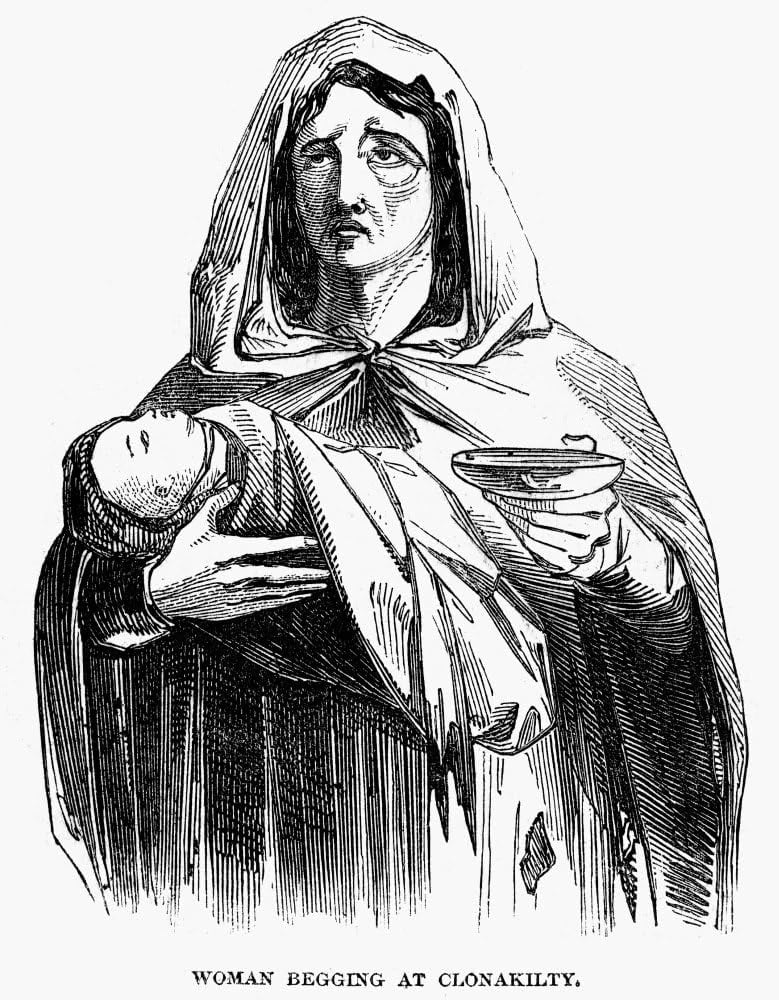
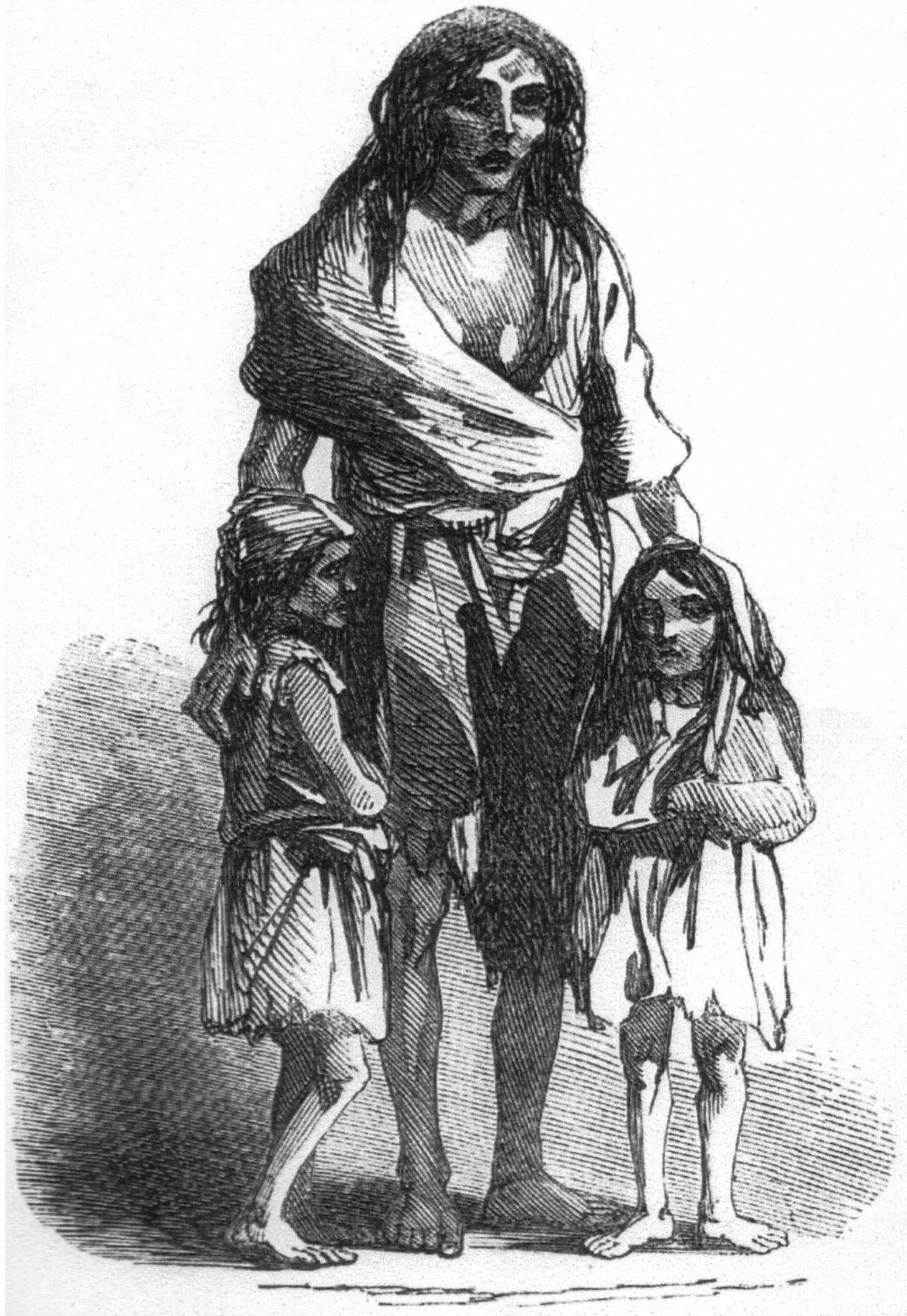
Fever came with hunger, as it always does — typhus, relapsing fever, dysentery — and killed more people than starvation did. In December 1846 a Cork magistrate, Nicholas Cummins, wrote what he found at Skibbereen to the Duke of Wellington, copying the letter to The Times, which printed it on Christmas Eve. In the first cabin he entered, six people lay huddled on filthy straw, to all appearance dead; a low moaning told him they were alive, and in fever. Reprinted across Britain, Ireland and America, it moved opinion as no official report had.
In 1847 the Choctaw Nation, sixteen years after being marched off their own land on the Trail of Tears, collected $170 and sent it to Ireland.
How many people died in the Irish potato famine
The census of 1841 counted 8,175,124 people in Ireland. The census of 1851 counted about 6.55 million — a fall of roughly a fifth in ten years. Around a million died of starvation and disease, and around a million more had gone; something over two million left between 1845 and 1855, mostly for the United States, Canada, Britain and Australia. The population kept falling for decades afterwards, bottoming out in the mid-twentieth century at barely half the pre-Famine figure.
Passages were cheap because the ships were bad, and the worst earned the name coffin ships. The Canadian route was cheapest and deadliest: in 1847 the quarantine station at Grosse Île, downstream of Quebec in the St Lawrence, was overwhelmed by fever ships, and over five thousand people are buried there.
Almost everything else about modern Ireland runs through this. The Irish language, still the majority tongue in the west in 1845, collapsed with the communities that spoke it. Subdivision of holdings stopped, replaced by the single-inheritor farm, late marriage, and permanent emigration for everybody else.
In June 1997 the British Prime Minister, Tony Blair, issued a statement acknowledging that those who governed in London at the time had failed their people by standing by while a crop failure turned into a massive human tragedy. It was 152 years late, and it was still news.
The mould is still here, and still one of the most destructive plant pathogens on earth. In 2013 researchers sequenced it from herbarium leaves collected in the 1840s and named the historic lineage HERB-1; later work using different genetic markers called the same famine genotype FAM-1 and traced it across six continents. Both agree it was displaced by other strains within about a century — and whether it survives anywhere is a question the researchers themselves decline to close.
Sources
- Great Famine (Ireland) — Wikipedia — the relief legislation, the Gregory clause, the Choctaw donation, Grosse Île, and the emigration figures
- 1845 in Ireland — Wikipedia — the September dating, the scale of the 1845 loss, and Peel's maize order
- National Botanic Gardens of Ireland — History — David Moore's record of 20 August 1845
- National Botanic Gardens (Ireland) — Wikipedia
- David Moore (botanist born 1808) — Wikipedia — born Dundee 1808, came to Ireland in 1828, curator at Glasnevin from 1838
- Spud Smart — “The Potato Murrain: The Birth of Modern Plant Pathology” — Lindley's stop-press paragraph of 13 September 1845, quoted in full
- The History Place — “Irish Potato Famine: The Blight Begins” — the stench, and the tubers that rotted in the pit after lifting
- Britannica — “The Mold that Wrecked Ireland” — the wet, cool summer of 1845
- Britannica — Great Famine
- History.com — Irish Potato Famine
- Anthropocenes — “The Voyages of a Potato Companion” — the pathogen's arrival at Courtrai at the end of June 1845 and its spread that summer
- Farming Life — “Bygone Days: we trust it will prove no more” — the blight in southern England in August 1845
- Irish Lumper — Wikipedia
- National Geographic — “Meet the Lumper: Ireland's New Old Potato”
- Lazy bed — Wikipedia
- Scientific Reports — “Global historic pandemics caused by the FAM-1 genotype of Phytophthora infestans” — the FAM-1 genotype, its spread across six continents, and its displacement
- eLife — “The rise and fall of the Phytophthora infestans lineage that triggered the Irish potato famine” — the HERB-1 herbarium sequencing, and the authors' own hedge on whether it survives
- APS — “Potato Late Blight: the Birth of Plant Pathology” — de Bary's 1861 proof, and the useless remedies of 1845
- Encyclopedia.com — Heinrich Anton de Bary
- Gript — “On This Day: 24th December 1846, Letter to the Times re the Starvation in Skibbereen” — the Cummins letter, its date, and the passage quoted here
- Skibbereen Heritage Centre — the Cummins letter
- 1841 census of Ireland — Wikipedia — the 8,175,124 figure, and the half-million smallholders
- Library Ireland — “Decline of the Population in Ireland”, from Thom's analysis of the 1861 census — the 1851 count and the decade's fall
- Acts of Union 1800 — Wikipedia — royal assent 1800, in force 1 January 1801
- The Irish Post — “On This Day in 1997: Tony Blair apologises on behalf of Britain for the Irish Potato Famine” — the June 1997 statement, quoted here in the words it used
- Smithsonian Magazine — “Scientists Finally Pinpoint the Pathogen That Caused the Irish Potato Famine”
- RTÉ — “Peel's brimstone: the Temporary Relief Commission”
- RTÉ — The Great Irish Famine project
- The Victorian Web — The Irish Famine


