A Timeslip story
The four ships that forced Japan open
Fishing crews in the mouth of Edo Bay stood up to watch two black hulls come up the channel against the wind with no sail set at all. Nobody in Japan had ever seen a steamship, and the two centuries in which the country had kept the world out had about nine months left to run.


The fishing crews in the mouth of the bay stood up in their boats to watch. Two of the four ships coming up the channel had no sail set at all — not reefed, not furled against a squall, simply not there — and they were making eight or nine knots straight into the wind, each with a second ship under tow behind it. Black hulls, a tall funnel apiece, a bending column of coal smoke. Nobody in Japan had ever seen a steamship.
It was the afternoon of 8 July 1853, in the Uraga Channel at the mouth of Edo Bay, some thirty miles from one of the largest cities on earth. At about five o'clock the four vessels anchored in a line opposite the town of Uraga, guns bearing on the shore batteries and the roofs behind them. They had cleared for action hours earlier — guns run out and shotted, small arms issued, everything, in the words of the expedition's own account, “usual before meeting an enemy.” Nothing was fired. Nothing needed to be.
The squadron was American, and its commander, Commodore Matthew Perry, carried a letter from President Millard Fillmore asking Japan to open its ports. Japan had been sealed for more than two centuries and had turned away every Western caller who ever asked. It signed a treaty the following spring, and the government that had closed the country was gone within fifteen years. The ships have a name of their own in Japanese: kurofune, the black ships.
What made this attempt work where the others had failed was not the letter. It was Perry's answer when he was told where to take it.
Why Japan had been closed for two centuries
Between 1633 and 1639 the Tokugawa shogunate issued a series of edicts that shut the country almost completely. No foreigner could enter, no Japanese could leave, and any Japanese already abroad could not come back. The Portuguese were expelled, and when they sent an embassy in 1640 to argue the point, most of it was executed. The policy is remembered as sakoku, the closed country.
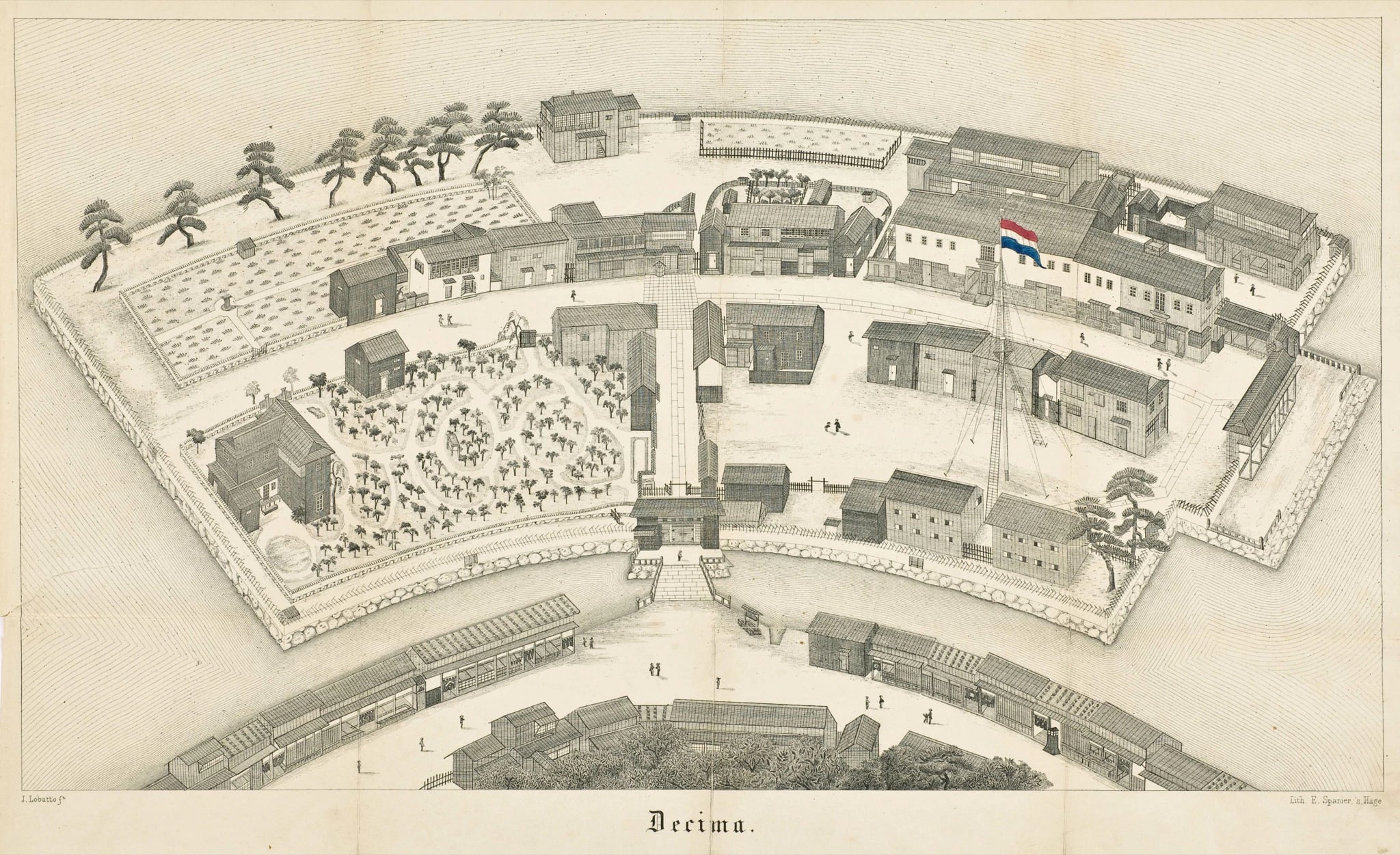
One door was left ajar and it was very narrow: a few dozen Dutch traders on Dejima, a thousand kilometres down the coast from Edo. Which is why every Western ship that reached Japan was handed the same sentence, and why Perry was handed it before he had been at anchor a day. Nagasaki, a vice-governor came out from Uraga to explain, was the only place, according to the laws of Japan, for negotiating foreign business.
Why the Americans came, and why in 1853
The United States had reached the Pacific and was looking across it: a whaling fleet working the northern ocean, sailors off it washing up on Japanese shores with no lawful way home, and — since the 1840s — steamships, which cannot cross an ocean unless somebody sells them coal in the middle. Fillmore's letter asked for trade, for coal and provisions, and for the decent treatment of castaways. Every line was politely put, and it was delivered by four warships anchored in a firing line off an undefended town.
There is a second reason and it is not in the letter. In 1842 China had signed the Treaty of Nanking to end the First Opium War: Hong Kong ceded, four more ports thrown open, an indemnity paid. The largest state in Asia had been beaten inside three years by steam gunboats not unlike the two now smoking in Edo Bay.
Why Perry refused to go to Nagasaki
He was not the first to try. The Russian envoy Adam Laxman was turned away from Hokkaido in 1792, and Nikolai Rezanov was refused at Nagasaki in 1805 after waiting all winter. In 1846 Commander James Biddle of the United States Navy anchored two ships in this same bay, asked for a trade agreement and was refused. Perry's own book disposes of Biddle in a sentence: the ships “remained at anchor some eight or ten days, accomplished nothing, and quietly left when the Japanese desired it.”
Perry had read that record and settled his method before he reached the coast. He would demand as a right what his predecessors had asked for as a favour. No official below the highest rank would be received, no Japanese would be allowed aboard any ship but his own, and the commodore himself would not be seen until the man he wanted appeared — which meant days in his cabin, speaking through an aide.
To demand as a right, and not to solicit as a favor.
Matthew Perry, on the policy he settled before reaching Japan
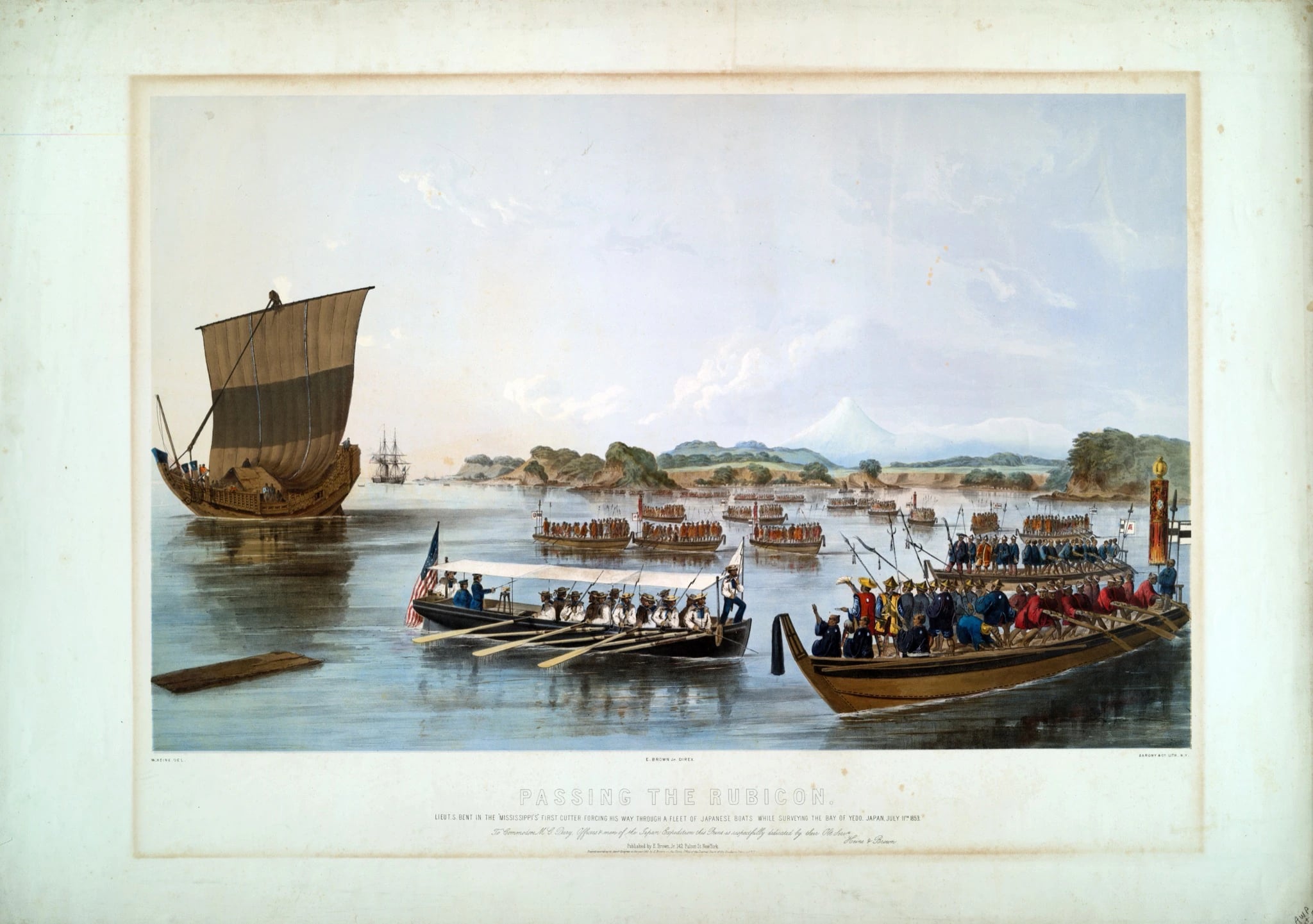
The six days that followed were a slow and entirely serious argument about protocol, conducted while American boats rowed about taking soundings — a survey of the bay the Japanese had no way to stop. Someone in the first boat to come alongside called out, in good English, “I can speak Dutch,” Dutch having been the language of Japanese foreign business for two hundred years. Guard boats that made fast to the sloop Saratoga were cast off, and men climbing her chains were checked by the sight of pikes, cutlasses and pistols.
On 14 July Perry landed at Kurihama with about 250 sailors and Marines from fifteen boats under a thirteen-gun salute, handed Fillmore's letter to two commissioners, Toda Ujiyoshi and Ido Hiromichi, said he would return in the spring for an answer, and on the 17th he sailed.
The dates are worth pinning down, because accounts disagree: the arrival was 8 July, the landing at Kurihama the 14th, and a good many retellings run the two together. Japanese records of the time used the lunar calendar, in which the arrival falls on the third day of the sixth month of Kaei 6 — which is how some English pages date the black ships to 3 June.
What Japan made of the black ships
The news went up the bay faster than the ships could have. A rumour that the foreigners meant to fire on Edo put the city into what the Tokyo Metropolitan Library's own account calls a panic. From August the shogunate began throwing up gun batteries along the Shinagawa shore; twelve were planned, six were finished by April 1854, and the money ran out.
Ten days after the squadron sailed the shogun, Tokugawa Ieyoshi, died, and the response fell to the chief senior councillor, Abe Masahiro. Abe then did something no Tokugawa government had done: instead of deciding, he asked. He put the American demands to the daimyo and invited their opinions. Of sixty-one recorded replies, nineteen were for accepting and nineteen against, fourteen worried vaguely about war, seven wanted a temporary concession and two would go along with whatever was chosen. It did the regime more damage than the ships had.
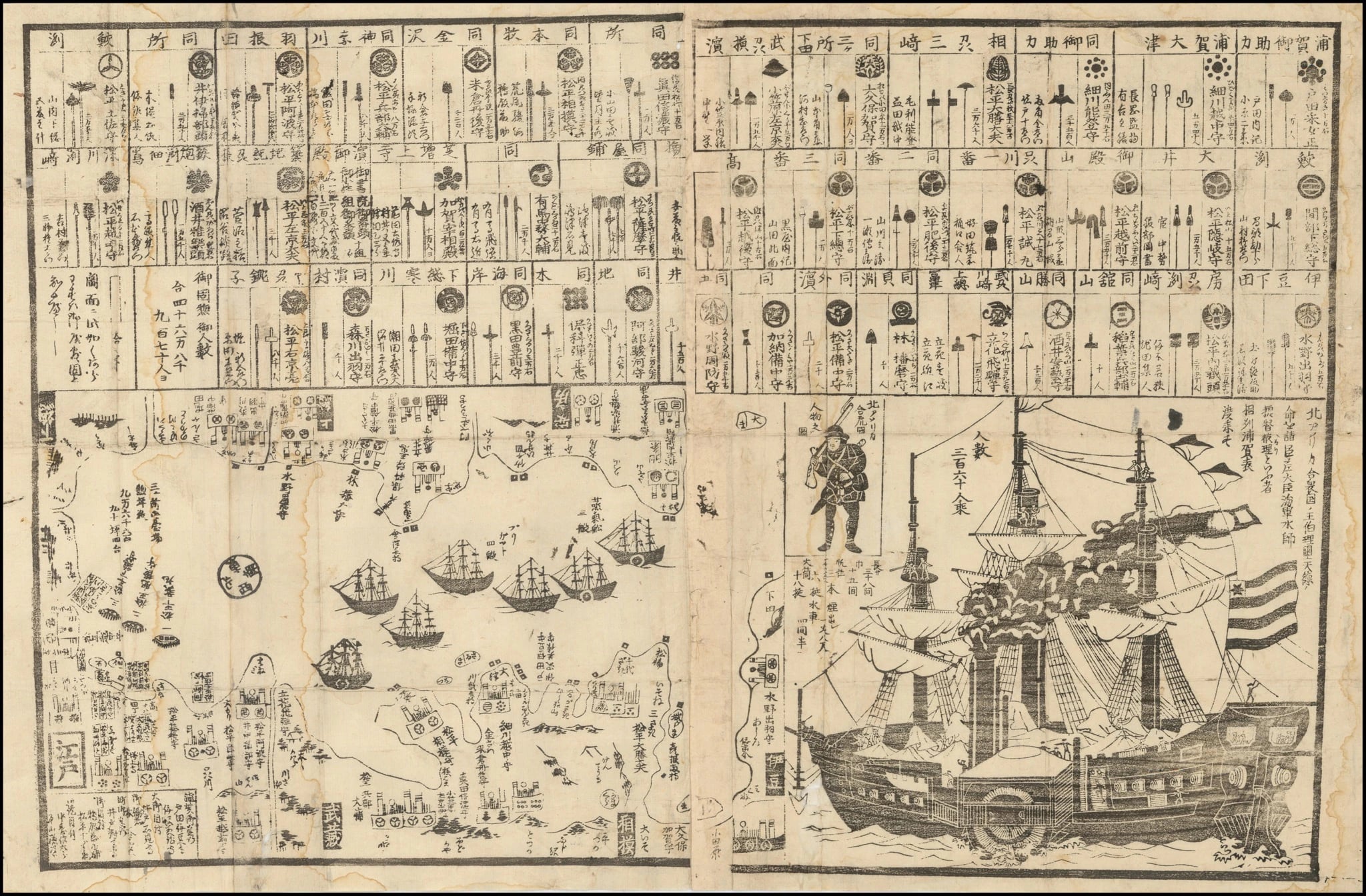
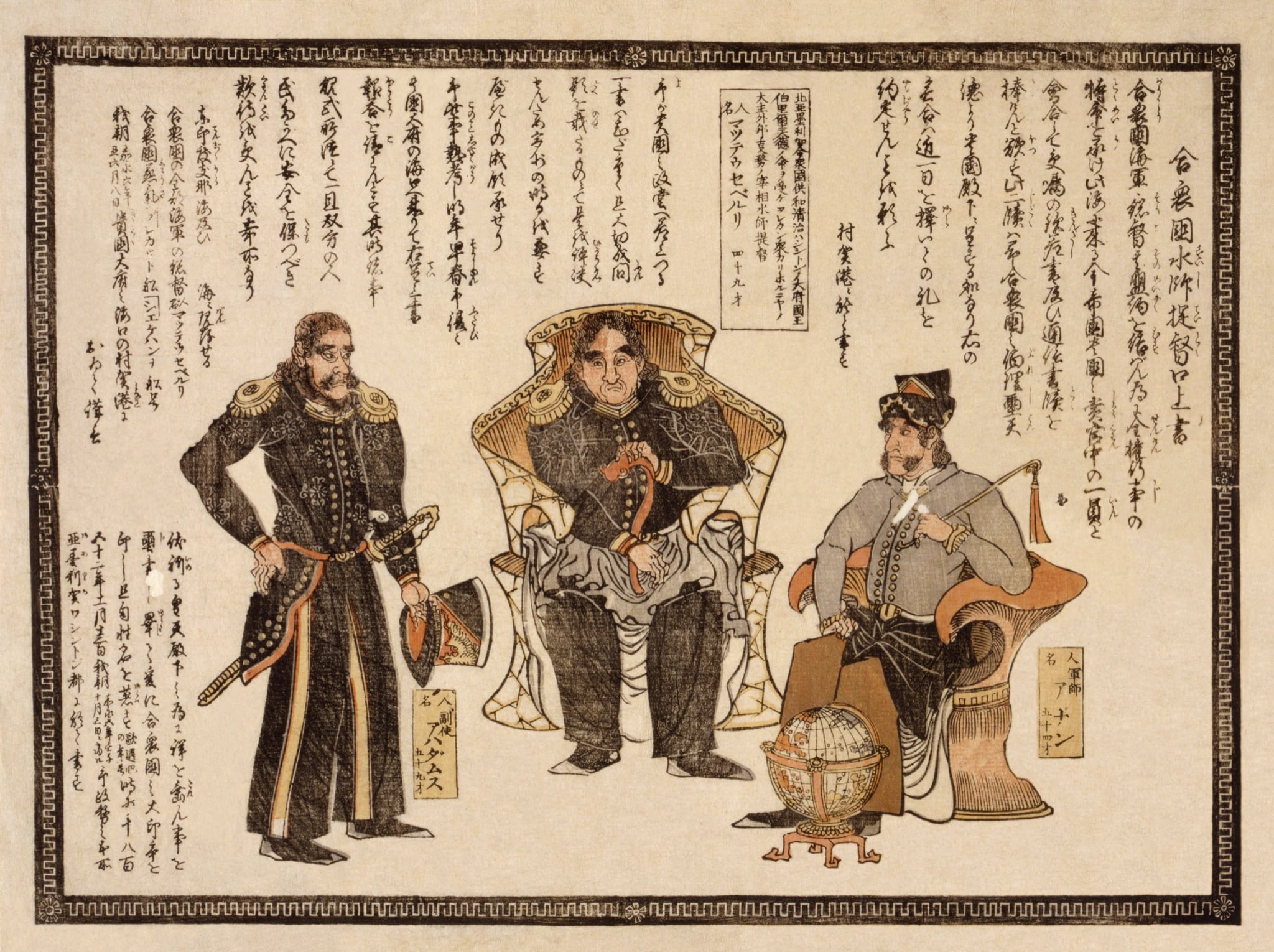
The street answered in print. Edo's kawaraban — cheap woodblock news-sheets, produced fast and sold in the road — went into overdrive, carrying maps of the bay, plans of the ships, portraits of the strangers, speculative anatomies of the steam engine and jokes. The best remembered is a senryu built on jokisen, a word meaning both a brand of green tea and a steamship: awoken from sleep of a peaceful quiet world by Jokisen tea; with only four cups of it one can't sleep even at night. Four cups, four ships.
Because both sides drew and printed compulsively, this is one of very few nineteenth-century encounters that left two complete parallel visual records. Neither set is the true version.
What “opening Japan” cost, and who paid
The standard phrase is that Perry opened Japan, and one part of the mechanism is almost always left out. The squadron's forward base was Naha, in the Ryukyu Kingdom — a separate country, tributary to both China and the Satsuma domain, which had asked for none of this. On 6 June 1853, a month before Edo Bay, Perry marched an armed party with artillery and a band up to the royal palace at Shuri to force an audience with the regent, and later told him that unless his terms were met by the next day he would take possession of the palace. Ryukyu is usually not in the story at all, which is itself part of the story.
In Japan nothing was fired and nobody was hurt, which is much of why the episode is remembered as diplomacy. The guns never had to go off. They only had to be there, in a line, pointing at the town.
What the black ships led to
Perry came back on 13 February 1854 with a considerably larger fleet, and on 31 March the Convention of Kanagawa was signed. It opened Shimoda and Hakodate to American ships, guaranteed help for shipwrecked sailors, allowed a United States consul at Shimoda after eighteen months, and — in Article IX — granted the United States automatically any privilege Japan might later grant anyone else. It was not a commercial treaty. It was the hinge every later one turned on.
The rest came quickly. In 1858 Townsend Harris obtained the full commercial treaty: six ports, fixed low tariffs, and consular courts for Americans accused of crimes in Japan. Near-identical treaties with Russia, France, Britain and the Netherlands followed within months, and in Japan they are remembered together as the unequal treaties. The opened ports wrecked the currency, the humiliation supplied a slogan, and in 1868 the Tokugawa regime that had ruled since Sekigahara fell and the Meiji Restoration began.
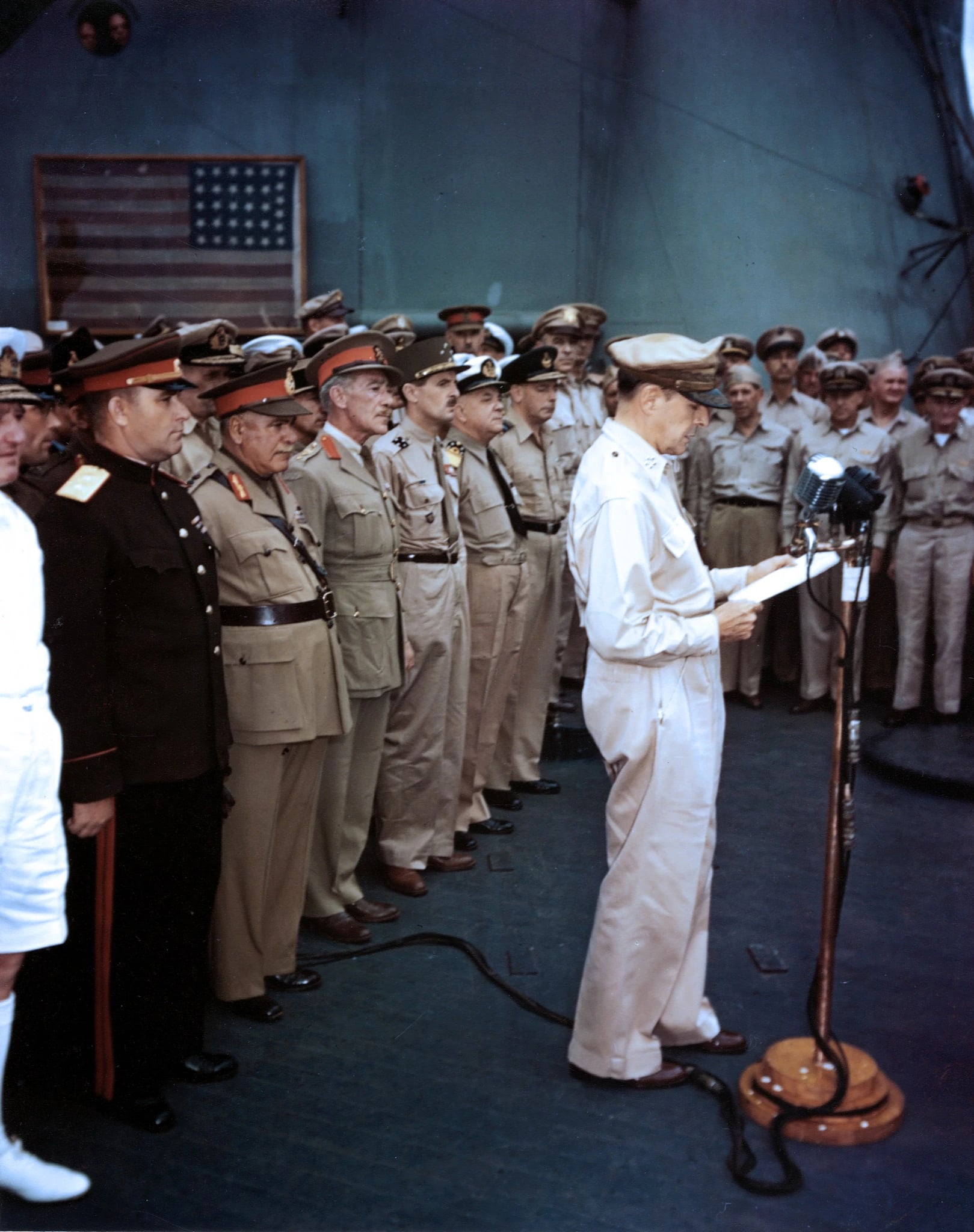
On 2 September 1945, in the same bay, Japan signed the instrument of surrender on the deck of USS Missouri. Framed on the bulkhead above the table, brought out for the occasion, was the flag Perry's flagship had flown there ninety-two years earlier.
Uraga is quieter than any of this suggests. It was absorbed into the city of Yokosuka in 1943 and is a suburb now, with a monument on the beach at Kurihama where the boats came in.
Sources
- Perry / Hawks, Narrative of the Expedition of an American Squadron to the China Seas and Japan (1856), vol. 1 — the expedition's own account, compiled under Perry's supervision; the source of every quotation here, and of the arrival timings, the clearing for action, the guard boats and the Ryukyu episode
- The United States and the Opening to Japan, 1853 — Office of the Historian, US Department of State
- Perry Expedition — Wikipedia — the day-by-day chronology of the first visit, the surveying of the bay, and the names of the officials involved
- Sakoku — Wikipedia — the seclusion edicts of 1633–1639, Dejima, and the failed approaches by Laxman, Rezanov and Biddle
- The Coming of the “Black Ships” (kurofune) to Japan — Tokyo Metropolitan Library, EDO TOKYO Digital Museum — the view from inside Edo: the panic, the kawaraban, the Shinagawa batteries and the jokisen verse quoted here in its translation
- Black Ships and Samurai — MIT Visualizing Cultures, John W. Dower — the two parallel visual records of the same event, and the view of the squadron from the shore
- A Brief Summary of the Perry Expedition to Japan, 1853 (Navy Department, 1953) — HyperWar
- The Perry Expedition and the Opening of Japan — Columbia University, Asia for Educators
- Treaty of Kanagawa, 31 March 1854 — Avalon Project, Yale Law School — the full treaty text, including Articles IX and XI
- Treaty of Amity and Commerce (United States–Japan) — Wikipedia — the 1858 Harris treaty and the Ansei treaties that followed it
- Abe Masahiro — Wikipedia — the poll of the daimyo and the tally of their replies
- Tokugawa Ieyoshi — Wikipedia — the shogun's death on 27 July 1853
- Treaty of Nanking — Wikipedia
- Uraga, Kanagawa — Wikipedia
- Full Circle: The Japanese Surrender in Tokyo Bay, September 2, 1945 — The National WWII Museum
- Perry in Japan — Brown University Library digital collection — the Heine and Brown plates from the Narrative, including Passing the Rubicon


