A Timeslip story
How Paris came to tip two million of its dead down a mine shaft
The tunnels were not dug for the dead, and nobody called them catacombs until 1786. What Paris consecrated that April was a worked-out limestone mine beyond the customs wall — and what it began sending there, night after night for fifteen months, was six centuries of burials from a graveyard in the middle of the food market.


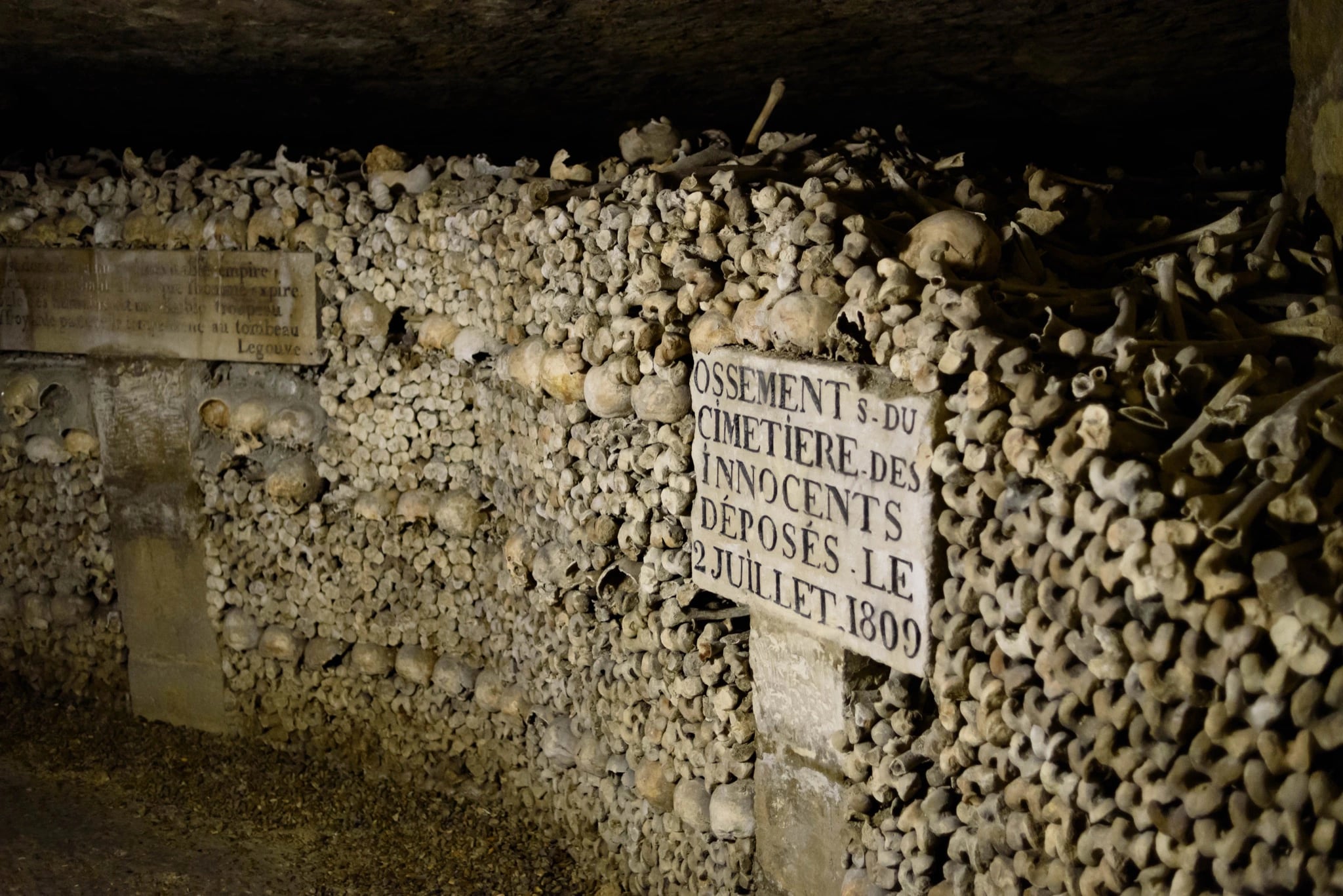
Almost everything people picture when they hear the words Paris catacombs is twenty-four years too late. The disciplined walls of stacked skulls and thighbones, the carved doorway, the plaques naming which cemetery each section came from — none of it existed when the place became an ossuary. What Paris consecrated on the evening of 7 April 1786 was a worked-out limestone mine on the far side of the customs wall, with a windlass over a shaft in an open field, and what went into it went in as a heap.
Three priests did the blessing — the abbés Motret, Maillet and Asseline — out on the market-garden flats called the plain of Montrouge, south of the barrière d’Enfer. With them stood two architects, Jacques-Guillaume Legrand and Jacques Molinos, and Charles-Axel Guillaumot, Inspector General of the Quarries of Paris, whose job for nine years had been keeping the city from dropping into its own cellars. The quarry they consecrated had never held a body and had no sacred character of any kind. Somebody thought to call it the catacombs, after the burial galleries of ancient Rome, and the borrowed name has done more to shape what people imagine down there than anything that happened.
What happened was a public-health operation with a funeral bolted onto the front of it. Paris had a burial ground it could not go on using and a subsoil full of holes nobody had mapped, and for six years the two files had been sitting on the same desks. The consecration is the moment they were solved against each other.
Why the Cimetière des Innocents had to be emptied
Two miles north of the quarry, hard against the food markets at Les Halles, stood the burial ground of twenty-two Paris parishes. The Cimetière des Innocents had taken the ordinary dead of the centre of the city since the Middle Ages, into common pits that held around fifteen hundred bodies at a time — dug, left open until full, closed, and another begun beside it. Nobody kept a running total. Two million is the figure usually given, across six centuries.
The site never grew, because there was nowhere for it to grow. What grew was the ground. Earth and bone had piled the interior a full storey above the surrounding streets, retained by a wall, and every new pit meant lifting an older generation out of the way first.
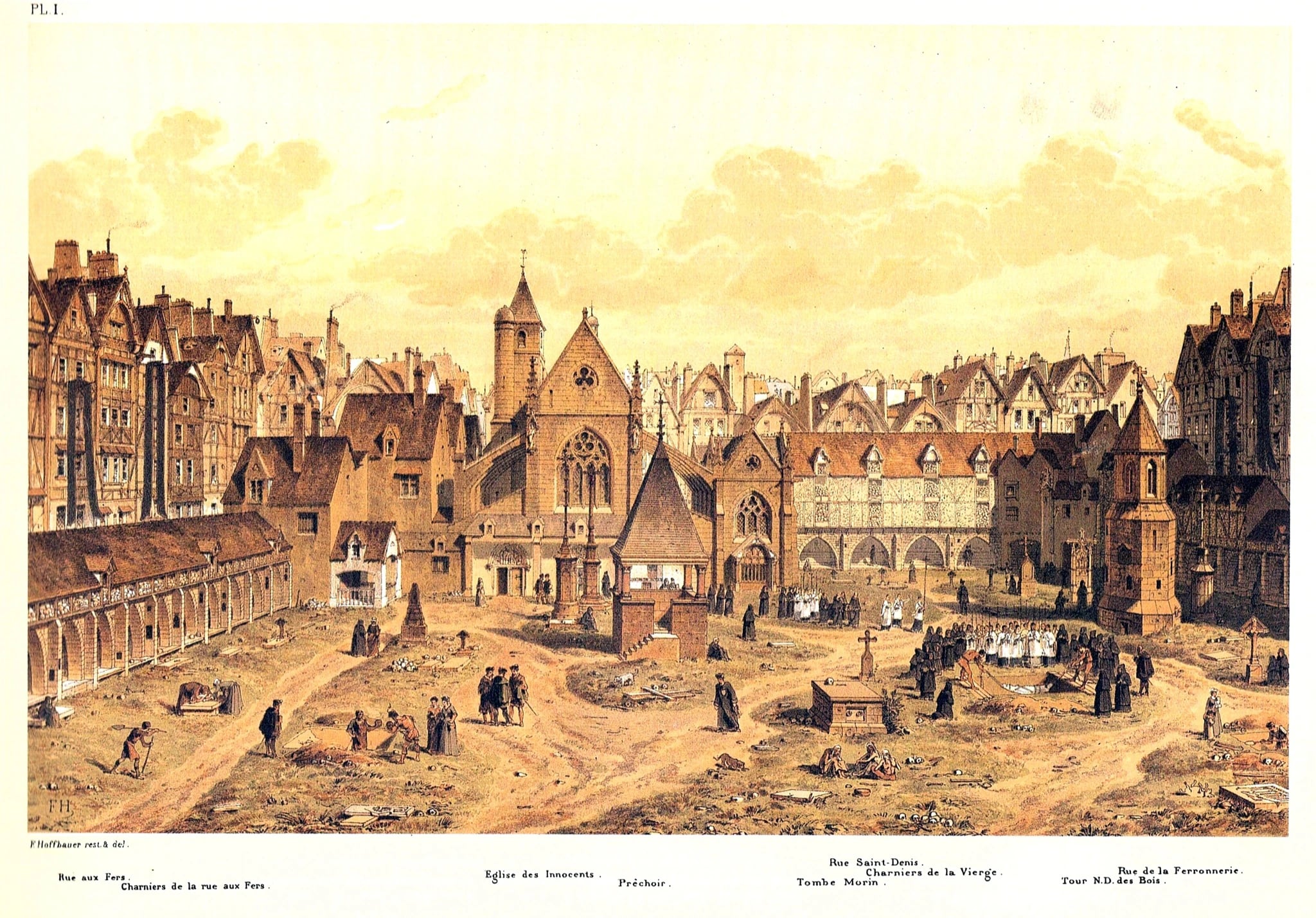
Those lifted bones went into the charniers — arched galleries built along the cemetery walls in the fourteenth and fifteenth centuries for exactly that purpose, the bones stacked in the roof space over an arcade where Parisians walked, shopped and did business. One of those walls carried the Danse Macabre, painted between August 1424 and Lent 1425 — pope, emperor, labourer and child led away by skeletons, and one of the images by which the European Middle Ages is still remembered. It came down in 1669 to widen the lane behind it.
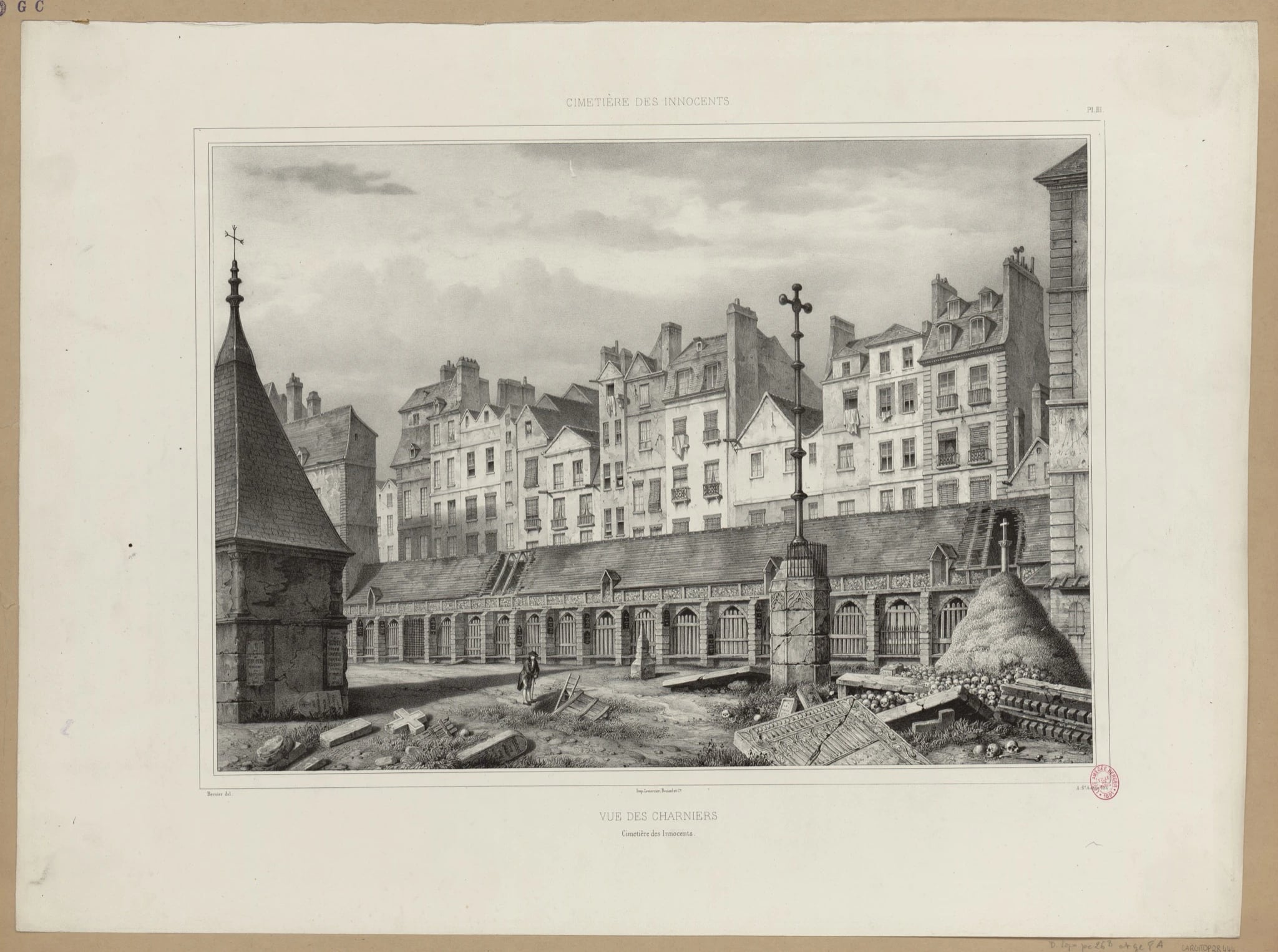
Eighteenth-century medicine held that disease travelled through corrupted air, and Les Innocents was manufacturing a great deal of it. In 1765 the Parlement of Paris banned burial inside the city and ordered eight new cemeteries outside the walls. Essentially nothing happened; custom, piety and the resistance of the parish clergy saw to that.
It took a structural failure to move anybody. Through the early months of 1780, households on the rue de la Lingerie, whose cellars backed directly onto the cemetery, complained that something seeping through the walls was putting out their tallow candles. The official response was to whitewash the cellars with lime. At the end of May a cellar wall gave way completely under the mass of the common grave behind it, and the grave came through into the house. The people living there fell ill with vomiting and delirium. An edict of 4 September 1780 forbade any further burial at Les Innocents — which solved the problem of adding to it, and none of the problem already in the ground.
Why there are quarries under Paris
The city is made of the rock it stands on. Lutetian limestone built Notre-Dame, the Louvre and the townhouses of the Marais, and it was cut out of workings that ran under what were then fields and villages to the south. A worked-out quarry was simply abandoned, unmapped, and Paris grew out over the top of it. By the eighteenth century a good deal of the Left Bank stood on voids whose position no living person knew.
In 1774 a house on the rue d’Enfer dropped into one. Others followed, and the collapses caused a genuine panic. On 4 April 1777 Louis XVI created the Inspection Générale des Carrières — a department that existed for no purpose but to find, survey and shore up the holes under Paris — and handed it to Guillaumot, who spent the rest of his career underground, raising the stone pillars and inspection galleries that still carry that part of the city.
It was Lieutenant General of Police Jean-Charles-Pierre Lenoir who put the two problems together. The disused workings under the old Tombe-Issoire estate, out beyond the barrière d’Enfer in the commune of Montrouge, were outside the city, out of sight, and for practical purposes bottomless.
How the bones were moved from Les Innocents to the catacombs
An order of the King’s Council dated 9 November 1785 abolished Les Innocents outright, directed that its bones be removed, and assigned the cleared site to a public market. Underground, Guillaumot laid out an enclosure of eleven thousand square metres with something like a kilometre and a half of galleries; above it he walled a compound, the clos de la Tombe-Issoire, to take the carved tombstones and the finer monuments, so that the great families with graves at Les Innocents had somewhere their dead could be said to have gone. Lifting began in the last months of 1785, the consecration followed on 7 April 1786, and Lenoir’s successor Louis Thiroux de Crosne directed the operation from there.
It kept the same form for fifteen months. Bones were pulled out of the pits and down out of the charniers, cleaned, and forked into closed carts; at dusk the carts crossed the city under black catafalque cloth. A choir of religious walked ahead carrying the lantern of the dead, torch-bearers went at the sides, priests came behind chanting the office of the dead. The largest exhumation in European history was conducted, as far as anyone watching from a doorway could tell, as a funeral. The reason for going after dark was plainer than piety: the authorities expected hostility from Parisians and from the Church, and preferred the work not to be seen.
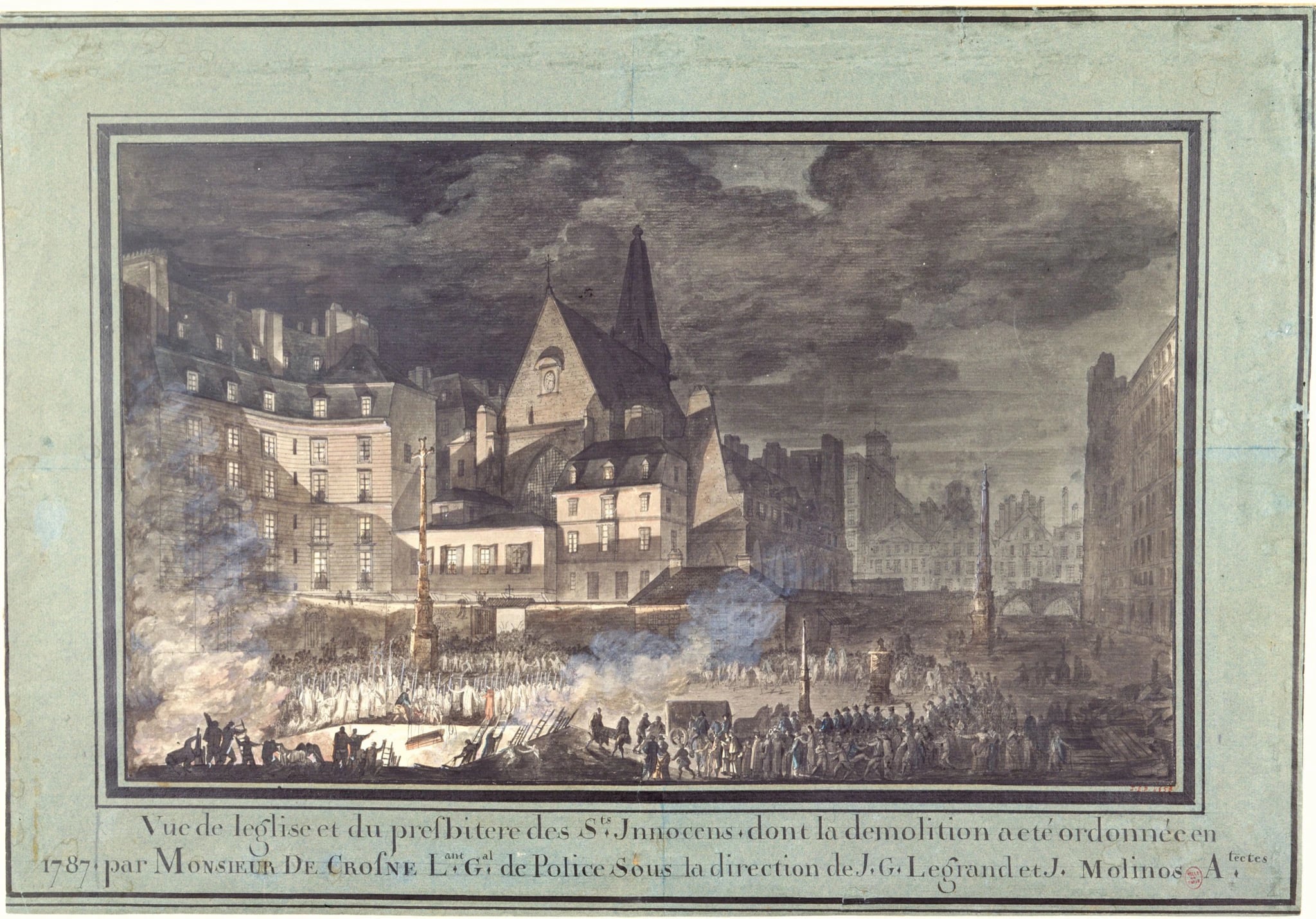
The rite stopped at the quarry. The carts drew up at a stone-extraction shaft — the well the quarrymen had used to bring rock to the surface, at what is now 21 avenue René-Coty — and the loads went over the lip. Twenty metres down, quarrymen barrowed and heaped them along the galleries. There was no arrangement and no order to any of it. Once Les Innocents was clear the church came down in 1787, and the ground became a herb and vegetable market.
The administration judged the experiment a success and generalised it. Every other churchyard cemetery in Paris was emptied in turn until January 1788, and further clearances ran from 1787 to 1814 and again from 1842 to 1860 — seventeen cemeteries, a hundred and forty-five religious houses, a hundred and sixty places of worship. More than six million people are in the galleries, several times the number of the living above them. The Bastille fell three years and three months after the consecration, and the Revolution’s own dead went down the same holes in their turn — Danton, Robespierre, Lavoisier among them — to lie indistinguishably among the medieval dead of Les Halles.
Why the Paris catacombs have walls of stacked skulls
A heap in a mine was not what visitors came to look at, and visitors started coming almost immediately. The first on record went down in 1787: the comte d’Artois, the future Charles X, with ladies of the court. Irregular public descents began in 1806, and a system of admission by appointment in 1809.
The place they were eventually shown is the work of Louis-Étienne Héricart de Thury, who took over the Quarry Inspection in 1810. Between then and 1814 he had the heaps sorted and faced into retaining walls of skulls and long bones, set plaques recording which cemetery each section had come from, and added the inscriptions and memorial columns that give the ossuary its funereal-classical character; he published a description of the works in 1815. What a visitor photographs today is his composition, laid over Guillaumot’s engineering — the empire of the dead, the descent, the thing a Parisian takes a visitor to see. In 1786 none of it was there.
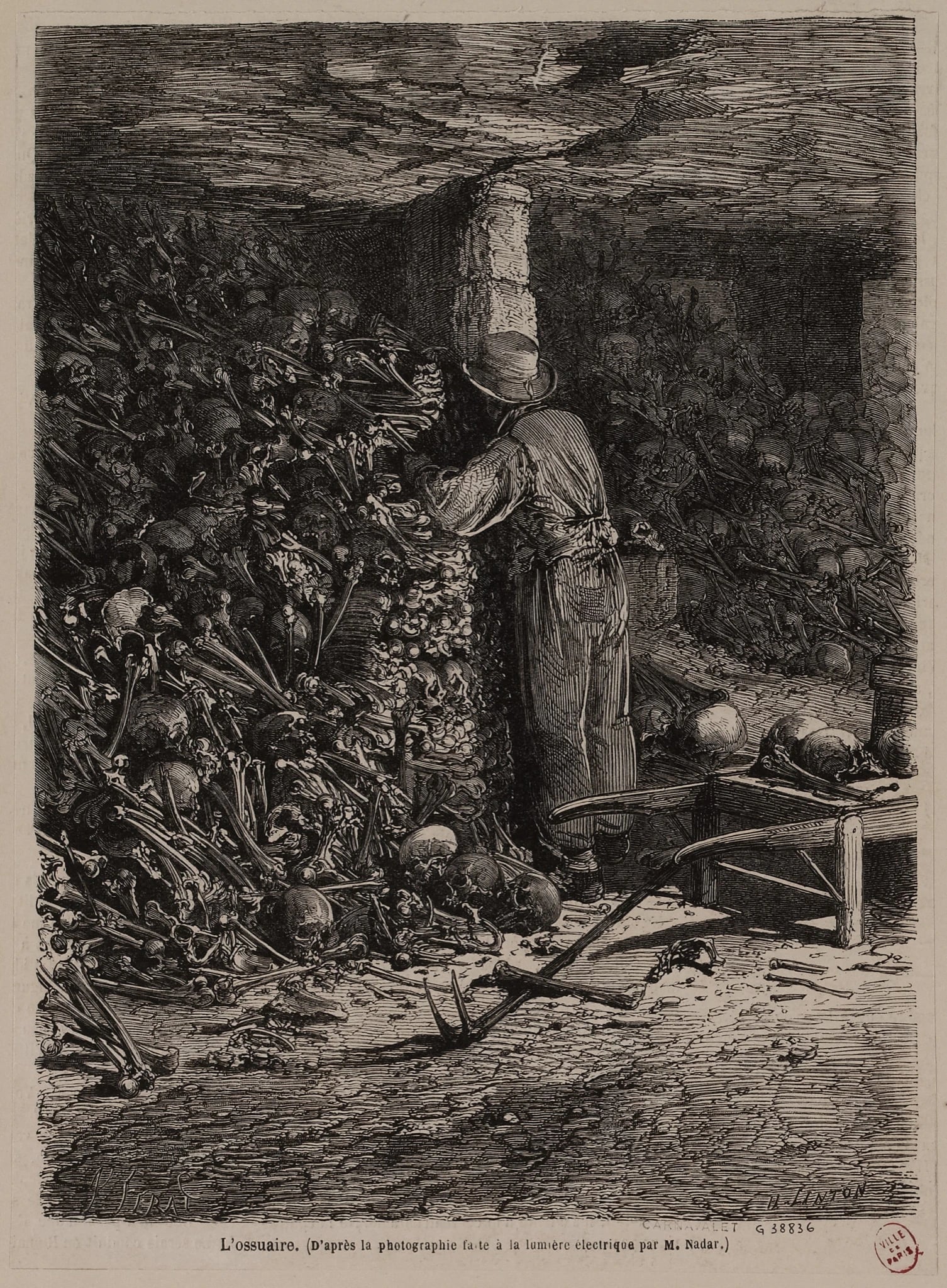
What is left of it in Paris today
The plain of Montrouge is the fourteenth arrondissement. It stopped being open country on 1 January 1860, when the ring of communes around Paris was annexed in the middle of the rebuilding Baron Haussmann had begun as prefect of the Seine on 22 June 1853 — a rebuilding that was only possible because Guillaumot’s successors knew where the holes were.
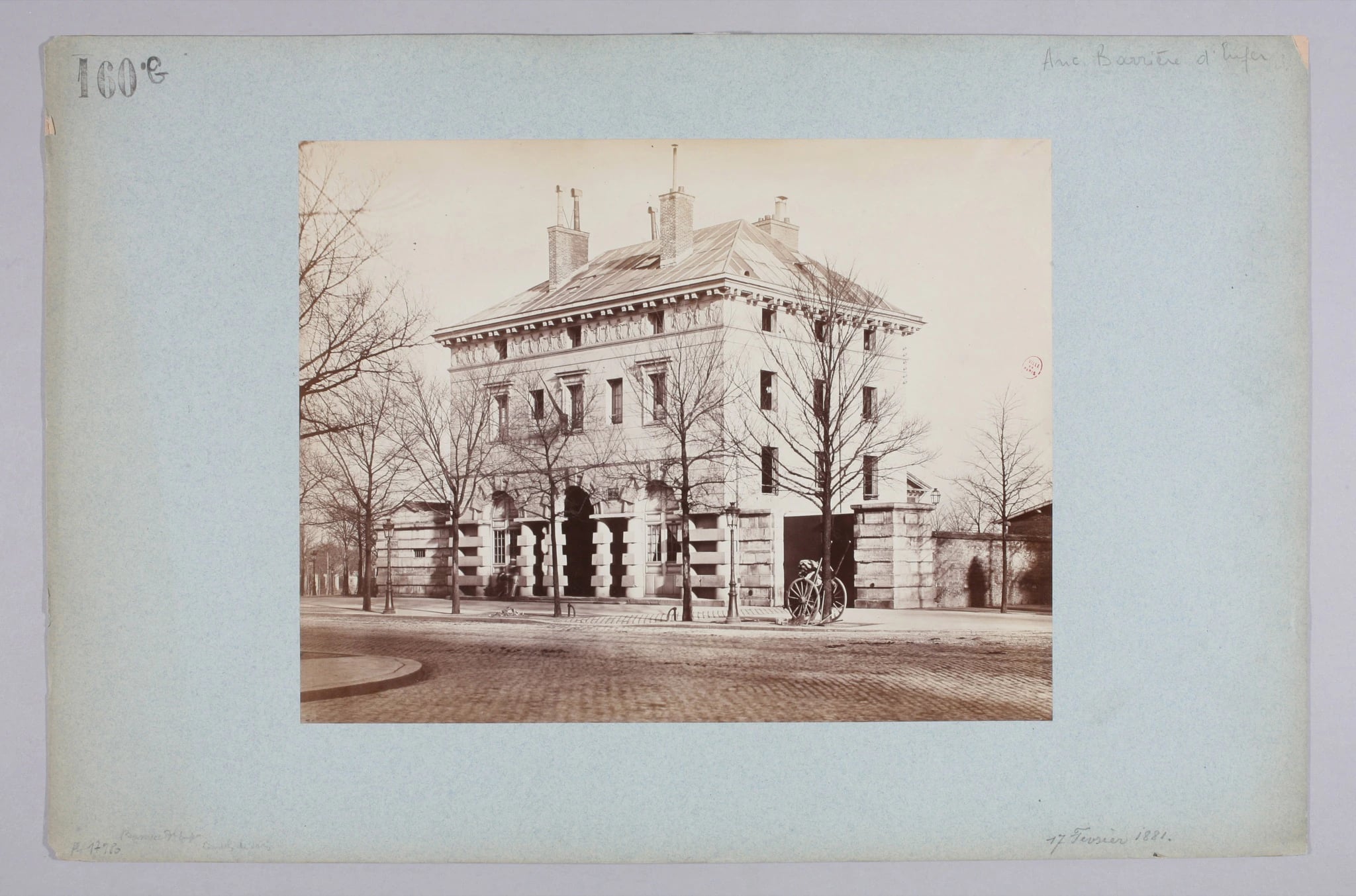
The customs barrier the carts passed through is the place Denfert-Rochereau, and the two pavilions on it are among only four survivors of the fifty-five gates in the old wall. The visit below is 131 steps down and 112 back up, about twenty metres beneath the street, along a circuit of roughly 1.5 kilometres through Guillaumot’s enclosure — a fraction of one percent of the tunnel network under the city. Les Innocents is now the place Joachim-du-Bellay, beside the shopping centre at Les Halles. The Renaissance Fontaine des Innocents still stands on it. Nothing else does.
And somewhere off the tourist route, under the rue Henri-Barbusse, there is a grave. Philibert Aspairt, a doorkeeper at the Val-de-Grâce hospital, went down a staircase into the quarries on the evening of 3 November 1793 and did not come back up. His body was found eleven years later, identified by the ring of hospital keys on his belt, and buried where it lay on 30 April 1804. Of the six million people in the catacombs he is the only one who went down of his own accord, and the only one with a grave of his own.
Sources
- Catacombes de Paris — Site history — the operator’s own chronology: the quarry inspection of 4 April 1777, the 1780 closure, the benediction of 7 April 1786, night transport and the two dumping wells, and Héricart de Thury’s work of 1810–1814
- Catacombes de Paris — History — the site figures: twenty metres down, 131 steps down and 112 up, an 11,000 m² enclosure and a circuit of about 1.5 km
- Catacombes de Paris — French Wikipedia — the abbés Motret, Maillet and Asseline, the architects Legrand and Molinos and Guillaumot at the consecration; the order of the King’s Council of 9 November 1785; the rite of the night convoys and the extraction well at 21 avenue René-Coty; the fifteen-month transfer; the totals of cemeteries and remains; the name borrowed from Rome
- Catacombs of Paris — English Wikipedia — the rue d’Enfer collapse of 1774, the law of late 1785, the ceremony of 7 April 1786 and the nightly black-draped processions
- Holy Innocents’ Cemetery — Wikipedia — twenty-two parishes, pits of about 1,500, the charniers, the ban of 1765, the Danse Macabre of 1424–25 and its destruction in 1669, the edict of 4 September 1780, the demolition of 1787 and the market that replaced it
- The Dark Origins of the Paris Catacombs — HISTORY — the 1774 sinkhole, the 1777 inspection, the cellar gases and the illnesses on the rue de la Lingerie, and the start of the night transfers
- L’exhumation des ossements du cimetière des Innocents, vers 1787 — Musée Carnavalet — the museum record for Sobre’s contemporary drawing of the clearance, used here as the hero image
- Erin-Marie Legacey, Making Space for the Dead: Catacombs, Cemeteries, and the Reimagining of Paris, 1780–1830 (Cornell University Press, 2019) — the standard modern scholarly account of what the ossuary meant to the city that built it
- Héricart de Thury, Description des catacombes de Paris (1815) — the man who arranged the ossuary describing his own work, with a history of its creation
- Wall of the Farmers-General — Wikipedia — the customs wall begun on the Left Bank in 1784, its fifty-five gates and the four that survive
- Barrière d’Enfer — French Wikipedia — the two toll pavilions built in 1787 — a year after the consecration — and what occupies them today
- Haussmann’s renovation of Paris — Wikipedia — Haussmann’s appointment on 22 June 1853 and the annexation of the surrounding communes on 1 January 1860
- Philibert Aspairt — Wikipedia — his disappearance on 3 November 1793, the recovery of his body eleven years later and his grave in the quarries
- Philibert Aspairt — French Wikipedia — the stele’s inscription, which gives 30 April 1804 as the date he was buried where he was found


