A Timeslip story
The ninety-five theses are real. Nobody can prove Martin Luther nailed them to a door.
He was thirty-three, a friar and a professor in a town of two thousand people, and the argument he wanted was an academic one, conducted in Latin. What he got was the first mass-media event in European history — and a scene, hammer raised at a church door, that nobody alive at the time ever described.


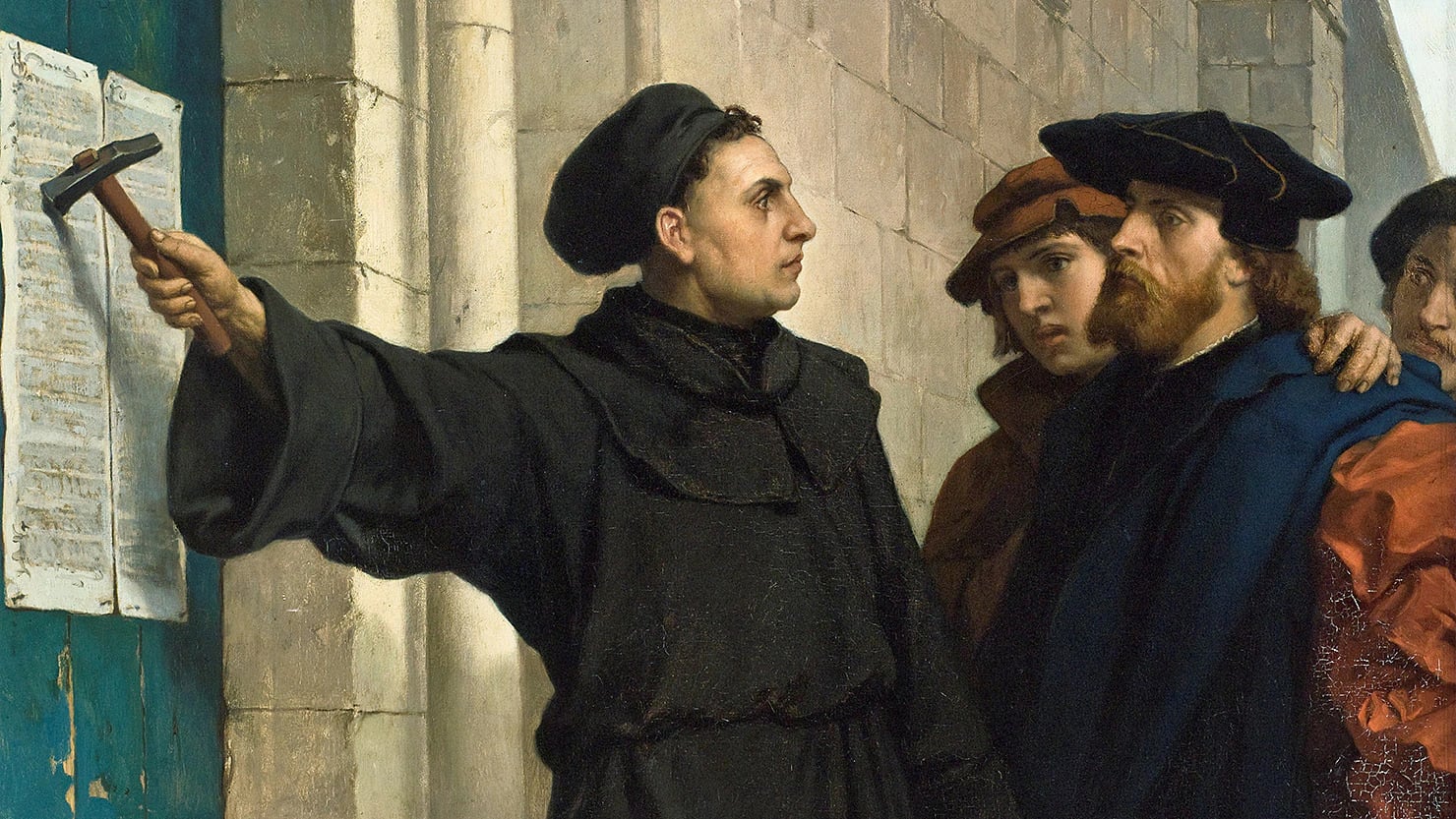
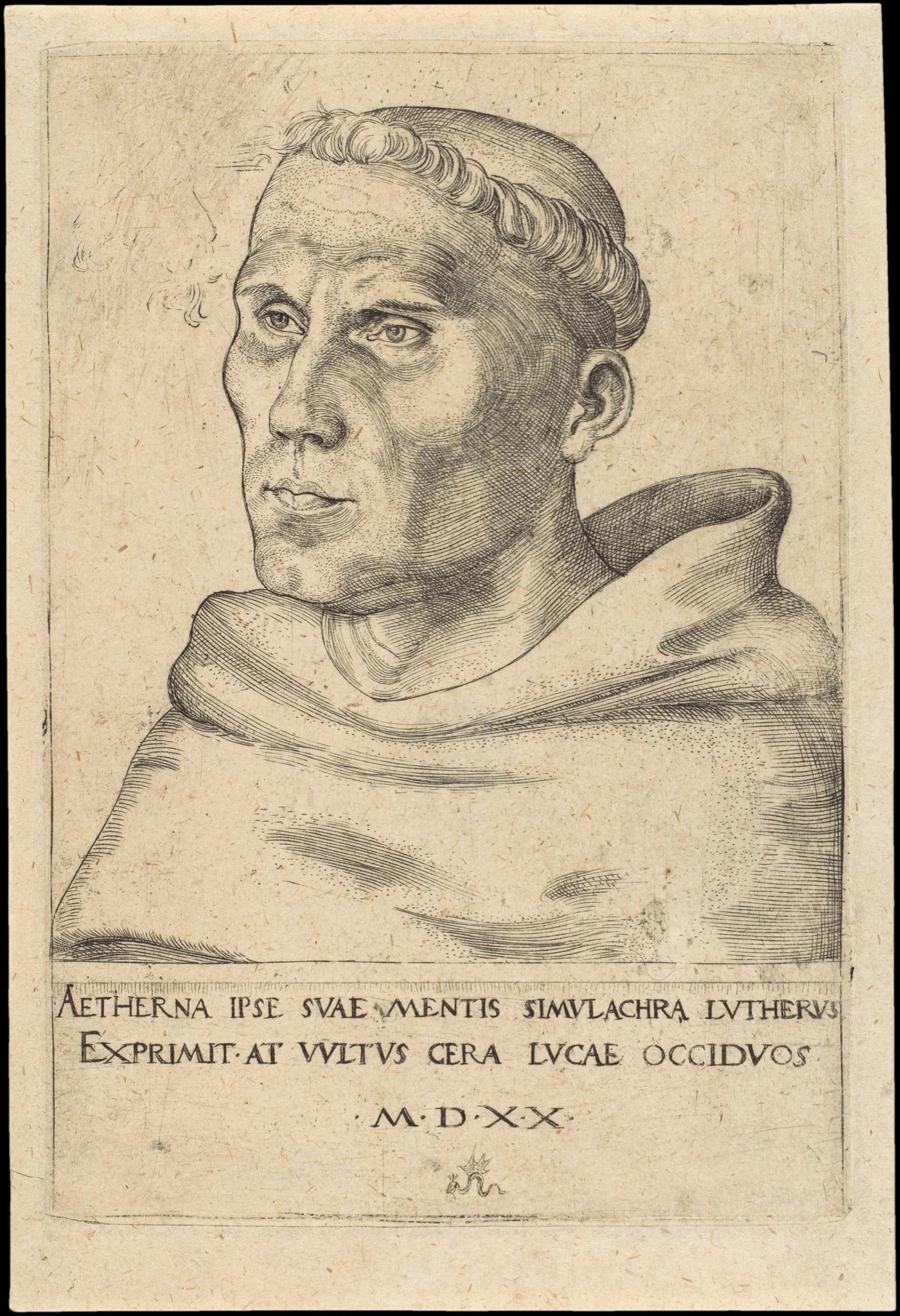
The part nobody argues about is the letters. On the eve of All Saints' Day 1517, an Augustinian friar in the Saxon town of Wittenberg sent a letter to Albrecht of Brandenburg, Archbishop of Mainz, and another to his own diocesan bishop at Brandenburg. Enclosed with each was a sheet of ninety-five short propositions in Latin about the sale of indulgences, offered for academic debate, with an invitation to anyone who could not come and argue in person to do it by correspondence instead.
His name was Martin Luther. He was thirty-three — he would turn thirty-four on 10 November — and professor of theology at a university founded fifteen years earlier in a town of about two thousand people on the sandy north bank of the Elbe. His own verdict on the place, in a letter, was that it stood in termino civilitatis — on the edge of civilisation. He had published nothing anyone outside Saxony had read.
Eight weeks earlier he had put up ninety-seven theses attacking scholastic theology, and nothing whatever had happened. This time somebody had the sheet printed. Within four years Luther had been excommunicated by the pope, declared an outlaw by the emperor and hidden in a castle by his own prince, and the Western church never reassembled. And the one image that carries all of it — friar, hammer, church door — rests on a claim nobody who was in Wittenberg in 1517 ever made.
What indulgences were, and where the money went
An indulgence did not forgive a sin. Sin was forgiven in confession; what an indulgence remitted was the temporal punishment left over, to be worked off in penance here or in purgatory afterwards. The church held that it possessed a treasury of surplus merit accumulated by Christ and the saints, and that the pope had the authority to draw on it. By 1517 the theory had been comprehensively overtaken by the practice, which was a fundraising instrument with printed certificates, regional sales targets and preachers working on commission.
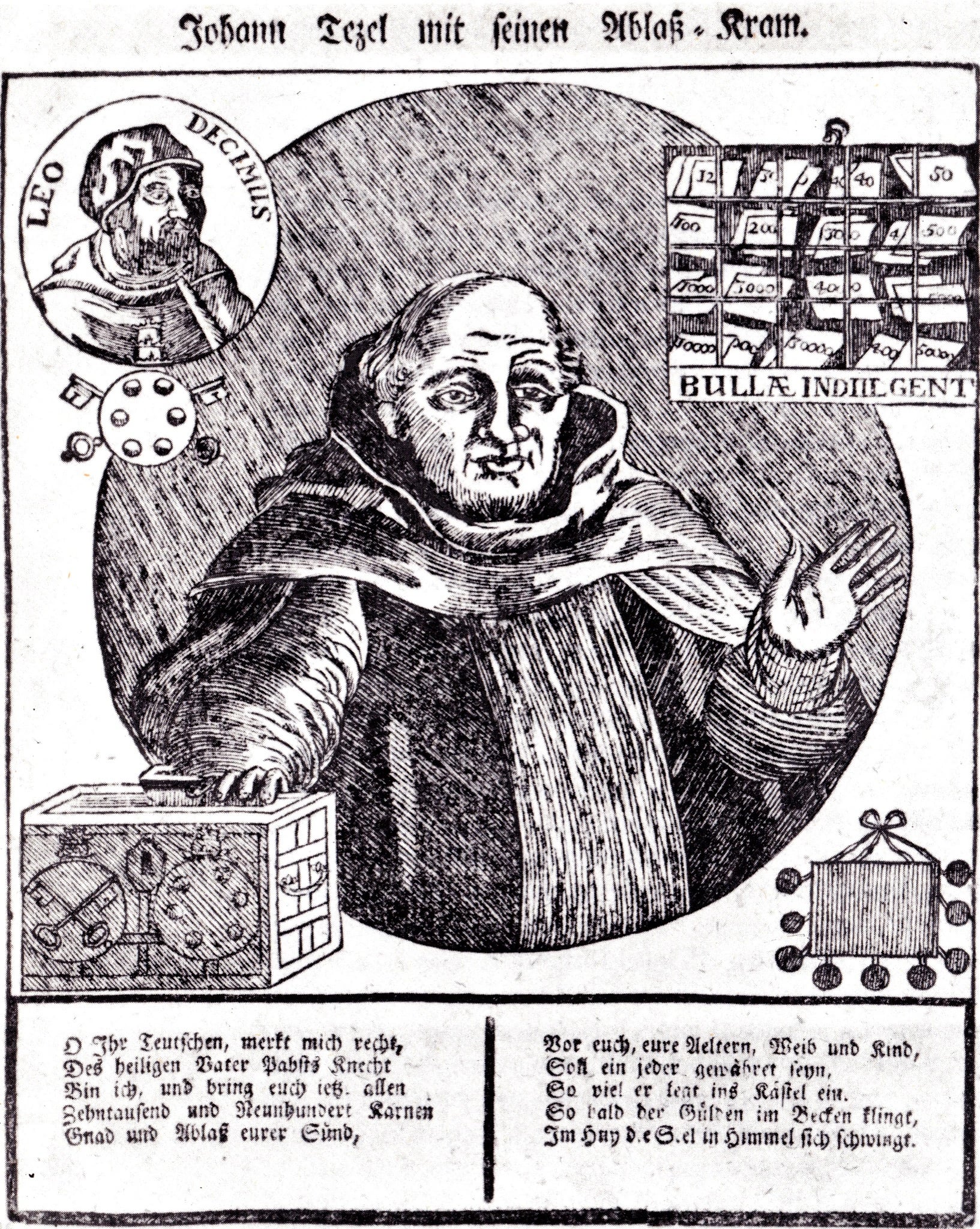
Leo X authorised a plenary indulgence for the rebuilding of St Peter's in 1515. Half the German proceeds went to Rome. The other half went to Albrecht of Brandenburg, who was already Archbishop of Magdeburg when he took Mainz as well in 1514 — a plurality canon law forbade — and who had borrowed something like twenty-four thousand ducats from the Fugger bank in Augsburg to pay for the appointment and the dispensation that made it legal. Fugger agents travelled with the preachers and took their cut off the top. The best known of those preachers was a Dominican named Johann Tetzel, made commissioner in January 1517, to whom the couplet about the coin in the coffer and the soul springing out of purgatory is attributed — probably wrongly, though it is a fair summary of what people heard.
Tetzel never preached in Wittenberg, and could not: Frederick the Wise had barred the St Peter's indulgence from Electoral Saxony, on the entirely commercial grounds that it competed with his own. So Tetzel worked the territories over the border — Jüterbog, about forty kilometres north, and Zerbst, about forty west — and Luther's parishioners walked over, bought, and then turned up in his confessional with a receipt, declining to repent of anything on the grounds that they had already paid. That is how the sales reached him at all.
Why the eve of All Saints' Day mattered
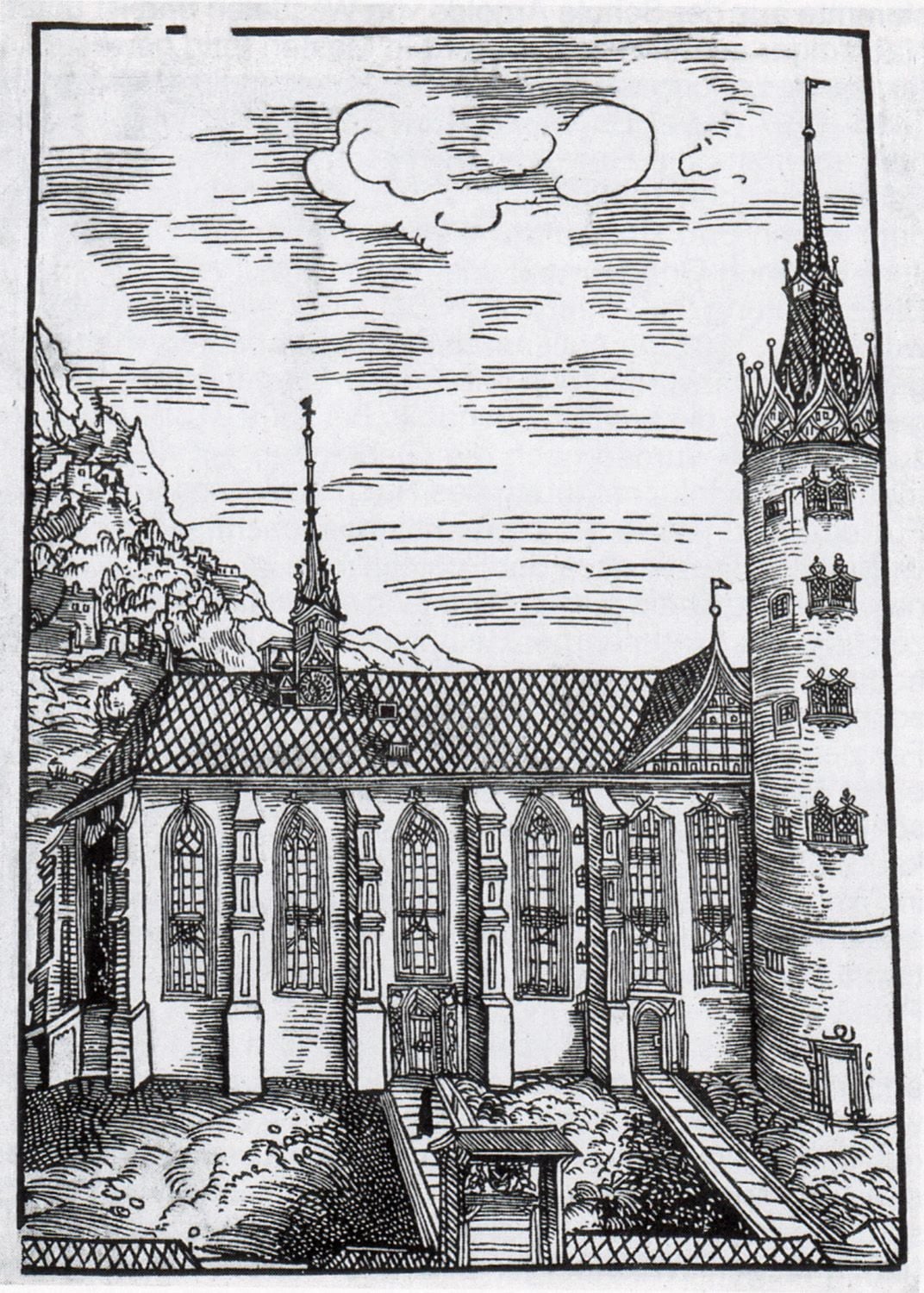
The indulgence Frederick was protecting was attached to the relic collection housed in the Castle Church, and it was one of the largest in Europe. The catalogue of 1509, illustrated with woodcuts by Lucas Cranach the Elder, lists 5,005 pieces; the inventory of 1518 lists 17,443, and the collection passed nineteen thousand by 1520. It included a thumb of St Anne, straw from the manger, and milk of the Virgin. Venerating the whole of it, properly and in order, was reckoned to be worth 1,902,202 years off purgatory.
It went on public display once a year, on All Saints' Day, 1 November. Which is what makes the eve of it, if the timing was a choice at all, so pointed: whatever went up on that door on 31 October would be read the next morning by the largest and most indulgence-minded crowd the town assembled all year. The relics were shown for the last time in 1522.
What the ninety-five theses actually say
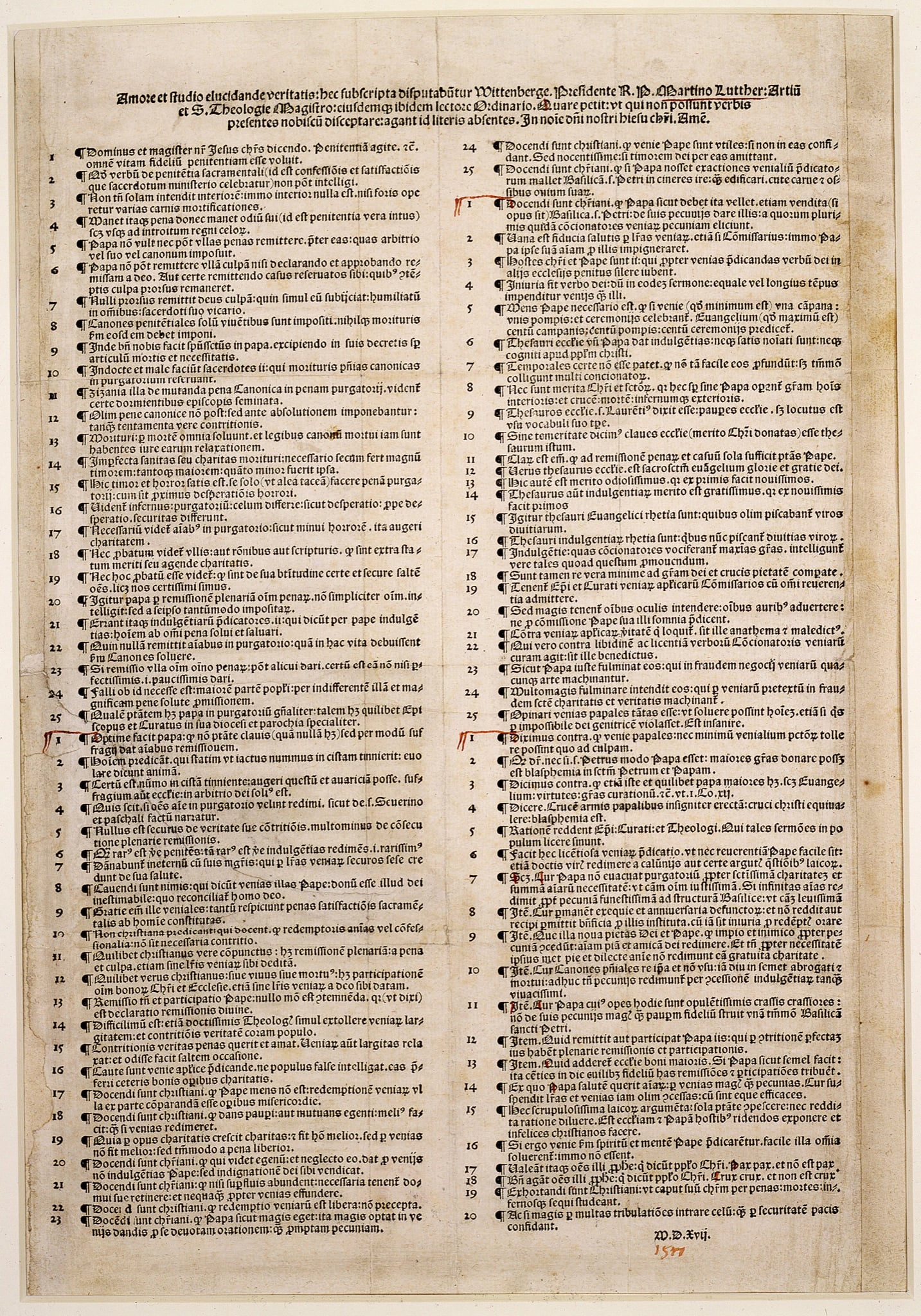
They are ninety-five short Latin propositions for an academic debate, and they are a good deal less radical than their reputation. Luther does not deny the pope's authority. He attacks the sale, the certainty being promised with it, and the pastoral damage. Thesis 1 sets the frame: when Christ said poenitentiam agite, “he willed that the whole life of believers should be repentance” — a condition, not a transaction you complete. Thesis 27 goes straight at the sales pitch: “They preach man who say that so soon as the penny jingles into the money-box, the soul flies out of purgatory.” Thesis 62 says what he thinks the church's real treasure is: “the Most Holy Gospel of the glory and the grace of God.”
It is the awkward questions near the end that got repeated in taverns. Why does the pope not simply empty purgatory out of love, rather than for money to build a church? And thesis 86, the one that travelled furthest:
Why does not the pope, whose wealth is to-day greater than the riches of the richest, build just this one church of St. Peter with his own money, rather than with the money of poor believers?
Thesis 86, the Ninety-five Theses, 1517
Did Martin Luther really nail them to the door?
The story first appears in print in 1546, in Philip Melanchthon's preface to a volume of Luther's Latin works, written months after Luther's death — and Melanchthon did not arrive in Wittenberg until 1518, so he was not a witness. Luther himself, who was not a shy man, never described nailing anything to a door; his own account is the letter to the bishops. Nor did anyone record the hour. The familiar detail that it happened around midday comes from the church historian Heinrich Boehmer, writing about 1900 in confident circumstantial detail and citing no source whatever for it. In 1961 the Catholic historian Erwin Iserloh argued that the posting never happened at all, and a great many scholars accepted it.
Then in 2006 Martin Treu found, in the university library at Jena, a note in the hand of Luther's secretary Georg Rörer, written around 1544: in 1517, on the eve of All Saints, theses on indulgences were posted on the doors of the Wittenberg churches by Doctor Martin Luther. It is the closest thing to corroboration that exists. But Rörer was not in Wittenberg in 1517 either, and Volker Leppin has argued that the note is better read as a stage in the growth of the legend than as a witness to the fact.
What can be said is that the act would have been utterly ordinary. Church doors were the university's noticeboard, and the statutes expected a disputation's theses to be posted; if it was done, the beadle may well have done the actual nailing rather than the professor. No manuscript of the theses in Luther's hand survives either. There is no eyewitness on either side of the question, and there probably never will be.
How ninety-five Latin theses reached the whole of Germany
Because somebody had them printed. By December 1517 the Latin text was out as broadsides from Jakob Thanner in Leipzig and Hieronymus Höltzel in Nuremberg, and as a quarto pamphlet from Adam Petri in Basel — perhaps three hundred copies of each, of which a handful survive. German translations followed. Luther's friend Friedrich Myconius wrote later that hardly a fortnight had passed before the propositions were known throughout Germany, and four weeks before almost all of Christendom had them. That is a recollection rather than a measurement, but the direction of it is right.
What followed was the first mass-media event in European history, and Luther turned out to be extraordinarily good at it. By the end of 1522 he had written some 160 works, published in 828 editions. In the decade after 1517 his own writing accounted for around a fifth of everything printed in Germany, and in the years 1521 to 1525 the German lands produced roughly one book in every two printed in Europe — four-fifths of them, unusually for the period, not in Latin.
What happened to Luther in the four years after
Cardinal Cajetan interrogated him at Augsburg in October 1518 and got nothing. Johann Eck manoeuvred him at the Leipzig debate of 1519 into conceding that church councils could err, which was the real heresy. In 1520 the bull Exsurge Domine gave him sixty days to recant; he burned it in public at Wittenberg on 10 December, and was excommunicated on 3 January 1521. On 18 April 1521, before the Emperor Charles V at the Diet of Worms, he refused to take any of it back — bound, he said, by the scriptures he had quoted, his conscience captive to the Word of God. (“Here I stand, I can do no other” is a later embellishment.)
The Edict of Worms made him an outlaw whom anyone might kill. Frederick the Wise, who never once met him face to face and dealt with him entirely through a secretary, had him ambushed on the road home by his own men and hidden in the Wartburg, where he grew a beard, called himself Junker Jörg, and translated the New Testament into German in about eleven weeks. Then the movement went where he did not want it to go. The Peasants' War of 1524 to 1525 borrowed his language of Christian freedom, and he wrote Against the Robbing and Murdering Hordes of Peasants urging the princes to cut them down, which they did, killing something like a hundred thousand people. The Empire did not settle its religion until the Peace of Augsburg of 1555, which let each prince choose the confession of his own subjects.
He also wrote, in 1543, On the Jews and Their Lies — burn the synagogues, raze the houses, seize the books — a text of such violence that it was reprinted with enthusiasm by the Nazis four centuries later. It is not a marginal aberration, the German Protestant churches have spent decades reckoning with it, and any account of what came out of that door has to carry it.
Is the door at Wittenberg the original?
No. On the night of the bombardment of Wittenberg in 1760, during the Seven Years' War, Imperial artillery set the Prussian-held town alight and the Castle Church burned; the wooden portals went with it. The doors there now are bronze, cast for Luther's 375th birthday and installed on 10 November 1858, with the Latin text of all ninety-five theses on them — a monument to a document, on the site of an argument nobody can prove took place. The church around them was rebuilt again in 1885 to 1892, when the tower acquired the crown it has now.
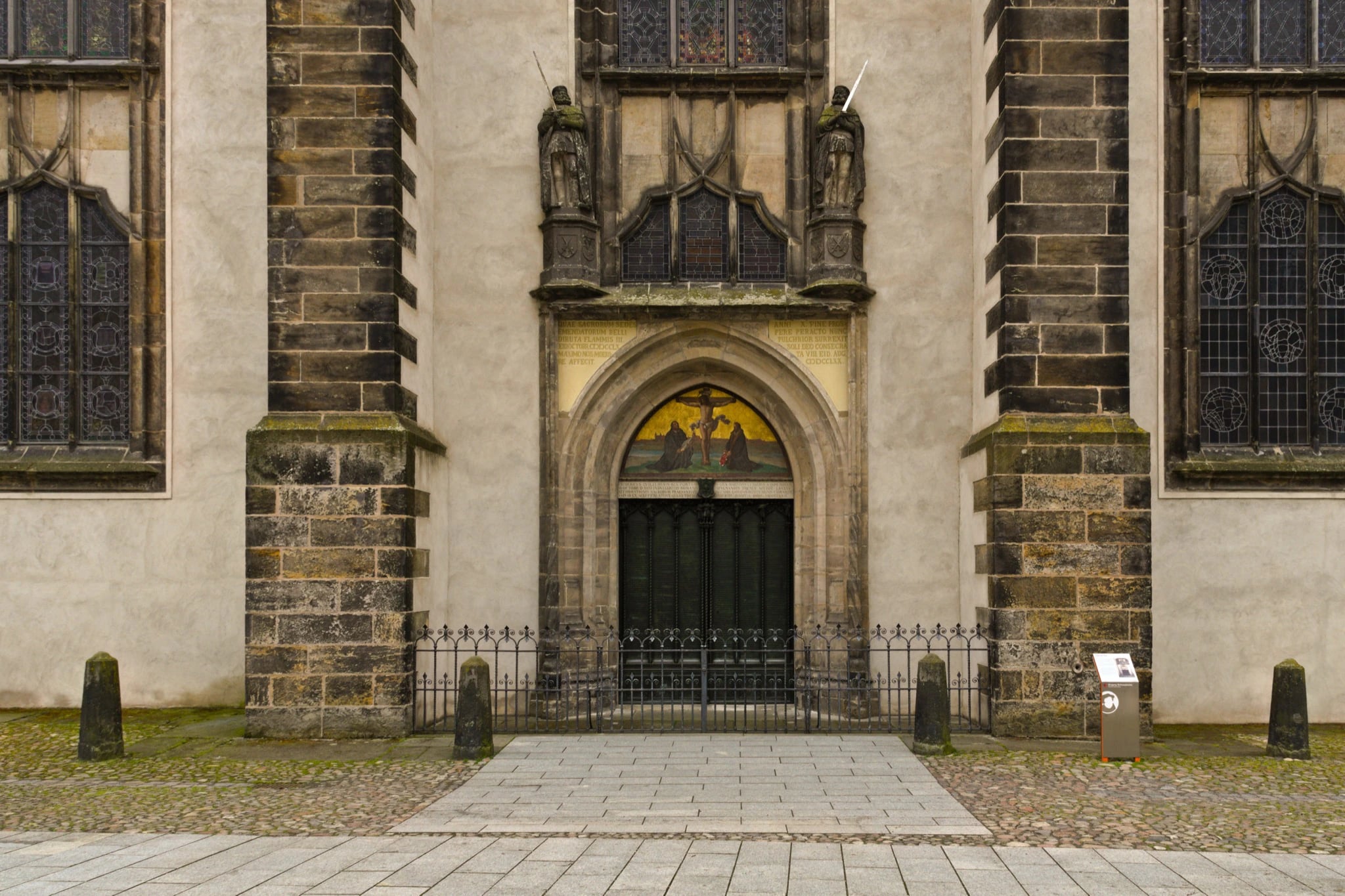
Luther died at Eisleben on 18 February 1546, in the town he was born in, and was buried in the Castle Church in front of the pulpit. Wittenberg is officially Lutherstadt Wittenberg now, about forty-five thousand people and a UNESCO World Heritage site since 1996. On 31 October it fills up all over again.
Sources
- Ninety-five Theses — Wikipedia — the letters of 31 October 1517, the printing history, and the dispute over the posting
- Martin Luther — Wikipedia — the life: Eisleben 1483, Erfurt 1505, the Wittenberg chair from 1512, the Wartburg, Eisleben 1546
- Disputation on the Power and Efficacy of Indulgences (Works of Martin Luther, vol. 1) — Wikisource — the English text quoted here for theses 1, 27, 62 and 86
- Martin Luthers Thesenanschlag ist unter Historikern umstritten — EKD — Iserloh 1961, Treu's 2006 find of the Rörer note, and Boehmer's unsourced “about noon”
- Volker Leppin, Sources for and against the Posting of the Ninety-Five Theses (PDF) — Universität Tübingen — the case for reading the evidence as a legend forming rather than a record surviving
- Volker Leppin, Geburtswehen und Geburt einer Legende: zu Rörers Notiz vom Thesenanschlag (PDF) — Universität Tübingen — the Rörer note in detail
- Johann Tetzel — Wikipedia — the commission of January 1517 and the attribution of the couplet
- Johann Tetzel — Britannica — Jüterbog and Zerbst, and Frederick the Wise's ban on the St Peter's indulgence in Saxony
- Albert of Brandenburg — Wikipedia — Magdeburg and Mainz, the Fugger loan, and the half share of the German proceeds
- Frederick III, Elector of Saxony — Wikipedia — the relic collection, the university of 1502, and a prince who never met Luther face to face
- Wittenberg Reliquary Book (Wittenberger Heiligthumsbuch), 1509 — Art Institute of Chicago — the 1509 catalogue of the relics, with Cranach's woodcuts
- All Saints' Church, Wittenberg — Wikipedia — the church, the 1760 fire and the bronze doors of 1858
- Schlosskirche (Lutherstadt Wittenberg) — Wikipedia (German) — the building history: consecrated 1503, burned 1760, rebuilt 1885–92
- The 95 Theses — a Tale of Survival — The London Library — the December 1517 printings and how few survive (the Leipzig printer is Jakob Thanner, not Joseph as this page has it)
- The three oldest prints of Martin Luther's Ninety-Five Theses — Luther in Oxford — Thanner, Höltzel and Petri, and the absence of any surviving Wittenberg printing
- Ninety-five Theses, printed by Hieronymus Höltzel at Nuremberg, 1517 — Staatsbibliothek zu Berlin, via Wikimedia Commons — the surviving Berlin broadside, found in a London bookshop in 1891
- Medium and message in Luther's reformation (on Andrew Pettegree, Brand Luther) — Acton Institute — the 160 works in 828 editions by the end of 1522
- The printing press and the Protestant Reformation — World History Encyclopedia — Pettegree's figures: a fifth of German printing, one book in two in Europe, four-fifths in German
- Diet of Worms — Wikipedia — 18 April 1521, the Edict of 25 May, and “Here I stand” as a later addition
- Luther's Bible translations, 1522 — The Gruber Collection, LSTC — the New Testament translated at the Wartburg in about eleven weeks
- German Peasants' War — Wikipedia — 1524–25, Luther's pamphlet against the peasants, and the scale of the killing
- On the Jews and Their Lies — Wikipedia — the 1543 text and its twentieth-century reprinting
- Peace of Augsburg — Wikipedia — the settlement of 25 September 1555
- Wittenberg — Wikipedia — the town then and now: the Elbe, the single street, Lutherstadt, the World Heritage listing
- Martin Luther: Renegade and Prophet, by Lyndal Roper — sample chapter (Library of Congress) — Luther on Wittenberg as in termino civilitatis, on the edge of civilisation


_1.jpg)