A Timeslip story
The Eiffel Tower went up with an expiry date
Gustave Eiffel climbed 1,710 steps to raise a flag over the tallest thing human beings had ever built. His permission to leave it standing there was already running out.


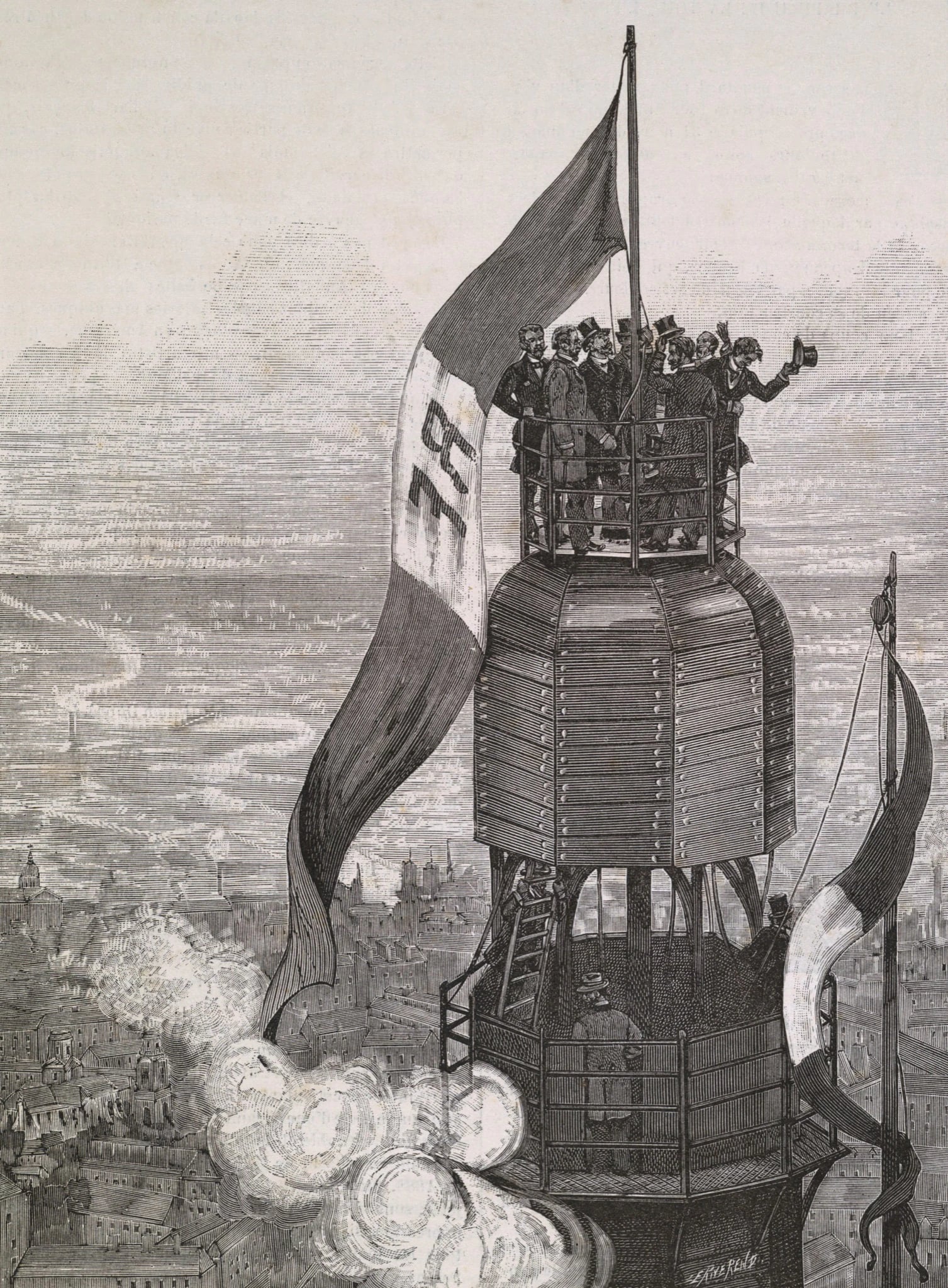
The lifts were not working, so everybody walked. Gustave Eiffel was fifty-six and dressed for a ceremony, in a frock coat and a top hat, and in front of him were 1,710 steps up the inside of a structure that had never been climbed to the top, because until that week it had not had one.
The climb took over an hour. Officials, engineers and journalists started up with him after a lunch for around two hundred of the workmen who had spent two years riveting the thing together, and most of them gave out at the lower platforms. A few finished: Émile Nouguier, one of the two engineers whose sketch the tower had begun as, and Jean Compagnon, who had run the construction. At about twenty-five to three on the afternoon of 31 March 1889, Eiffel hauled an enormous tricolore up the flagpole while guns fired a salute far below, and the tallest structure human beings had ever built was finished.
Back at the base, the prime minister, Pierre Tirard, announced that Eiffel was to be made an Officer of the Légion d'honneur, and a thousand francs was shared out among the workmen. It was a good afternoon for a man who had put most of his own fortune into a pile of iron on the Champ de Mars. It was also the start of a clock: the agreement that let Eiffel stand the tower there ran for twenty years, and when they were up the city of Paris meant to take it down and sell the metal.
Who actually designed the Eiffel Tower
Not Eiffel, in the first instance. In May 1884 two senior engineers at his company, Maurice Koechlin and Émile Nouguier, worked up an idea for the world's fair France was planning for 1889: a great pylon of four lattice girders, splayed apart at the base and curving in to meet at the top. Eiffel was not interested.
What changed his mind was architecture. Stephen Sauvestre, who ran the firm's architectural department, dressed the engineers' skeleton up — most visibly with the decorative arches that ring the base and give the tower the outline people draw from memory. Eiffel then took it very seriously indeed. He bought the rights to the patent the three men had taken out, and put the whole weight of his company behind it.
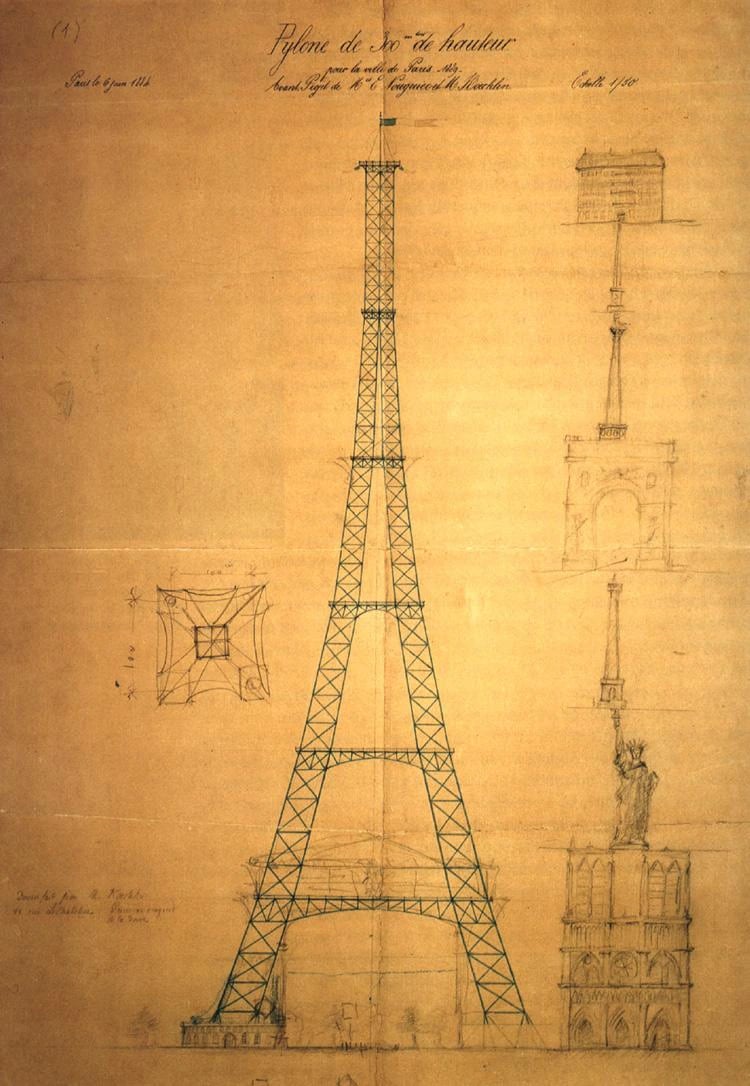
The tower carries his name because he bought it and because he carried the risk. The contract signed in January 1887 gave him a subsidy of 1.5 million francs against an estimated cost of about 6.5 million. The rest was his own money, and his repayment was written into the same document: every franc of commercial income from the tower during the fair, and for twenty years afterwards. It was one of the shrewdest bets in the history of engineering, and the expiry date came attached to it.
Why French artists tried to stop the Eiffel Tower
Three weeks after the ground was broken, on 14 February 1887, the newspaper Le Temps ran a protest on its front page signed by some forty of the most celebrated names in French culture. The composer Charles Gounod. The writers Guy de Maupassant and Alexandre Dumas fils. The poets François Coppée, Leconte de Lisle and Sully Prudhomme. The painters William Bouguereau and Ernest Meissonier. Charles Garnier, who had built the Paris Opera.
…in the name of the underestimated taste of the French, in the name of French art and history under threat, against the erection in the very heart of our capital, of the useless and monstrous Eiffel Tower…
Protest by artists against the tower of Monsieur Eiffel, Le Temps, 14 February 1887
The insults went on for years, and they are better written than most criticism. Paul Verlaine called it a belfry skeleton; Léon Bloy, a truly tragic street lamp; Maupassant, the most persistent of them, a high and skinny pyramid of iron ladders. Residents of the Champ de Mars took Eiffel to court.
Eiffel answered on the ground the protest had chosen, which was beauty rather than engineering. "Are we to believe," he asked, "that because one is an engineer one is not preoccupied with the beauty in one's constructions?" The conditions that make a structure strong, he argued, obey rules of harmony of their own. Legend has it that Maupassant took to eating in the tower's own restaurant, on the grounds that it was the one place in Paris where he did not have to look at it.
How long it took to build the Eiffel Tower
Two years, two months and five days, counting from 26 January 1887. For the tallest structure ever attempted that is an absurd figure, and it was possible because the tower was less built than assembled.
Its 18,038 iron pieces were made in advance at Eiffel's workshop at Levallois-Perret on the edge of Paris, cut and drilled to tolerances of fractions of a millimetre, then carted to the Champ de Mars and joined by around three hundred men driving two and a half million rivets. The finished frame weighed 7,300 tonnes. It went up like an enormous kit of parts.
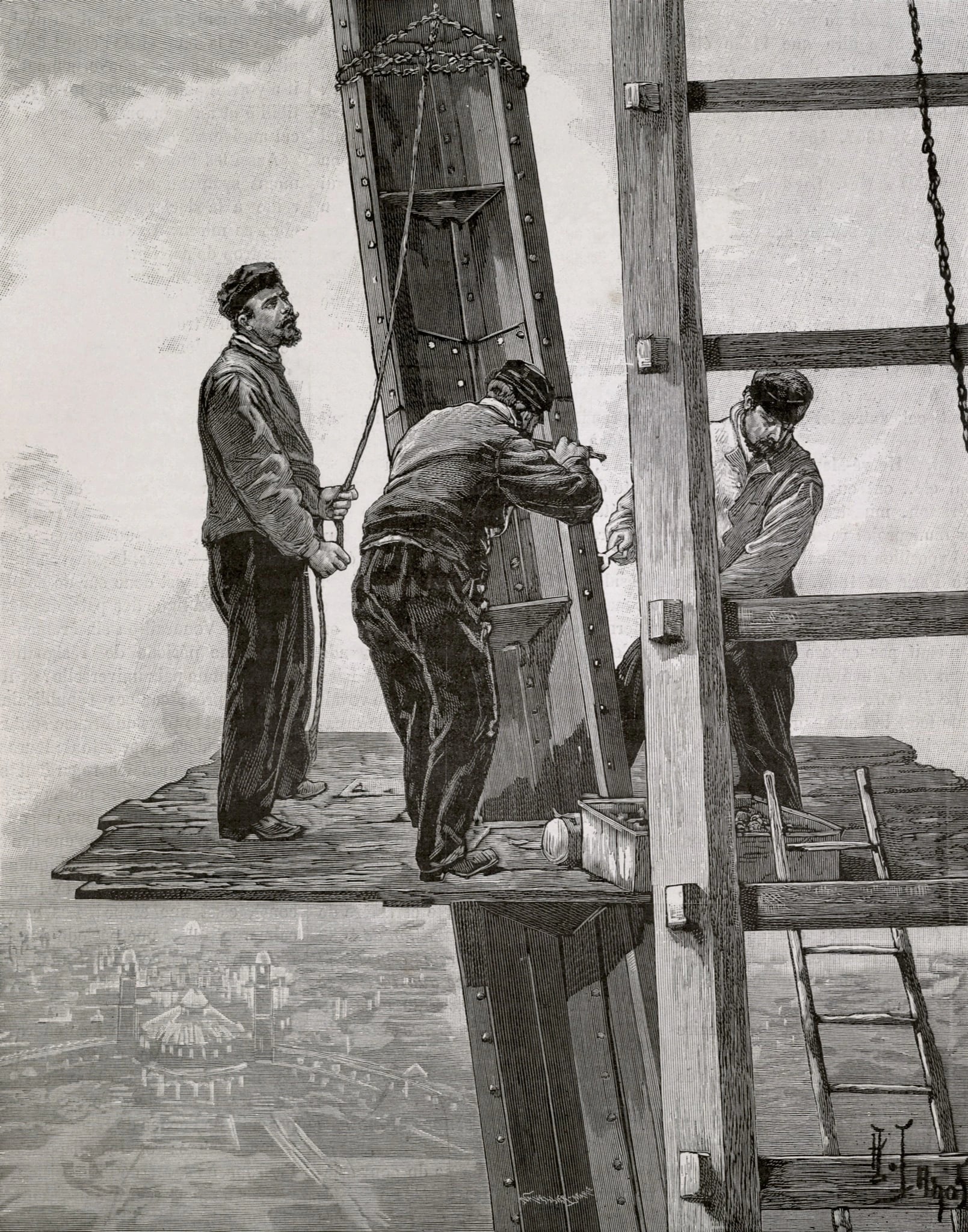
The safety record was extraordinary for a project of that scale and century. Eiffel used movable gangways, guardrails and screens, and one man died over the whole build — by most accounts off duty rather than out on the ironwork.
When it topped out at the end of March 1889 the tower was painted a reddish brown, and around the frieze of the first platform ran 72 names in gold letters: French scientists, engineers and mathematicians whose work, Eiffel said, had made the thing possible. It was a reply to Le Temps written in iron and paint, and it is still up there.
When the Eiffel Tower opened to the public
Not on the day the flag went up, and not when the fair opened either. The Exposition Universelle — timed to the centenary of the storming of the Bastille, and built to announce French industrial power to everybody else — opened on 6 May 1889 with the tower as its gateway and the tower not quite ready for visitors. The public was let in on 15 May; the lifts, an engineering problem in their own right because they had to climb the curve of the legs, not until 26 May.
It made no difference to demand. Nearly thirty thousand people paid to climb the 1,710 steps on foot before the lifts ran, and by the time the fair closed 1,896,987 had been up. Eiffel had built himself a small private apartment at the top, and its most famous guest arrived on 10 September 1889: Thomas Edison, who brought one of his new phonographs as a present and left a line in the visitors' book saluting "the brave builder of so gigantic and original specimen of modern Engineering."
How long the Eiffel Tower was the tallest structure in the world
Forty-one years — and it is worth pausing on how far ahead of the field it started. To the tip of its flagpole the tower stood 312 metres, or 1,024 feet, at a moment when the tallest structure on the planet was the Washington Monument at 169. The Eiffel Tower did not edge past the record. It very nearly doubled it. Nothing built in the previous five thousand years, no pyramid and no cathedral spire, had come close.
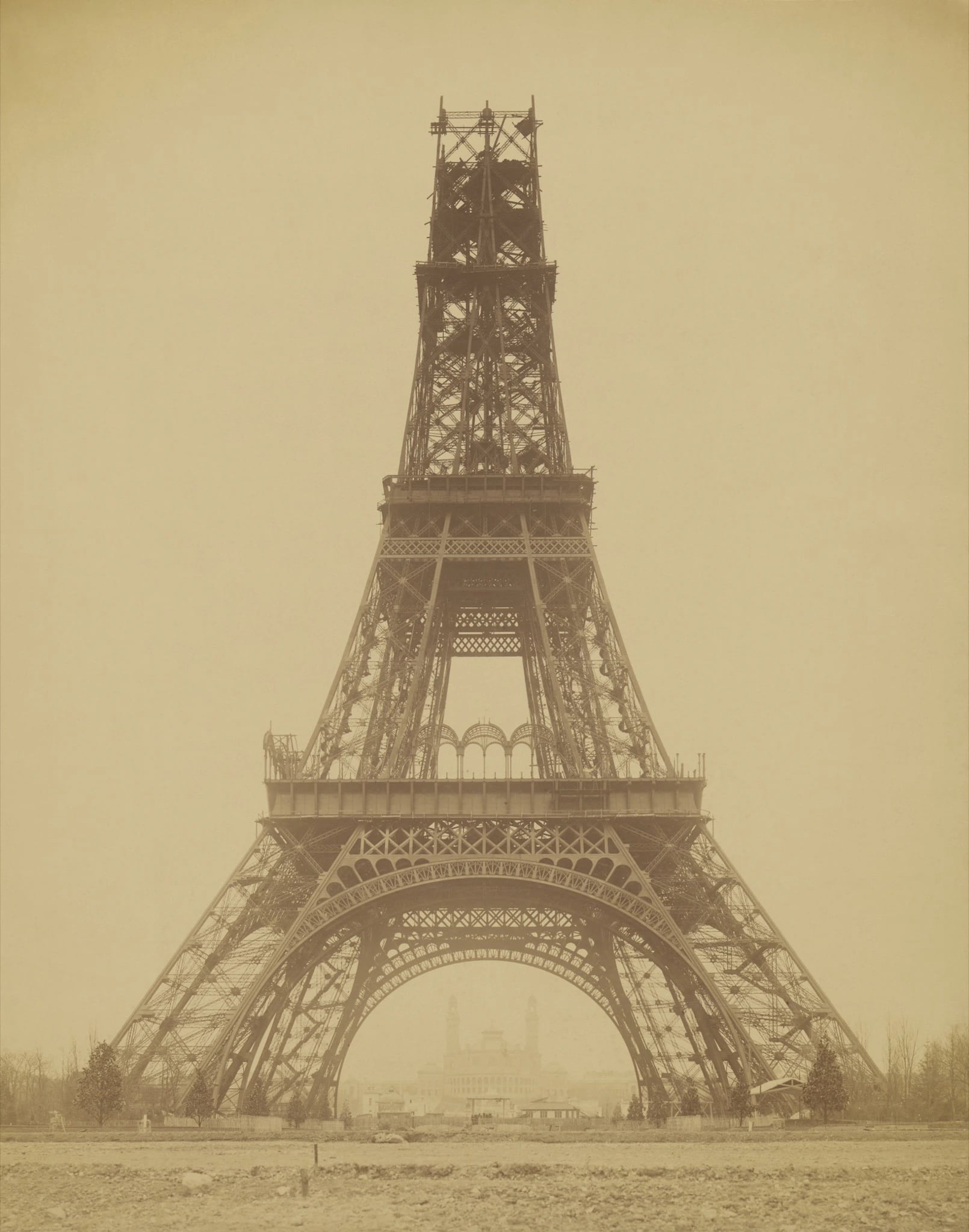
Nothing caught it for a generation, either. The challenger, when it came, was the Chrysler Building, whose spire was assembled in secret inside the crown and hoisted into place to take it to 319 metres in 1930. The tower had the last word anyway: a broadcasting aerial added in 1957 lifted it back above the Chrysler, and with its antennas it stands at around 330 metres today.
Why the Eiffel Tower was nearly demolished in 1909
Because the agreement said so. Twenty years on, ownership passed to the city of Paris, and the city's plan was to dismantle the tower and sell the iron. Eiffel spent those twenty years making that impossible — not by argument, which he had already lost once in Le Temps, but by making his tower useful to people whose opinion counted for more than a poet's.
He fitted it out for science: meteorological instruments at the summit, aerodynamic experiments down the height of it, studies of what low pressure does to the body. The tenant that saved it was invisible. In 1903 the military engineer Gustave Ferrié, working with Eiffel's encouragement and Eiffel's money, strung aerials from the summit for the new business of wireless telegraphy. The transmitting range went from 400 kilometres to 6,000 by 1908. The useless monstrosity was now the tallest antenna in the world and a strategic military asset.
It worked. On 1 January 1910 the concession was extended by seventy years, and the demolition never came. The tower repaid the favour during the First World War, when its radio station intercepted German military traffic — including, in March 1918, a coded radiogram that the cryptanalyst Georges Painvin broke after days of work, helping the French anticipate a German offensive.
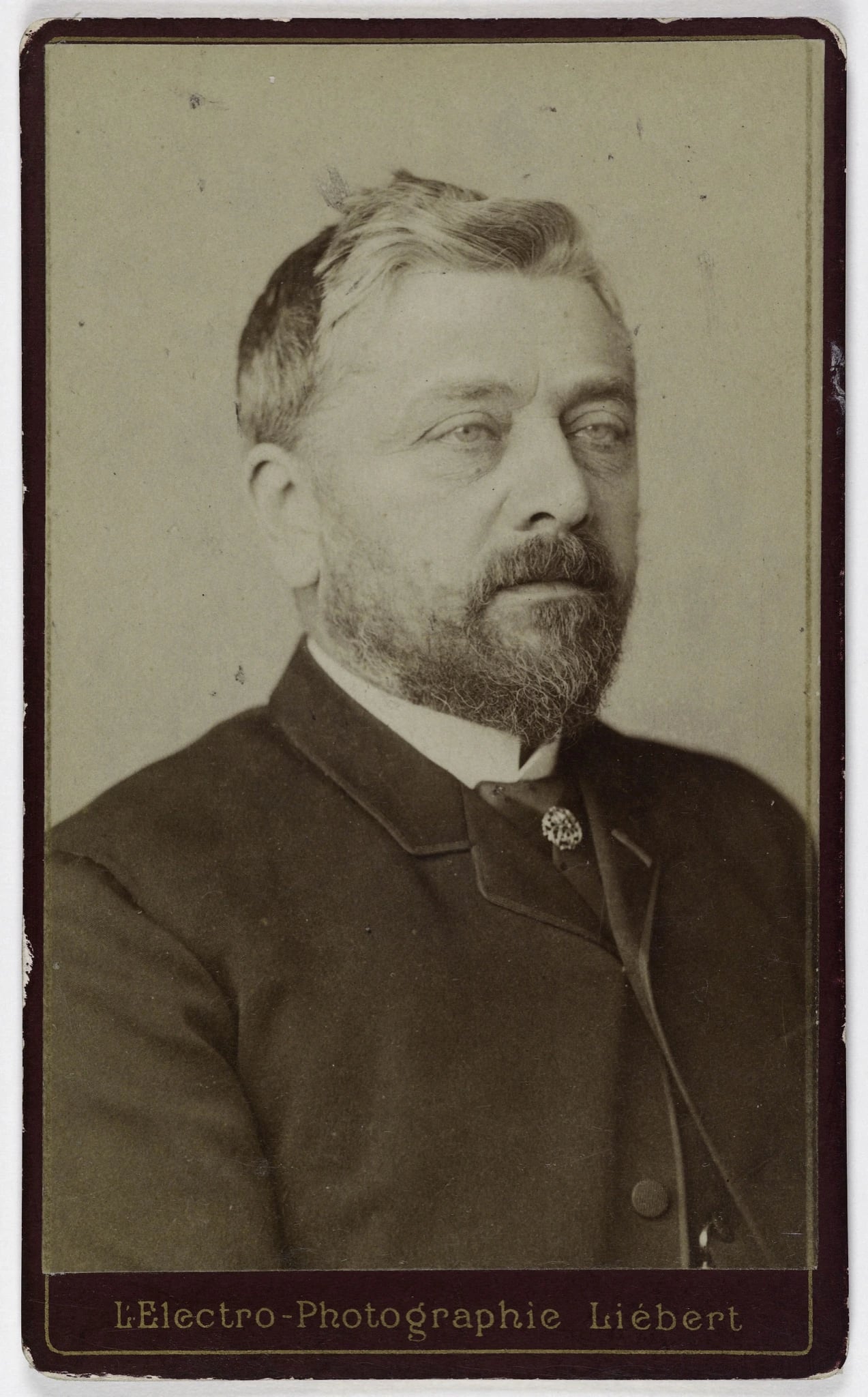
Eiffel died in 1923, at ninety-one. Two years later a Czech-born confidence man named Victor Lustig forged credentials from the ministry that looked after the tower, told a group of scrap dealers it had become too expensive to maintain and was quietly to be sold for its metal, and took around 70,000 francs from one of them, André Poisson, before leaving for Austria. Poisson was too embarrassed to go to the police, and Lustig came back to try it again.
That is the measure of how completely the argument had been lost and won. Thirty-eight years after forty of the most distinguished people in France begged their government to spare Paris a useless and monstrous tower, and sixteen years after the permission to leave it standing had expired, the story a hard-headed businessman would believe without blinking was that somebody had finally decided to pull it down.
Sources
- Eiffel Tower — Wikipedia — The Koechlin and Nouguier sketch, Sauvestre's arches, the January 1887 contract and the twenty-year concession, the construction figures, the 1889 fair dates and visitor numbers, Edison's visit, and the height record.
- Inauguration of the Eiffel Tower — Wonders of the World — 31 March 1889 in detail: the lunch for the workmen, the ascent from about half past one, the flag at about 2.35 pm, Tirard's announcement of the Légion d'honneur and the thousand-franc bonus.
- The birth of the Eiffel Tower — Official Eiffel Tower website — The official history of the design, the contract and the two-year build.
- Key figures — Official Eiffel Tower website — 18,038 iron pieces, 2.5 million rivets, 7,300 tonnes, the original 312 metres to the flagpole tip and the height today.
- The artists who protested the Eiffel Tower — Official Eiffel Tower website — Bertrand Lemoine on the Le Temps protest of 14 February 1887: the signatories, the text quoted here, the insults from Verlaine, Bloy and Maupassant, the Champ de Mars lawsuit, and Eiffel's reply about beauty and the pyramids.
- How radio saved the Eiffel Tower from destruction — Official Eiffel Tower website — The 1909 reversion to the city, Eiffel's scientific fit-out, Ferrié's aerials in 1903 and the seventy-year extension from 1 January 1910.
- Military broadcasting — Wonders of the World — The tower's wartime radio station and the intercepted German traffic, including the March 1918 radiogram broken by Georges Painvin.
- Gustave-Auguste Ferrié — Wikipedia — The military engineer who put the aerials on the summit; the 400-kilometre range of 1903 growing to 6,000 by 1908.
- Eiffel Tower opens in Paris, March 31, 1889 — History.com — The completion date against the 6 May opening of the exposition.
- History — Supertall! The Skyscraper Museum — The Washington Monument at 169 metres as the record the tower nearly doubled, and the forty-one years to the Chrysler Building.
- Gustave Eiffel — Wikipedia — His age at the tower's completion and his death in 1923.
- The Man Who Sold the Eiffel Tower. Twice. — Smithsonian Magazine — Lustig's 1925 forgery, André Poisson, and the second attempt.
- Victor Lustig — Wikipedia — Corroborates the scrap-dealer con and the flight to Austria.
- Trocadéro Palace — Wikipedia — The 1878 palace framed in the arch of the Durandelle photograph, demolished in 1935.


,_ing%C3%A9nieur,_constructeur_de_la_Tour_Eiffel,_PH50082_(1_of_2).jpg)