A Timeslip story
The German pilot who escorted a crippled American bomber home
He had two bombers down that day and needed one more for the Knight's Cross. Instead he flew wing to wing with Ye Olde Pub past his own coastal guns, saluted, and turned back. Neither man spoke of it for forty-seven years.


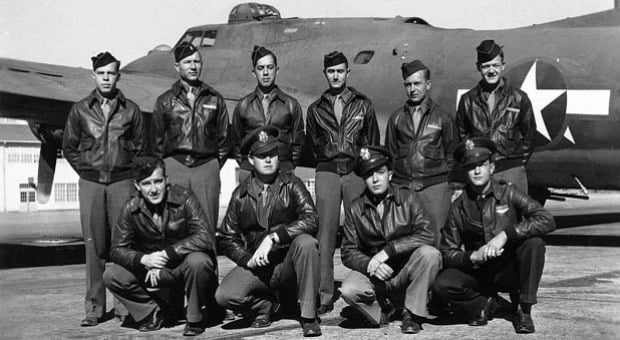
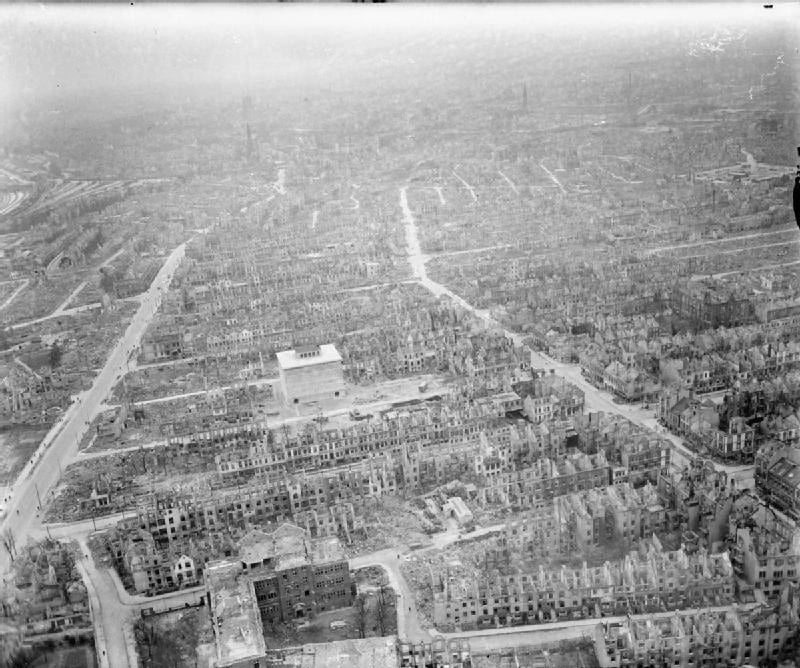
Bremen was a port, and the Eighth Air Force kept going back to it. On the morning of 20 December 1943, VIII Bomber Command put up Mission 159: 546 heavy bombers climbing off airfields across eastern England and turning for the shipyards and aircraft works on the River Weser, some sixty kilometres inland from the North Sea.
The city was ringed by more than two hundred and fifty flak guns, and the crews were told at briefing that they might meet German fighters in the hundreds. Both warnings were good ones. Only 197 of the bombers put their loads down on the target, bombing by radar through cloud from around twenty-seven thousand feet. Thirteen did not come back at all. A hundred and twenty-two came back damaged. Sixty-eight American airmen were killed that day, nineteen were wounded, and sixty came down alive and were taken prisoner.
Why a lone bomber over Germany was a dead bomber
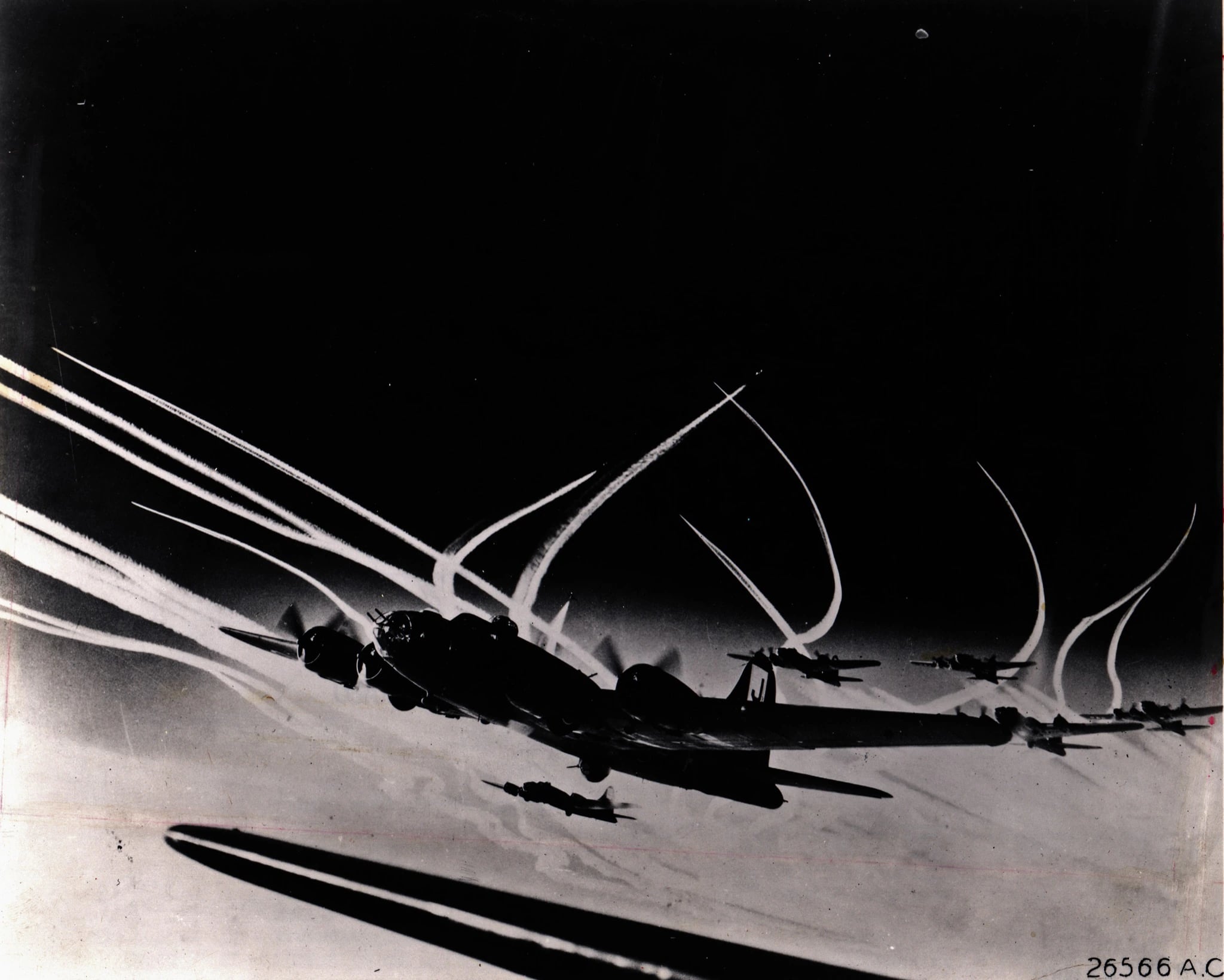
That was a normal loss return for the winter of 1943, and the reason was arithmetic. American doctrine held that a tight box of heavy bombers could defend itself with massed machine guns, so deep targets could be attacked in daylight without escort. The doctrine was wrong, and everybody flying knew it by the autumn.
The fighters that could escort a formation — Thunderbolts and Lightnings — did not have the range to reach Bremen, fight, and get home again. The aircraft that would change that had only just arrived: the 354th Fighter Group flew the first P-51B Mustang mission on 1 December, and on the 13th went into Germany for the first time, escorting a raid on Kiel. But in December 1943 there were nowhere near enough of them. A bomber that fell out of formation over Germany was, in practice, on its own.
What happened to Ye Olde Pub
One of the B-17s over Bremen that morning was B-17F 42-3167 of the 527th Bombardment Squadron, 379th Bombardment Group, flying out of RAF Kimbolton in Huntingdonshire. Her crew called her Ye Olde Pub. Her pilot was 2nd Lieutenant Charles L. Brown, twenty-one years old, from Weston, West Virginia. It was his crew's first combat mission.
Flak took the plexiglas nose off before bomb release and knocked out two of the four engines — one dead, one throttled back. Fighters worked the aircraft over for more than ten minutes and took a third. Half the rudder and the left horizontal stabiliser were shot away. Of eleven guns, three still worked; most of the rest had frozen. The tail gunner, Sergeant Hugh Eckenrode, was killed. Sergeant Alex Yelesanko was critically wounded, Sergeants Sam Blackford and Richard Pechout were wounded, and Brown was hit in the shoulder.
Then Brown lost consciousness on a shot-through oxygen system. The aircraft rolled inverted and fell. He came round in level flight at about a thousand feet, still flying — and flying south, inland, deeper into Germany. That is the moment this story turns on: a bomber at a thousand feet over the Lower Saxon plain, most of her guns frozen, going exactly the wrong way.
The man who came up behind: Oberleutnant Franz Stigler
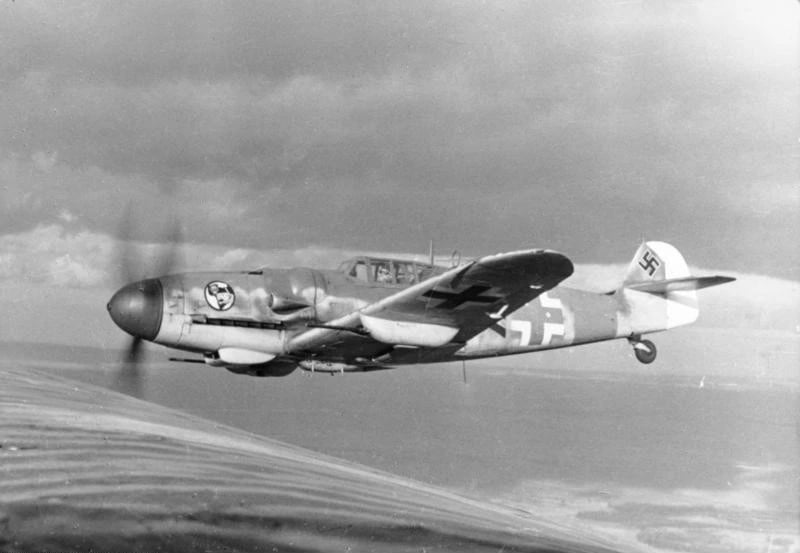
On an airfield on that plain, Oberleutnant Franz Stigler of 6./Jagdgeschwader 27 was on the ground having his Bf 109G refuelled and rearmed. He had already shot down two heavy bombers that day and had a .50-calibre round lodged in his radiator. One more would have earned him the Knight's Cross. He took off after the bomber, closed on her from astern, and found he was looking straight into an aircraft that could not fight back — and, through the torn-open fuselage, at the wounded men inside it.
What stopped him was something his commanding officer in North Africa, Gustav Rödel, had said to him years earlier.
If I ever see or hear of you shooting at a man in a parachute, I will shoot you myself.
Gustav Rödel, to Franz Stigler, in North Africa
Stigler's own account of the decision was as plain as that. “To me, it was just like they were in a parachute,” he said. “I saw them, and I couldn't shoot them down.”
Flying wing to wing past the coastal guns
Instead of firing, Stigler slid into formation off the bomber's port wing. He tried by hand signal to make Brown land in Germany, and then to divert to neutral Sweden, where the crew and their wounded would have been interned and would have lived. Neither signal got through — Brown had no idea what the German was doing there and told his gunners to track him.
So Stigler did the only other thing available to him. He stayed on the wing, tucked close, and flew the bomber out over the coast — because German anti-aircraft batteries would not fire on a formation with one of their own fighters in it. Over open water he pulled away, saluted, and turned back.
Brown flew roughly 250 miles across the North Sea on one good engine and put the aircraft down at RAF Seething in Norfolk, ten miles south-east of Norwich — not his own airfield, but the first one he could reach.
Why neither man talked about it
The crew were debriefed and then ordered not to discuss it. An enemy pilot who behaved chivalrously was not a story the Eighth Air Force wanted circulating among men who had to go back over Germany the next week.
Stigler's silence was simpler and far more dangerous. Sparing an enemy bomber was a capital offence. He said nothing to his superiors, and nothing to anybody else, for decades.
How Charlie Brown found Franz Stigler in 1990
Brown started looking in 1986, after being asked to speak about the war at a Gathering of the Eagles event at Maxwell Air Force Base. Four years of searching official records got him nowhere — there was no record, because neither air force had one. What finally worked was a notice in a combat-pilot association newsletter, which reached a former Luftwaffe officer living in Canada.
Stigler wrote back: “I was the one.”
They met, and were close friends for the rest of their lives. Franz Stigler died on 22 March 2008; Charlie Brown died on 24 November that same year, eight months later. In 2008 the US Air Force completed an investigation into the mission and awarded Brown the Air Force Cross and the nine other men of his crew the Silver Star. Ye Olde Pub herself was flown back to the United States in April 1944 and scrapped at Altus, Oklahoma, in 1945.
Sources
- 20 December 1943 — This Day in Aviation — Mission 159 in detail, the damage to 42-3167, and the aircraft's service history
- Charlie Brown and Franz Stigler incident — Wikipedia — the casualties, Rödel's order, and the 1990 reunion
- Valor: When an Enemy Was a Friend — Air & Space Forces Magazine — John L. Frisbee, January 1997
- Franz Stigler — Wikipedia
- Charlie Brown (pilot) — Wikipedia
- The Charlie Brown and Franz Stigler incident — e-WV: The West Virginia Encyclopedia — Becky Calwell
- Bremen, 20 December 1943 — 392nd Bomb Group mission record — corroborates the radar bombing through cloud
- 354th Fighter Group — HistoryOfWar.org — the arrival of the long-range Mustang escort
- A Higher Call, Adam Makos with Larry Alexander (Berkley Caliber, 2012)


