A Timeslip story
George Washington's Spy Ring
They were ordinary people who learned spycraft on the fly. For four years they sent valuable intelligence to George Washington about British movements, before fading back into society and living out their lives. They were never caught.


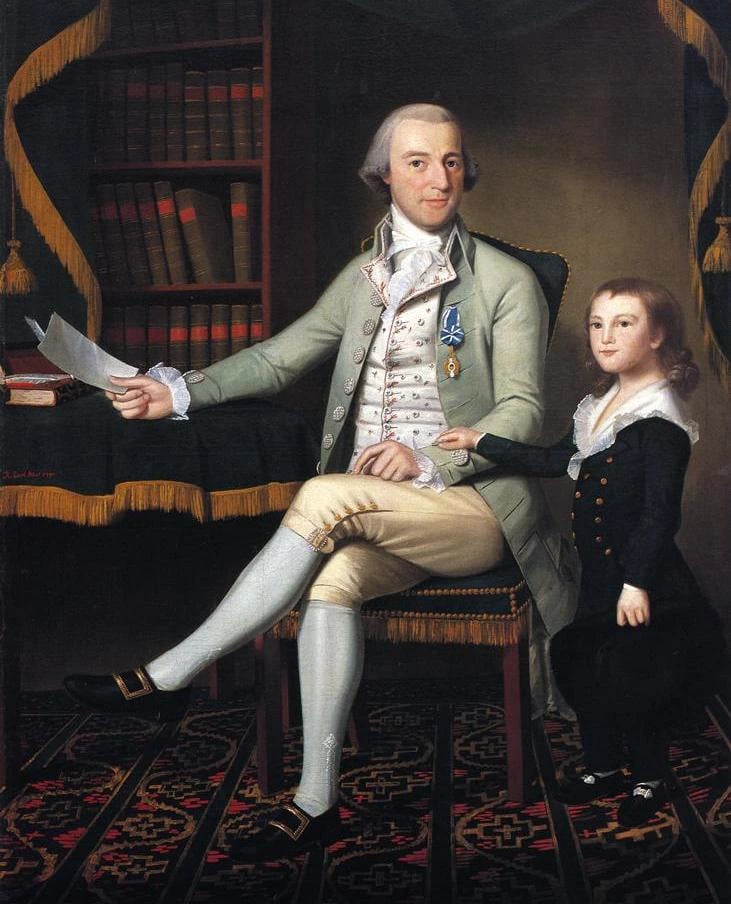
Let me set the scene for you: it's 1778, three years into the American Revolution, and George Washington is frustrated because he keeps getting surprised by British attacks. He knows he needs better information, but his attempts to gather it by setting up various spy networks have all been thwarted. Other sources were far too slow: sometimes Washington was making plans based on reports in six-month-old newspapers, a fact that seems almost farcical to us today.
The turning point was a small group of everyday people living undercover in enemy territory, sending regular letters to Washington with their observations.
On 21 July 1780, Alexander Hamilton received a short note: "8,000 troops are this day embarking at Whitestone." Hamilton wrote to Lafayette the same day that the enemy "are making an embarkation with which they menace the French fleet and army." Hearing this, Washington prepared a movement against Kingsbridge, the narrow northern gateway onto Manhattan, calculating that a credible threat to New York City would keep the British from attacking the French army, which had landed only ten days before to support Washington and the Continentals.
The result was that the seventy transports of eight thousand men in Huntington Bay never got their orders to attack Newport and the French. The expedition was abandoned and the men went ashore again. Newport was never attacked and a year later those same British troops watched Rochambeau march south past New York towards Yorktown.
Who was watching the British at Whitestone?
The network responsible for this intelligence is now called the Culper Ring. Washington set it up on British-occupied Long Island in August 1778 and it remained active until 1782 when the British began to move out of the area.
Everything we know about the Culper Ring is from one hundred and ninety-three letters they sent to Washington. Although the spies were desperate for him to destroy any evidence of their involvement, the letters were kept.
The Culper Ring was formed by Benjamin Tallmadge, a dragoon major Washington tasked with building a spy network. Unlike previous attempts, Tallmadge didn't use army professionals or have them crossing in and out of enemy territory for short bursts. His spies were civilians who blended into their surroundings because they were already embedded in the community as locals living and working there. They quietly listened and watched what was happening around them, and took notes.
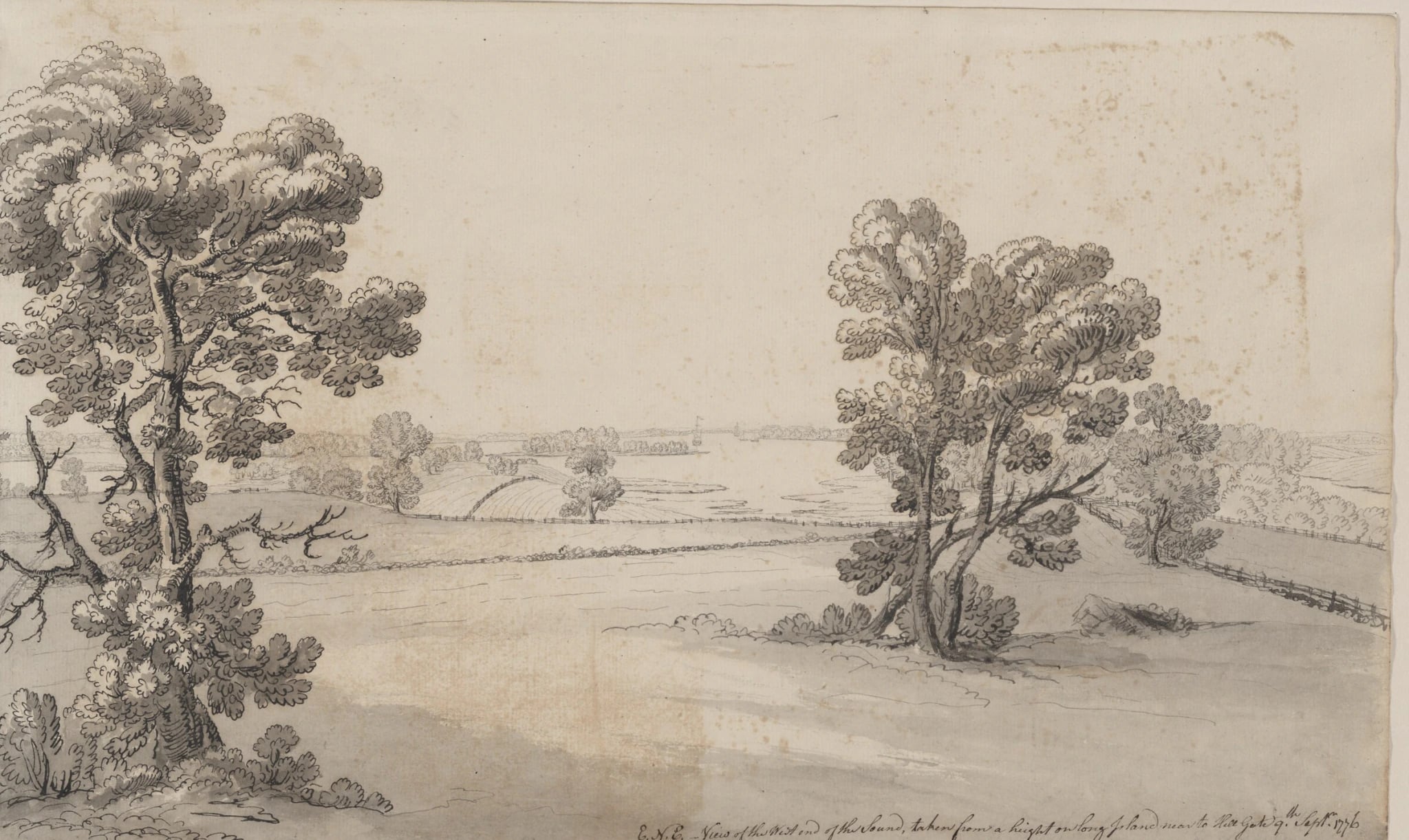
The first recruit was Abraham Woodhull, a farmer at Setauket, given the alias Samuel Culper. He became Culper Senior once the group added a Culper Junior, who — somewhat confusingly — was an acquaintance of, but no relation to, Culper Senior.
Culper Junior was Robert Townsend, a Quaker merchant from Oyster Bay whose family home had been requisitioned as a British regimental headquarters. He became the ring's inside man in Manhattan, stressing from the outset that his real identity must stay secret.
Townsend kept a dry-goods business, wrote a social column for a Loyalist newspaper, and held a share in a coffee house with James Rivington — an excellent place to pick up information from gossiping British officers.
Samuel Culper's instructions to him were to "remain in the City, to collect all the useful information he can — to do this he should mix as much as possible among the officers and refugees, visit the coffee houses, and all public places. He is to pay particular attention to the movements by land and water in and about the city especially."
Townsend successfully remained anonymous for a good one hundred and fifty years, until the wonderfully named New York historian Morton Pennypacker identified him as Culper Junior in 1930.
The historian Christian McBurney, who has reconstructed that fortnight day by day, credits the report about the British landing at Whitestone to Culper Junior.
How Washington's spies got a message off Long Island
A report gathered in Manhattan went overland to Setauket, a journey of fifty-five miles. For three years these back-and-forth trips were made by a tavern keeper named Austin Roe. His very real need to order supplies for his tavern meant he was a familiar, uninteresting face at the checkpoints.
At Setauket, the letters were passed to Woodhull, Culper Senior, who lived in constant terror of getting caught. He passed them to Caleb Brewster, a feisty whaleboat captain who didn't bother with an alias and all but dared the British to catch him, and who rowed the letters across Long Island Sound to Connecticut. Tallmadge was waiting at the far end, and express riders carried them to headquarters.
The Culper Ring had plenty of reason to be careful. Four years previously, 21-year-old Nathan Hale volunteered to go into enemy territory and spy on British troop movements. He arrived without a cover story and with his Yale diploma in his pocket. He was soon betrayed and hanged the day after his arrest, without a trial.
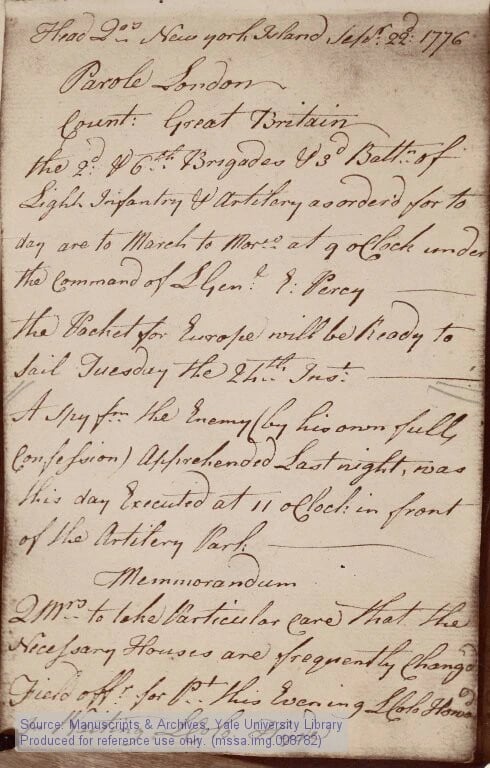
The Culper spies were essentially starting from scratch on tradecraft, with seemingly no access to, or knowledge of, the more advanced techniques being used in Europe. However, Washington had learned quite a lot from his previous spying efforts and acted as their mentor and guide.
In July 1779, Tallmadge compiled a simple numbered codebook containing some seven hundred and ten words, each with its number, with the key names and places numbered above that. Washington was 711, Tallmadge 721, Woodhull 722, Townsend 723, New York 727.
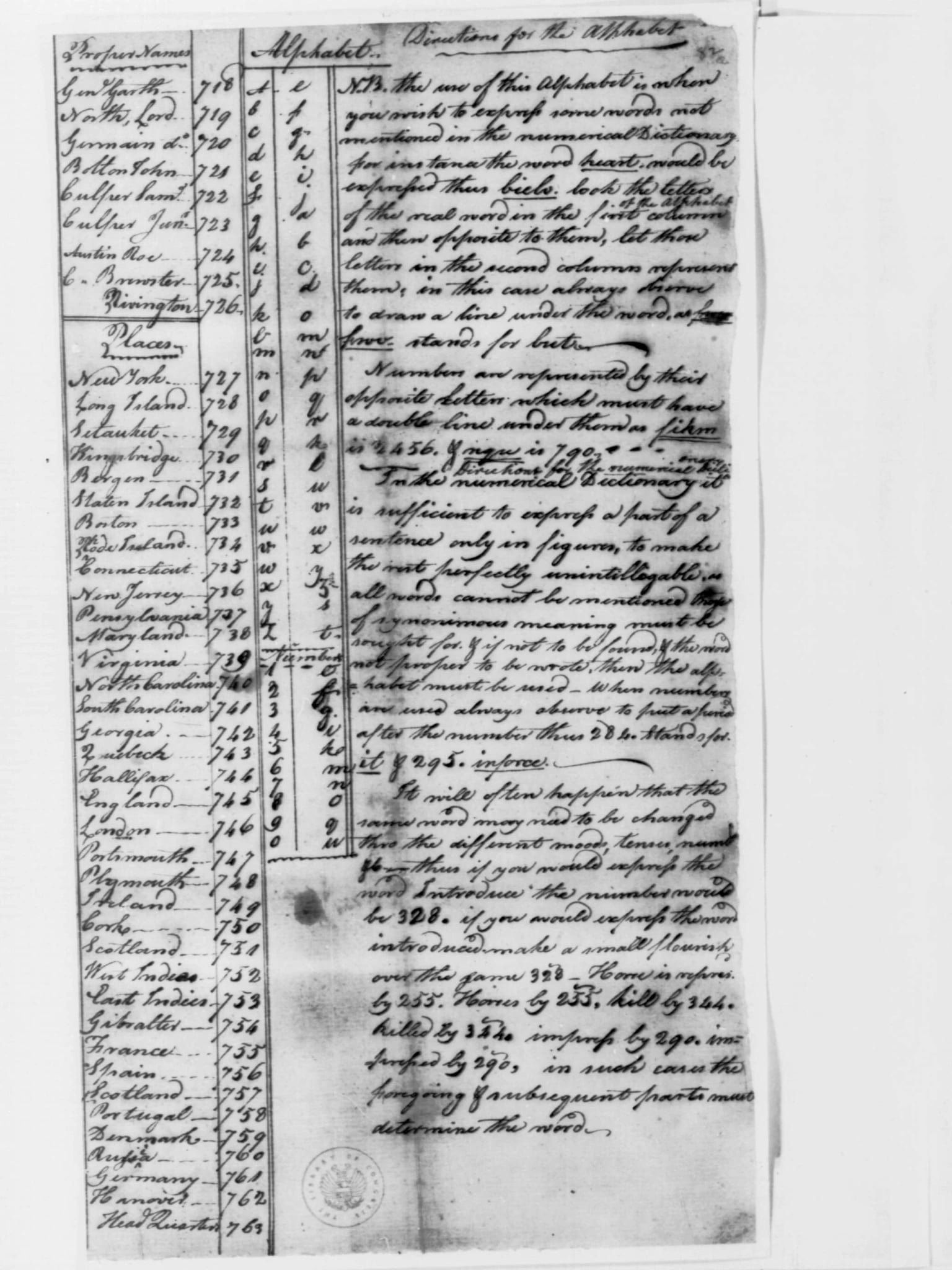
The Culper Ring also used invisible ink — often a mixture of ferrous sulphate and water, sometimes lemon juice or urine. A letter would discuss a bland business matter in real ink, with the real message written in invisible ink between the lines.
Being amateurs, the spies sometimes fumbled the technique. Woodhull's first attempt at invisible ink led to him sending Washington a single blank sheet of paper. Later, he passed Washington's correction on to Tallmadge for the benefit of Culper Junior: "C-r, Jr. should avoid making use of the stain upon a blank sheet of paper (which is the usual way of its coming to me). This circumstance alone is sufficient to raise suspicions."
How quickly did Culper intelligence reach Washington?
The editors of the Washington Papers project at the University of Virginia have traced one letter in detail: Woodhull wrote it at Setauket on 16 August 1780, and Washington probably did not read it until 28 August. Alexander Rose reckons that at their best, the Culper Ring could get messages to Washington within a week. Although this was often still too late, the speed was remarkable for the period, and Washington was pleased with the accuracy of the information.
Did the Culper Ring save the French at Newport?
McBurney's reconstruction shows at least two warnings reaching Rhode Island ahead of the Culper report, but the Culpers' intelligence was still a factor in Washington's decision to move against Kingsbridge, in the hope of distracting General Henry Clinton's troops from the French. We cannot prove why Clinton abandoned the expedition in the end, but the fact remains that Newport was never attacked.
The mysterious Agent 355
Was there a beautiful woman spy in the Culper Ring? It's an intriguing thought. The historian Morton Pennypacker thought so in the 1930s, when he identified the other members of the ring. Brian Kilmeade's 2013 bestseller George Washington's Secret Six and AMC's Turn: Washington's Spies both feature a female Agent 355.
However, Bill Bleyer, who read all 193 surviving letters, reports that there is only one mention of a woman. Abraham Woodhull, writing as Samuel Culper on 15 August 1779, said:
I intend to visit 727 [Culper code for New York] before long and think by the assistance of a 355 [lady in the code] of my acquaintance, shall be able to outwit them all.
Abraham Woodhull, writing as Samuel Culper, 15 August 1779
So all we actually know is that Culper knew a woman he thought could help with a particular task, but there is no evidence for anything more than that.
Life after spying
The Culper Ring stopped writing in July 1782 and went back to being farmers and shopkeepers.
Caleb Brewster settled in Connecticut as a blacksmith and farmer, served for years as an officer in the United States Revenue Cutter Service, and died at Black Rock in 1827, aged seventy-nine. Woodhull farmed and later became a judge. Tallmadge became a congressman for Connecticut. Robert Townsend lived until the grand old age of eighty-four. His identity was established only when Morton Pennypacker found a cache of his papers at Oyster Bay and had the handwriting matched against the Culper letters.
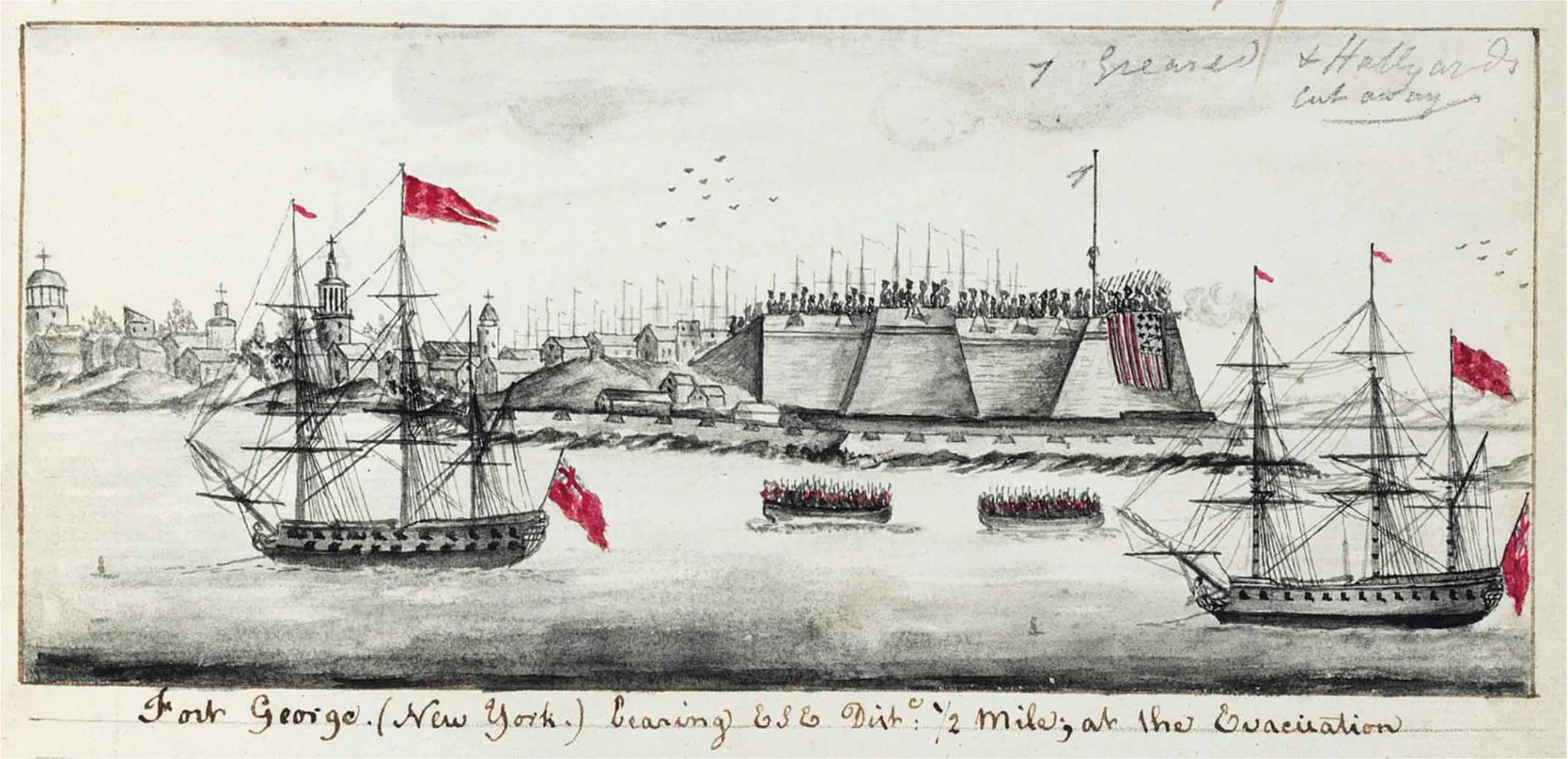
On 25 November 1783, the last British troops left Manhattan, and Washington rode back into the city. Six years later he took the presidential oath at Federal Hall, a few streets from where Culper Junior had kept his shop. Whitestone is a quiet corner of northern Queens now. There is a small park on the shore there, named for Francis Lewis, a signer of the Declaration of Independence, that looks over the water where the transports lay.
Sources
- The Culper Spy Ring Was not the First to Warn the French at Newport — Christian McBurney, Journal of the American Revolution. The day-by-day chronology of July 1780, and the source for every date and count in the Newport section.
- The Culper Spy Ring Was Not The First To Warn The French at Newport — The same reconstruction by McBurney in the Online Review of Rhode Island History, 10 September 2015.
- Separating Fact from Fiction on George Washington's Culper Spy Ring — Bill Bleyer, Long Island History Journal 30-1, Stony Brook University, 2022. The letter count, the courier chain and the case against the legends.
- George Washington's Culper Spy Ring: Separating Fact from Fiction — Bleyer again, in the Journal of the American Revolution, 3 June 2021.
- The Myth of Agent 355, the Woman Spy Who Supposedly Helped Win the Revolutionary War — Smithsonian Magazine, on the single clause the legend is built from and the people who built it.
- A Letter from George Washington's Spymaster, 1780 — Tallmadge to Washington, 8 May 1780, with the enclosed Culper letter. Gilder Lehrman Institute.
- Dating George Washington's Receipt of a Samuel Culper Letter to Benjamin Tallmadge — Jeffrey L. Zvengrowski, The Washington Papers, University of Virginia. The twelve-day letter.
- Abraham Woodhull — TBR News Media on Setauket's own spy, including Washington's correction about the stain on a blank sheet of paper.
- Caleb Brewster and the Culper Spy Ring — Connecticut History, a CT Humanities project. Brewster's whaleboats and his life afterwards.
- The Culper Spy Letter: A New Discovery at the Long Island Museum — The only surviving Tallmadge-to-Townsend letter, 8 November 1779.
- George Washington and the Culper Spy Ring: primary sources — Stony Brook University Libraries research guide to the surviving correspondence.
- Culper Ring — With the companion article on Robert Townsend, for the code numbers, Townsend's cover and the instructions he was given.
- Nathan Hale — The volunteer with no cover story, the diploma in his pocket, and the hanging of 22 September 1776.
- Whitestone, Queens — The shore itself, and the waterfront park named for Francis Lewis, a signer of the Declaration of Independence.
- Evacuation Day (New York) — 25 November 1783, and the greased flagstaff in the drawing above.
- George Washington's Long Island Spy Ring: A History and Tour Guide — Bill Bleyer. Further reading.
- Spies in Revolutionary Rhode Island — Christian M. McBurney. Further reading.
- Washington's Spies: The Story of America's First Spy Ring — Alexander Rose. Further reading, and the source for how fast the ring could move a message at its best.
- George Washington, Spymaster: How the Americans Outspied the British and Won the Revolutionary War — Thomas B. Allen. Further reading.
- Spies, Patriots, and Traitors: American Intelligence in the Revolutionary War — Kenneth A. Daigler. Further reading.


.jpg)
_092631.jpg)