A Timeslip story
The blacked-out room where Caravaggio painted The Calling of Saint Matthew
He was twenty-eight, had never been given a public commission, and had contracted to fill two walls of a Roman chapel with canvases eleven feet across. He painted them in a room with dark cloth nailed over every opening but one — no drawings, no cartoons, live models holding a pose in the beam. When they went up, the painters of Rome came to look, and then to copy.


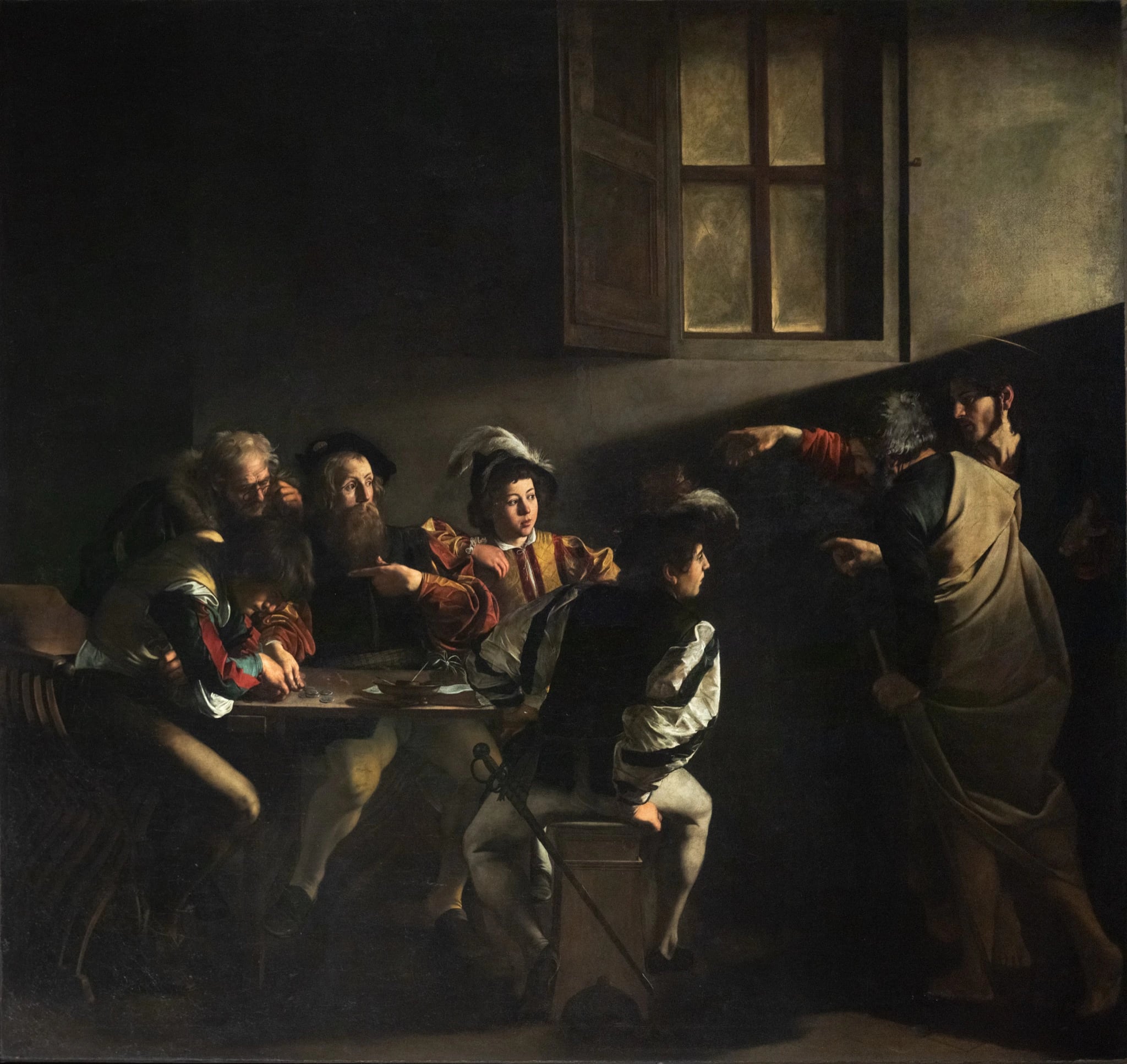
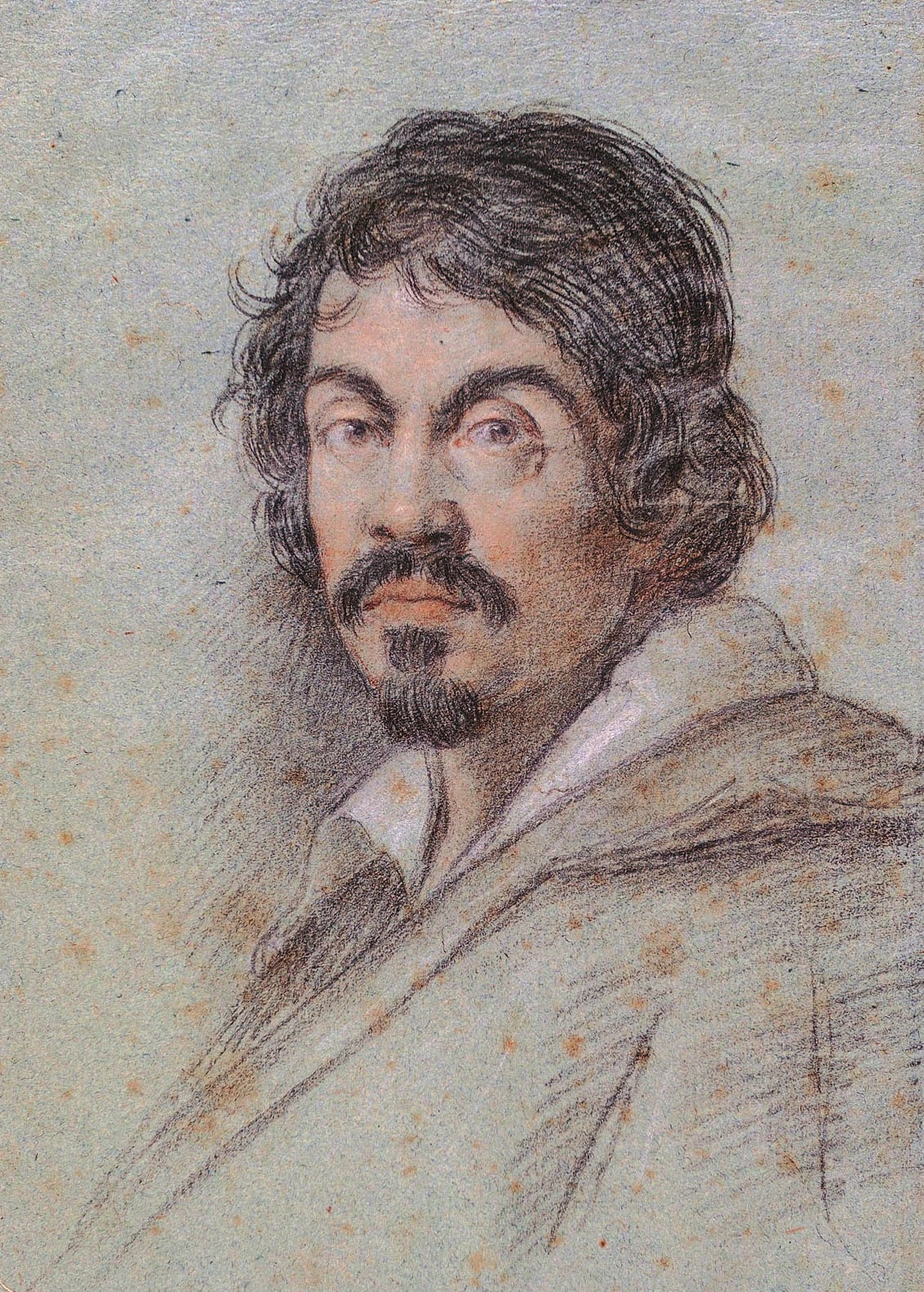
Every opening in the room had dark cloth nailed over it except one small window high in the wall, and that was the point. The single hard shaft it dropped across the floor was the only light in the place. Leaning against the far wall, all but finished, stood a canvas about eleven feet across; three hired men sat at a trestle table inside the beam, holding a pose; and a twenty-eight-year-old worked at it in the dark. His name was Michelangelo Merisi. Everyone called him Caravaggio, after the small Lombard town his family came from.
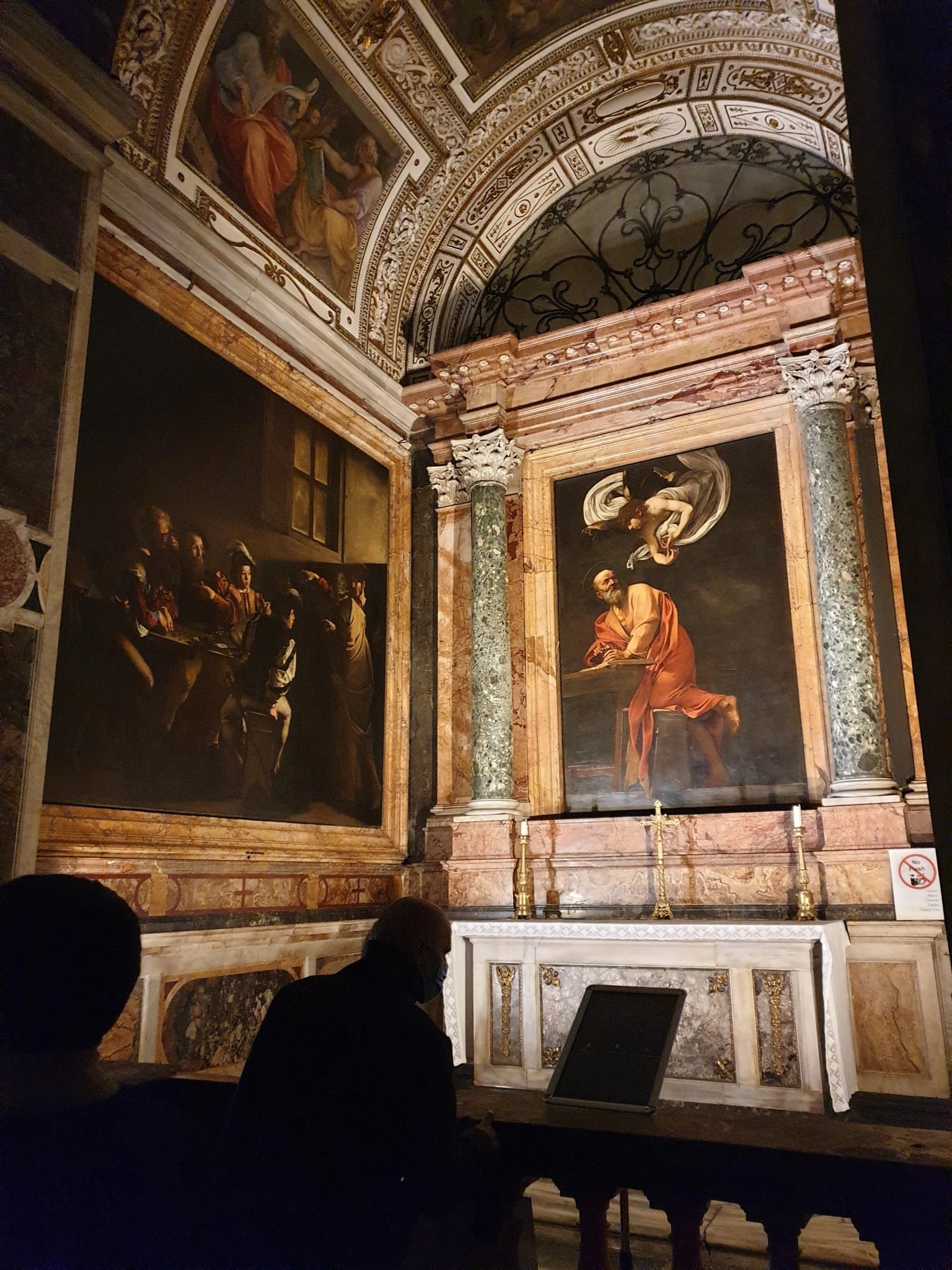
The picture was The Calling of Saint Matthew. Five men in fine, slightly flash contemporary dress sit counting money round a table; out of the shadow at the right two barefoot figures in plain robes come in, and the foremost puts out a long, slack hand. That is the entire event — a hand, a shaft of light, and a tax collector who has not yet worked out that his life has just ended.
Within weeks the canvas would go sixty metres east into the Contarelli Chapel of San Luigi dei Francesi, the French national church in Rome, in the middle of a Holy Year that had filled the city with pilgrims. It was the first public commission Caravaggio had ever been given. He had ten years left, four of them as an outlaw with a death sentence over him. The painting is still on that wall.
Who was Caravaggio before 1600?
He was born in Milan on 29 September 1571 — a baptismal record that only surfaced in the archives in 2007, correcting the old assumption that he came from Caravaggio itself. Plague reached Milan in 1576 and the family retreated to that town; in 1577 his father and grandfather died on the same day, and his mother in 1584, when he was twelve. That year he was apprenticed to Simone Peterzano, a Milanese painter who advertised himself as a pupil of Titian. What Lombardy gave him was the plain, unidealised naturalism of Moretto and Savoldo, and a reforming church that wanted religious pictures to hit poor people directly in the chest.
By 1592 he had sold his share of the family land and gone to Rome, apparently in a hurry, after some trouble involving a wounded officer. He arrived, one early account says, naked and extremely needy, and painted flowers and fruit into other men’s canvases for the most fashionable painter in the city. Then Cardinal Francesco Maria del Monte saw The Cardsharps in a dealer’s shop near San Luigi dei Francesi, bought it, and took him into his household at the Palazzo Madama — four or five years of room, board and educated patrons, and still no public commission, which in Rome meant he did not yet exist.
Why the Contarelli Chapel had stood empty for thirty-five years
The chapel was a standing scandal of delay. Cardinal Matteo Contarelli — Matthieu Cointerel, a Frenchman Italianised — had bought it in 1565 and left money to have it decorated with the life of his name-saint. He died in 1585 with nothing done; the first painter engaged died in 1592 without starting; Giuseppe Cesari frescoed the vault and drifted off to grander work. With the Holy Year coming and the walls still bare, Del Monte pushed his young household painter forward: the contract, usually dated 23 July 1599, gave Caravaggio both side walls for 400 scudi.
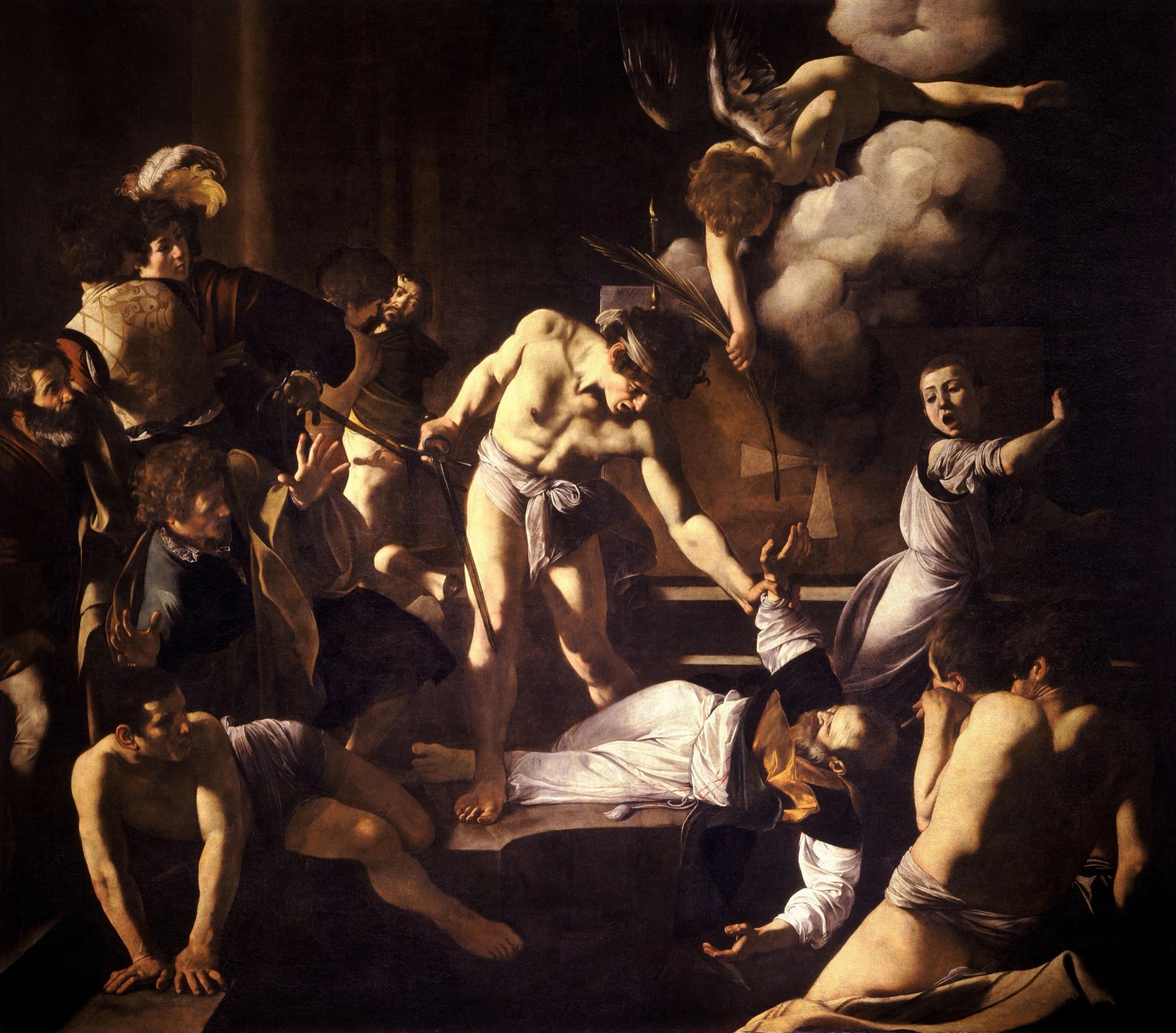
He had never handled a picture with more than a handful of figures in it, and the Martyrdom nearly beat him: X-rays show two complete abandoned compositions underneath the one that survives, the first crowded and Mannerist, the second closer to Raphael. He scraped both away, cut the cast, and shoved the violence up against the front of the picture. The Calling went more easily, though X-rays show Saint Peter was inserted while it was under way, between Christ and the viewer. Both canvases were in place in July 1600, and the final payment — fifty scudi, in the standard account — was made on 4 July.
How Caravaggio painted: no drawings, and one high window
Three things about his method were a scandal before they became a fashion, and the first is the hardest to believe of a painter working at this scale. He did not draw. There are no cartoons and no squared-up sheets, and barely a handful of drawings of any kind survive: he posed the model, scored a few position marks into the wet ground with the butt of a brush, and painted straight onto the primed canvas. For a profession built on disegno — invention worked out on paper before a brush was picked up — that was not a technique but an insult.
The second was the room. He blacked it out, left one narrow source high up, and posed his figures in the beam.
He never brought his figures out into the daylight, but placed them in the dark brown atmosphere of a closed room, using a high light that descended vertically.
Giovan Pietro Bellori, The Lives of the Modern Painters, Sculptors and Architects, 1672
That is tenebrism, the shadow half of chiaroscuro pushed until it swallows the walls, and the Calling half explains itself. The window painted inside the picture is covered with oilskin — the diffusing material of a working painter’s studio, not of a room in first-century Judaea — and the light comes in high on the right, above Christ’s head, exactly the kind of source Bellori describes.
The third was the models: the people around him, beggars and prostitutes and street boys and his own friends. The Virgin has dirty feet; the apostles have working hands. It made the sacred violently immediate, and it periodically got his altarpieces thrown out of the buildings they were painted for. There is one quotation in the picture, and it points the other way: Christ’s slack, dropping hand is Adam’s from Michelangelo’s Creation of Adam, given here to the one doing the calling.
What Rome was like in the Holy Year of 1600
The city the canvases went up in was jammed. Clement VIII had proclaimed a Holy Year in the bull Annus Domini Placabilis of 19 May 1599 and opened the Holy Door at the turn of the century — the century-opening one in a cycle that had run every twenty-five years since 1475. The traditional figure of three million pilgrims is certainly inflated for a city of about a hundred thousand, but the crowds were enormous, and the Contarelli canvases were hurried into place for them.
It was not a gentle year. On 17 February 1600, ten minutes’ walk from the studio, the Roman Inquisition burned Giordano Bruno in the Campo de’ Fiori for arguing that the stars were other suns with other worlds around them. Nor was it much of a city: past the last houses the ruins lay among vineyards and grazing, cattle were pastured in the Roman Forum — the Campo Vaccino, the cow field — and the Colosseum had been quarried for building stone for centuries.
What happened when the paintings went up
Into that city came a picture of Christ recruiting an apostle in what looks like the back room of a gambling house, in which the holiest figure is half hidden behind somebody else and the light does the theology. The painters of Rome, one early biographer wrote, looked on the work as a miracle. Federico Zuccari, the elder statesman of the Roman academy, came to see what the noise was about, studied the Calling, said he could see nothing in it but the thought of Giorgione, and walked out. He was both dismissive and correct: something Venetian had arrived, and it was not going to leave.
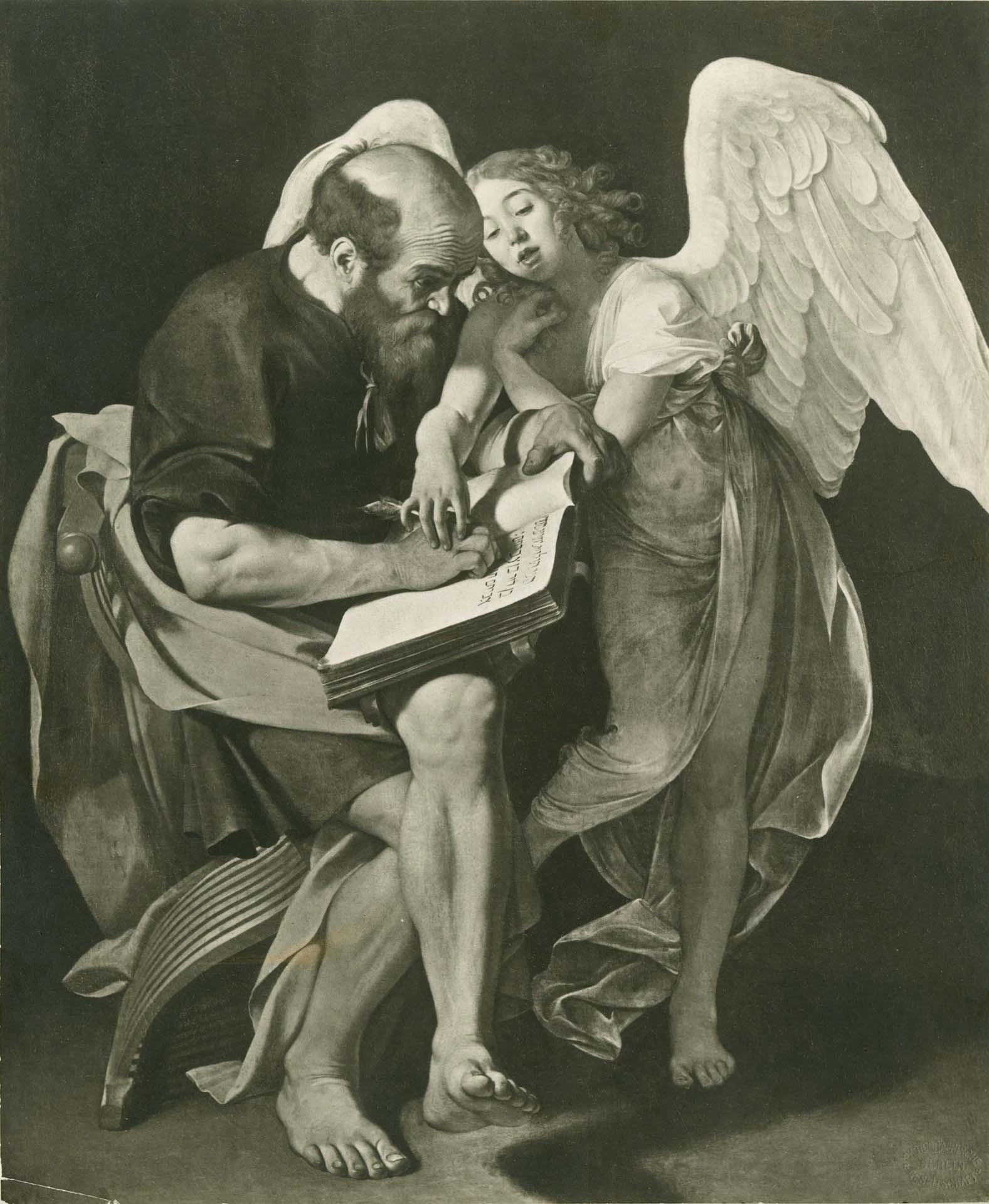
The same chapel then handed him his first public humiliation. In February 1602 the commissioners ordered an altarpiece to hang between the two canvases. Caravaggio delivered Saint Matthew and the Angel on 26 May and it was refused: the saint had neither the nobility nor the appearance of a saint, Bellori explains, and sat with his legs crossed and his bare feet stuck rudely out at the viewer. The replacement, The Inspiration of Saint Matthew, went up in February 1603 and is over the altar today.
Why Caravaggio fled Rome, and where the painting is now
The same decade produced a police file: arrests for carrying a sword without a licence and for insulting the watch, a libel suit from a rival painter, a waiter hit in the face with a plate of artichokes. On the evening of 28 May 1606 — some accounts say the 29th — on the tennis court at Via di Pallacorda, he fought Ranuccio Tomassoni with swords and cut his femoral artery. What the fight was about has never been settled: a wager, a game, or the courtesan Fillide Melandroni, and one reading of the wound makes it a botched maiming rather than a killing at all. Rome sentenced him to bando capitale — outlawry, with a death sentence any man in the papal states could carry out on sight. He was thirty-four, and he never went back.
He spent the next four years in Naples, Malta and Sicily, painting all the way. Malta nearly worked: the Knights of St John made him one of their own, and for their co-cathedral in Valletta he painted the Beheading of Saint John the Baptist, his largest canvas and the only picture he ever signed. Then they jailed him. He escaped, and the Order expelled him in his absence as a putrid and fetid member.
In the summer of 1610, believing a pardon was close, he took a boat north with paintings aboard as gifts for the man who could deliver it, and never arrived: he died at Porto Ercole on 18 July, aged thirty-eight. A 2018 paper in The Lancet Infectious Diseases, working on probable remains identified there in 2010, found Staphylococcus aureus in the dental pulp and concluded he most likely died of sepsis from an infected wound. The manner travelled without him — Artemisia Gentileschi, Ribera, the Utrecht painters, Georges de La Tour — and then the fashion turned. For the better part of two centuries he was a footnote with a police record, until Roberto Longhi’s 1951 exhibition in Milan drew more than 400,000 people and put him back.
The Calling has not moved. It is on the left wall of the Contarelli Chapel, where it was put in July 1600, in a church anyone can walk into. The chapel is dark. There is a coin box on the rail, and if you feed it a light comes on for a few minutes and then goes out again, which is a fair approximation of how the picture was made.
Sources
- Caravaggio — Wikipedia — the Milan birth and the 2007 baptismal record, the Peterzano apprenticeship, the Del Monte household, the police record, the exile and the death
- The Calling of Saint Matthew — Wikipedia — the canvas at 322 by 340 cm, the oilskin window, the quotation of Michelangelo's Adam, and the X-ray evidence that Peter was added during execution
- Paintings in the Contarelli Chapel — Wikipedia — the Cointerel bequest and the decades of delay, the 23 July 1599 contract for 400 scudi, the July 1600 installation, and Zuccari's visit
- The Martyrdom of Saint Matthew (Caravaggio) — Wikipedia — the two abandoned compositions found beneath it, and its installation first
- The Inspiration of Saint Matthew — Wikipedia — the 1602 altarpiece commission, the rejection of the first version, and its destruction in Berlin in 1945
- Paintings in the Contarelli Chapel — Web Gallery of Art — gives the contract as 13 June 1599 rather than the usual 23 July — the disagreement is real and this page does not settle it
- Caravaggio and the Contarelli Chapel — JCU Caravaggio — the final payment of 4 July 1600
- Giovan Pietro Bellori, The Lives of the Modern Painters, Sculptors and Architects, 1672, trans. Alice Sedgwick Wohl (Cambridge University Press, 2005) — the Life of Caravaggio: the closed room and the high vertical light, and the complaint against the first Saint Matthew
- Stork & Nagy, Inferring Caravaggio's studio lighting and praxis in The Calling of St Matthew (PDF) — the technical reconstruction of the single high source, and the working method of painting from posed models without drawings
- Francesco Maria del Monte — Wikipedia — the cardinal, the household, and how the Contarelli commission was got
- Palazzo Madama, Rome — Wikipedia — where he lived from about 1597, and how close it stands to the church
- San Luigi dei Francesi — Wikipedia — the French national church in Rome, consecrated in 1589, and the chapel's position in it
- Pope Clement VIII — Catholic Encyclopedia — the bull Annus Domini Placabilis, the Holy Year of 1600 and the traditional pilgrim count
- Jubilees throughout history — Vatican — the twenty-five-year cycle running from 1475, which makes 1600 the century-opening Jubilee
- Giordano Bruno — Wikipedia — the burning in the Campo de' Fiori on 17 February 1600
- Roman Forum — Wikipedia — the Campo Vaccino: pasture from the Middle Ages until the nineteenth-century excavations
- Colosseum — Wikipedia — centuries of quarrying for building stone, stopped only in the eighteenth century
- Caravaggio — St John's Co-Cathedral, Valletta — the knighthood of 14 July 1608, the only signed painting, the escape and the expulsion
- On 29 May 1606 Caravaggio killed Ranuccio Tommasoni in Rome — Italian Art Society — the killing, and the disagreement over whether it fell on the 28th or the 29th
- Barbieri, Drancourt et al., Did Caravaggio die of Staphylococcus aureus sepsis? — The Lancet Infectious Diseases, 2018 — the dental pulp analysis and the sepsis conclusion
- Caravaggio 1951: Roberto Longhi's exhibition at the Palazzo Reale — ArtsLife — the Milan exhibition and its 400,000 visitors
- How did a masterpiece by Caravaggio end up in a Dublin dining room? — National Gallery of Ireland — the recognition of The Taking of Christ in 1990


