A Timeslip story
The five men who reached the South Pole first
Five Norwegians halted their sledges on an empty white plain, put their hands on one flag shaft together, and became the first people to stand at the bottom of the world. Robert Falcon Scott arrived thirty-four days later and found their tent already there.


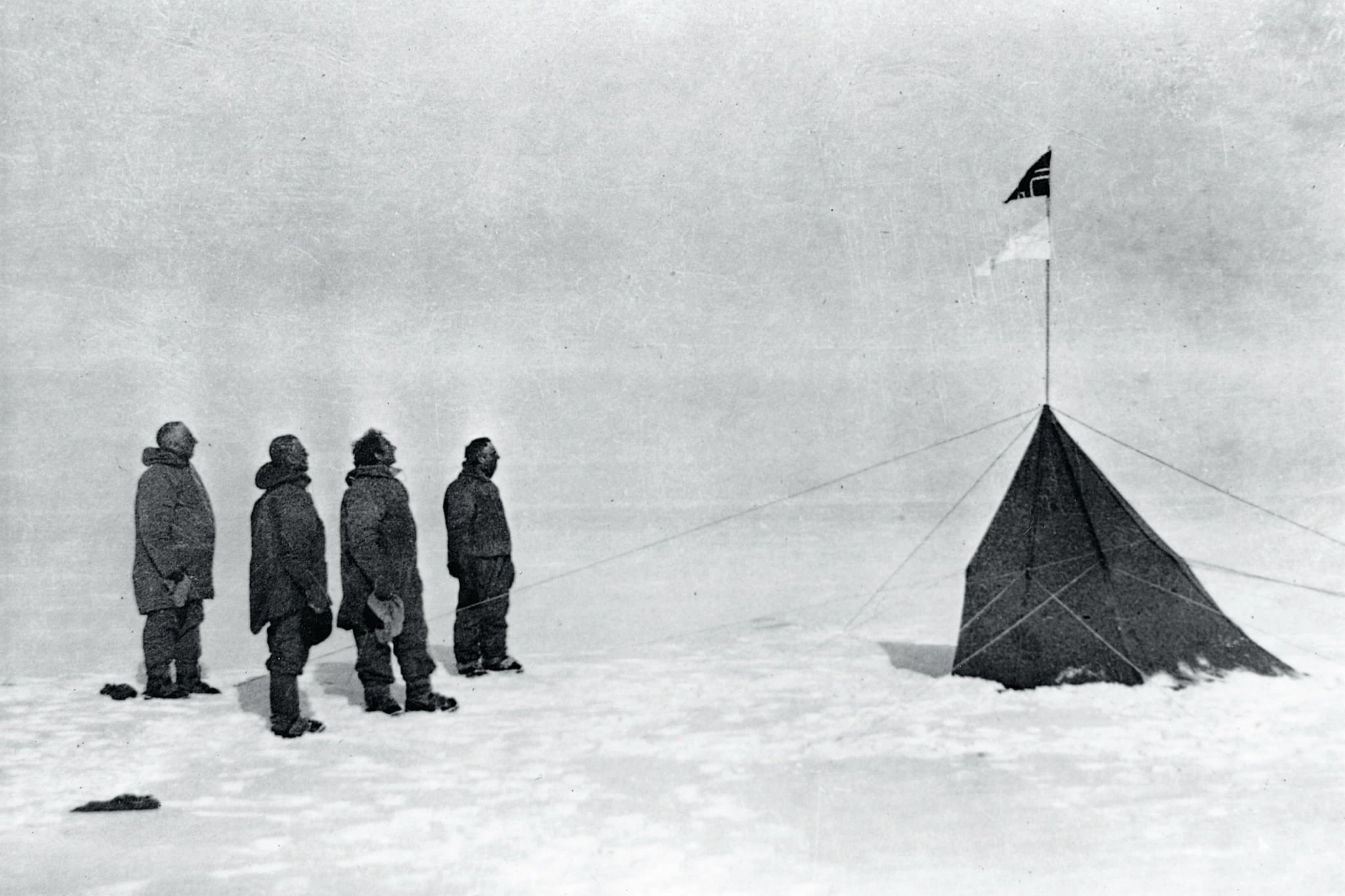
There is nothing at the South Pole to tell you that you have arrived. No rock, no ridge, no mountain on the horizon: the polar plateau is a wind-carved plain nine thousand feet up, hard as pavement underfoot and identical in every direction for hundreds of miles. Five men in fur stopped their sledges on it at about three in the afternoon, checked their reckoning, and agreed that this was the place.
It was ten degrees below zero Fahrenheit, about minus twenty-three Celsius, with a light wind out of the south-east. The sun had not set for weeks and would not set for months; it swung round the sky at a constant low angle, so the shadows lay long and level and never shortened. The date was 14 December 1911, and nobody had ever been there before.
Roald Amundsen had thought about how to mark the moment, and what he had decided was that he would not do it himself.
We all assembled about the Norwegian flag — a handsome silken flag — which we took and planted all together.
Roald Amundsen
The five were Amundsen, Helmer Hanssen, Olav Bjaaland, Sverre Hassel and Oscar Wisting, ten hands on one shaft. The photographs from the Pole show four men rather than five: the expedition's proper camera had been damaged on the way south, the only one still working belonged to Bjaaland, and in every picture somebody is behind it.
They were not alone on the continent. Somewhere behind them, dragging their own sledges without dogs, were five Britons under Robert Falcon Scott who did not yet know the race was over. That there was a race at all was Amundsen's doing, and he had arranged it by lying about where he was going.
Why Amundsen said he was sailing for the North Pole
Fram left Norway in June 1910 announcing the opposite journey. The plan on paper was to freeze the ship into the Arctic ice and drift across the North Pole, extending Fridtjof Nansen's famous drift of the 1890s. Amundsen had his money, his crew and his ship on that basis — and the ship was Nansen's own, lent for it.
He had already changed his mind. In 1909 both Frederick Cook and Robert Peary claimed the North Pole, and whatever the truth of either claim — they are still argued over — the prize was gone. Amundsen turned south and told almost nobody: not his backers, not Nansen, not his own men.
The crew found out at the last port of call, Funchal in Madeira, on 6 September 1910. Amundsen's brother Leon left the ship there with the letters that would break the news in Norway — to Nansen, to King Haakon VII, and to the newspapers. One more went to Scott, already sailing south, and said no more than that Amundsen begged to inform him Fram was proceeding to the Antarctic.
It was not a gracious act and Amundsen never claimed otherwise. It also turned a scientific expedition into a race, which is why anyone remembers the date.
Why Amundsen beat Scott to the South Pole
What he brought south was not courage — Scott had that in quantity — but a method, and he had spent a decade acquiring it at the other end of the world. Between 1903 and 1906 he took the tiny Gjøa through the Northwest Passage, the first vessel ever to complete it, and wintered twice at Gjoa Haven on King William Island among the Netsilik.
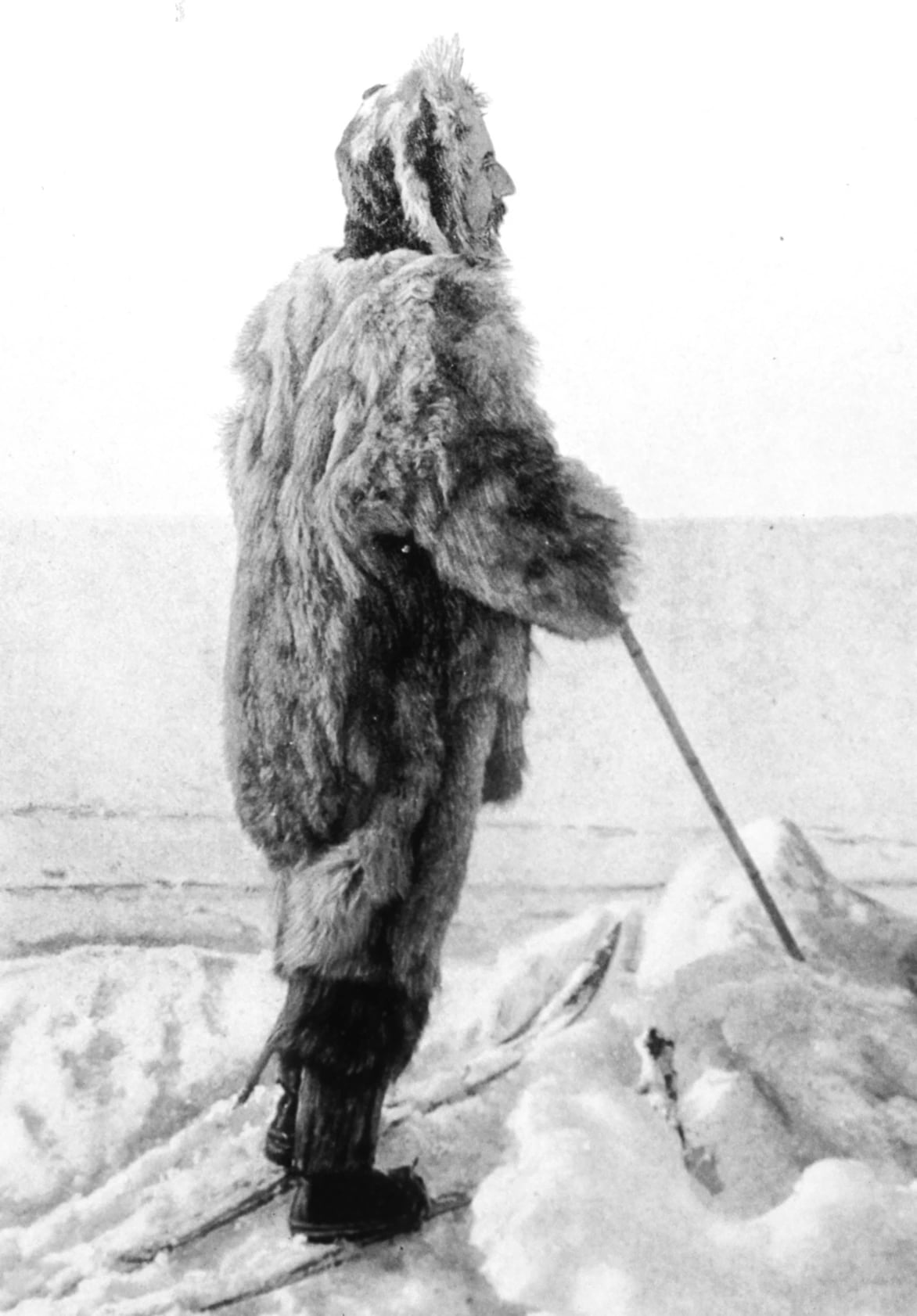
What he learned there decided the South Pole. He learned to wear loose fur rather than woven wool, so that sweat could escape instead of freezing inside the clothing. He learned to drive dogs properly, and to travel on skis rather than walk.
These sound like refinements. They were the whole difference. Scott's men hauled their own sledges, wore wool that soaked and froze, and went snow-blind in numbers, and their ration on the plateau has since been calculated at a little over half the calories the work actually demanded. Amundsen's men skied behind dogs and gained weight on the journey.
The dogs, and the place Amundsen called the Butcher's Shop
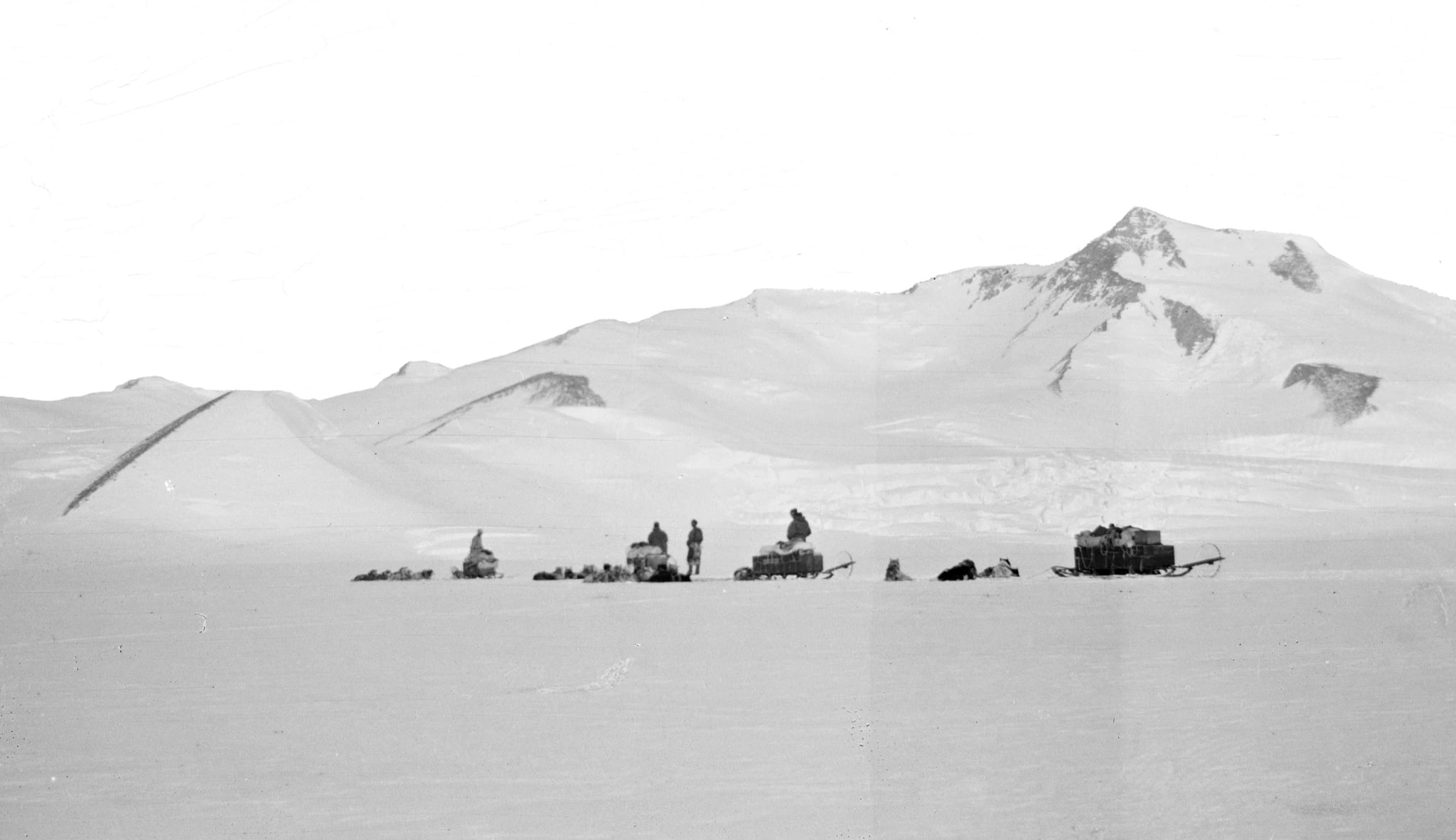
His base, Framheim, went up in the Bay of Whales on the Ross Ice Shelf — sixty miles closer to the Pole than Scott's at Cape Evans, and on floating ice rather than rock, which a good many people thought reckless. That season he laid three tonnes of supplies in depots at 80, 81 and 82 degrees south, marking each not with a single flag but with lines of cairns and pennants running miles east and west, so that a party could not miss one in bad light.
A first attempt in September 1911 turned back in temperatures near minus fifty, with frostbitten heels and dogs dying, and ended in a bitter row over whether Amundsen had abandoned his slower men on the retreat. The real start came on 20 October: five men, four sledges, fifty-two dogs. They found their own way up onto the plateau by a steep glacier nobody had ever seen, which Amundsen named for his backer Axel Heiberg. At the top, on 21 November, at around 3,230 metres, they did what had been in the plan from the beginning: twenty-four of the dogs were shot, and the meat divided between the men and the surviving animals. Amundsen called the place the Butcher's Shop.
Each driver killed his own team's dogs. The diaries make it plain that they hated it and did it anyway: the dogs were transport and they were also provisions, and the arithmetic had been settled in Norway. Eighteen dogs went forward from the Butcher's Shop. Seventeen were alive at the Pole.
How Amundsen proved he had stood at the Pole
Standing at ninety degrees south is easy to claim and hard to demonstrate. There is no marker and nothing to sight on, and Amundsen knew perfectly well that a disputed claim is worth nothing: Cook and Peary had just proved the point in the north.
So they did not simply plant a flag and leave. Four of them took observations with sextant and artificial horizon every hour for a full twenty-four, the sun obligingly circling rather than rising and setting. Then skiers went out in different directions to box the pole — bracketing the true point on a radius of about eight kilometres, so that wherever it actually lay, somebody had walked across it. Their computed position came within a mile or two, as close as the instruments of 1911 could take anybody.
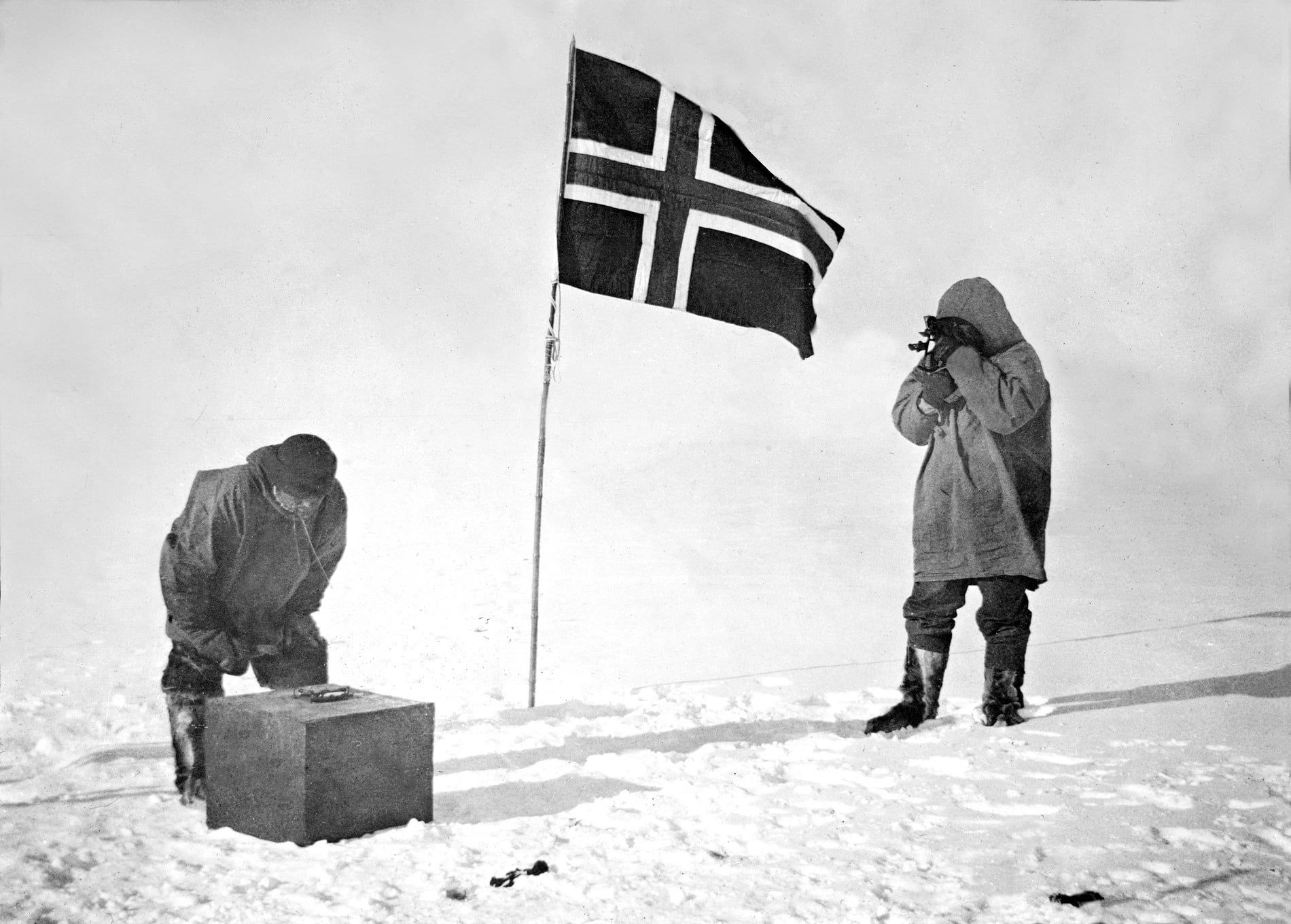
On 17 December they pitched a small spare tent sewn by the expedition's sailmaker, Martin Rønne, and named it Polheim: home at the pole. The Norwegian flag and Fram's pennant went up above it, and inside they left a letter to King Haakon VII reporting the achievement and a note asking Scott to deliver it — insurance, in case the Norwegians died on the way home and the British did not. They left on 18 December and were back at Framheim on 25 January 1912, ninety-nine days out, with two sledges and eleven dogs.
What Scott found at the South Pole
Scott's five reached the same spot on 17 January 1912, thirty-four days later. They had seen a black flag tied to a sledge runner the day before and understood immediately. The worst has happened, Scott wrote; all the day dreams must go. On 18 January they found Polheim itself, with the letters inside.
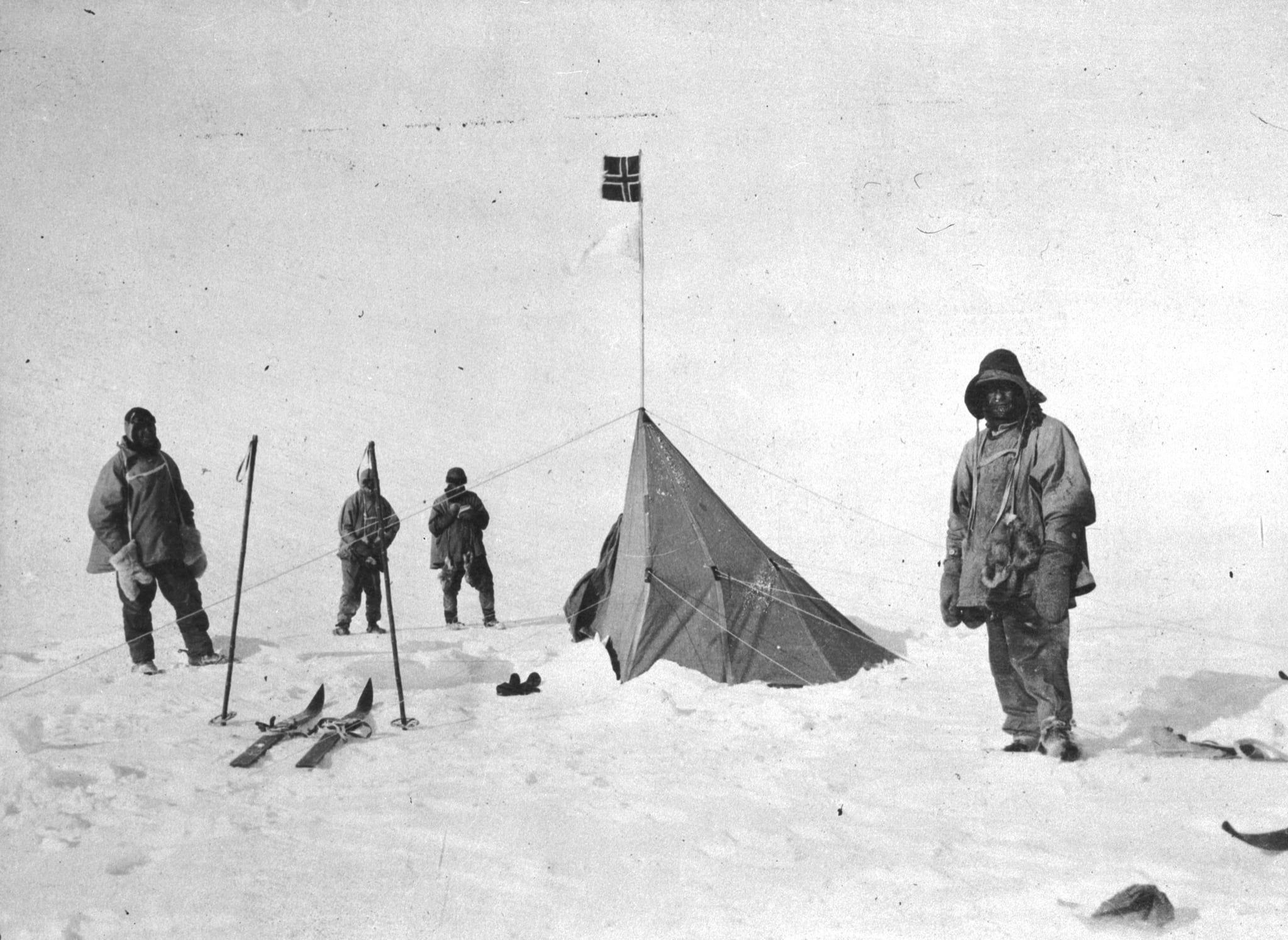
None of them survived the return. Edgar Evans died on 17 February at the foot of the Beardmore Glacier. Lawrence Oates, crippled by frostbite and convinced he was slowing the others, walked out of the tent into a blizzard on 16 March saying that he was just going outside and might be some time. Scott, Edward Wilson and Henry Bowers died around 29 March, eleven miles short of the depot that would have saved them; the tent, the bodies, the diaries and the geological specimens they had hauled to the end were found on 12 November.
Why they died is still argued over. Some of it was plainly avoidable — the rations, fuel lost through cork-stoppered cans, a late decision to take five men on supplies calculated for four. Some of it may have been luck: Scott blamed exceptional cold, and historians remain divided about whether the weather that March was genuinely unusual or merely ordinary weather visited on exhausted men.
What happened to Amundsen, and to the tent he left
Amundsen got the news out from Hobart in March 1912 and found that winning had cost him something. In Britain especially the deception was held against him, and once Scott's fate was known the contrast hardened into a morality tale: the Norwegian professional who did it efficiently against the British amateur who died beautifully. Scott's reputation stood above his for most of a century.
He kept collecting firsts. In 1926 he crossed the Arctic Ocean by airship in Norge with Umberto Nobile — probably the first verified attainment of the North Pole, the prize he had given up sixteen years earlier. The two then fell out in public, and in June 1928, when Nobile's airship Italia came down on the ice, Amundsen flew out from Tromsø to look for him. His aircraft has never been found. Nobile was rescued by somebody else.
Polheim has never been seen again either. The ice it stands on flows, and snow piles on top of it; a calculation published by the glaciologist Olav Orheim in 2011 put the tent near 89°58′51″S, give or take three hundred metres, and about seventeen metres below the present surface. It is almost certainly still there, intact in the cold and the dark, with two letters inside it.
The Pole is permanently occupied now: the Amundsen–Scott South Pole Station has stood on the spot since 1956, named for both of them, and since the Antarctic Treaty of 1959 the continent has been a demilitarised scientific preserve where no country's claim is recognised and no new one may be made. There is nothing left to race for, which is one way of saying that what those five men did on 14 December 1911 could only ever be done once.
Sources
- Amundsen's South Pole expedition — Wikipedia — the five names, the Funchal disclosure, the depot lines, the Butcher's Shop, and the boxing of the pole
- Roald Amundsen, The South Pole (1912) — Project Gutenberg — Amundsen's own account, complete and free
- Amundsen's first published account of the arrival at the Pole — the three o'clock halt, the temperature and wind, the flag planted by all five, and the return with two sledges and eleven dogs
- Polheim — Wikipedia — the tent, its contents, and Olav Orheim's 2011 calculation of where it now lies
- The Third Fram Expedition (1910–1914) — the Fram Museum, Oslo — the dog numbers, and the Arctic cover story
- Comparison of the Amundsen and Scott expeditions — Wikipedia — fur against wool, dogs against man-hauling, the ration calorie analysis, and the weight the two parties gained and lost
- Terra Nova Expedition — Wikipedia — the black flag on 16 January, the Pole on the 17th, Polheim on the 18th, and the dates of the four deaths
- Axel Heiberg Glacier — Wikipedia — the route onto the plateau, and the height at the Butcher's Shop
- Hjalmar Johansen — Wikipedia
- Fridtjof Nansen — Wikipedia
- Arnoldus Schytte Blix, “On Roald Amundsen's scientific achievements”, Polar Research 35 (2016) — the case against the charge that the expeditions produced no science
- Roald Amundsen's South Pole Expedition (1910–1912) — UNESCO Memory of the World
- The race to the South Pole: Scott and Amundsen — Royal Museums Greenwich
- Antarctic Treaty System — Wikipedia


.jpg)
